Four compressors under two hundred dollars, plus the hose and the fittings that are not in most of the boxes - and why the number you should shop on is decibels, not gallons.
How this is funded: we earn a commission if you buy through our links, at no extra cost to you. It never changes which tool we recommend, and we’ll tell you plainly when to skip one. Full disclosure.
The short answer. Buy the California Air Tools 1P1060S. At a published 56 dBA it is the quietest machine under $200 in our registry, it publishes 1.2 CFM at 90 PSI, and a brad nailer needs roughly 2 CFM only if you are firing continuously — hand-nailing uses far less. Our budget pick is the Craftsman 2-gallon kit, because it is the only one here that comes with a hose and fittings, which otherwise cost real money. If you want a six-gallon tank instead, the Craftsman CMXECXA0210641C is the one to take — it includes a 25 ft hose and matches the specification of pancake compressors that cost more.
Here is the thing nobody tells you about shopping a compressor on a budget: the spec on the box barely matters. Our guide to whether you need a compressor at all does the arithmetic — an 18-gauge brad nailer fires a short burst using roughly 0.3 cubic feet of air, so about 2 CFM at 90 PSI covers nailing and a 1 to 6 gallon tank is ample. Every machine on this page is in that territory or close to it. Horsepower and gallons are not what separates them.
What separates them is noise and contents. The two quiet machines here publish 56 and 59 dBA. The pancake compressors publish no noise figure at all, and their bigger siblings that do publish one say 78.5 dBA. That is roughly a four-fold difference in perceived loudness, and in a garage sharing a wall with a bedroom it decides whether the tool gets used at 9pm or sits under a dust sheet.
So the lens for this page, in order. Published noise first, because the air is already sufficient. Published CFM second— and note that two of the four listings publish none, which is a reason to be suspicious rather than a reason to assume the worst. What is in the box third: a compressor with no hose and no couplers cannot drive a nail, and that gap is typically $20 to $40. Tank size last, which decides how often the motor restarts, not whether the nailer works. All four machines sat under $200 on the live feed as of November 23, 2026; the card on each one shows today’s number, because we never type a price into a page.
Quick picks
Ranked on the specs that matter for a beginner and honest buyer fit. Select a row to jump to the full write-up. We haven’t hands-on-tested these — here is exactly what we do instead.
#
Product
Best for
Price
1
California Air Tools CAT-1P1060S Light & Quiet Portable Air Compressor, 1 Gallon
The quietest machine on this page at a published 56 dBA, and for a garage shop attached to a house that number matters more than any other spec here. 1.2 CFM at 90 PSI is modest, and the listing names brad nailers, finish nailers and staplers directly - which is the whole job. If your shop shares a wall with a bedroom, start here.
Craftsman CMXECXA0210641C 6-Gallon Pancake Air Compressor with 25 ft Hose
The same 6 gallon, 2.6 SCFM specification as the Bostitch, with a 25 ft hose in the box and a lower price. If you have no hose yet - and if this is your first compressor, you do not - this is the cheapest way to get from a sealed box to driving a nail.
The other quiet 1 gallon machine, at a published 59 dB and 25.2 lb - the lightest compressor here. A steel roll cage and a shaped rubber handle make it the one that survives being carried around and set down carelessly, which is how a small compressor actually lives.
Craftsman CMXECXA0200244A 2 Gallon Air Compressor with 10-Piece Accessory Kit
The cheapest way into air, and the one that arrives with the fittings. 19 lb, 2 gallons, 125 PSI and a box of couplers, plugs, a blowgun and a tire chuck - which is most of the shopping list a first compressor generates. Read the honest con first: it publishes no CFM figure, so nothing here promises it will keep up with a nailer.
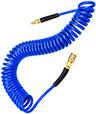
Yotoo Polyurethane Recoil Air Hose, 1/4 in x 25 ft
The hose to buy with a compressor that does not include one, and a recoil hose is the right type for a small shop: it springs back on itself when you drop it, so it does not lie across the floor waiting to be tripped over. It arrives with the coupler and plug fitted, which is the difference between working tonight and ordering fittings.
Amazon Basics Quick Connect Brass Air Coupler and Plug Kit, 14 Count
The small box that stops a compressor purchase stalling. Every air tool needs a plug on its inlet and every hose end needs a coupler, and they are sold separately from both. Fourteen brass fittings cost less than a single router bit and mean you can connect whatever turns up.
California Air Tools CAT-1P1060S Light & Quiet Portable Air Compressor, 1 Gallon
The quietest machine on this page at a published 56 dBA, and for a garage shop attached to a house that number matters more than any other spec here. 1.2 CFM at 90 PSI is modest, and the listing names brad nailers, finish nailers and staplers directly - which is the whole job. If your shop shares a wall with a bedroom, start here.
Strengths
+56 dBA published, the lowest figure on the page - and 22 dB below the 78.5 dBA pancakes, which on the usual 10 dB-per-doubling rule is roughly a quarter of the perceived loudness
+1.2 CFM at 90 PSI and 1.6 CFM at 40 PSI, with the listing naming staple guns, brad nailers, finish nailers, airbrushes and blow guns
+Oil-free single piston rated by the maker at over 3,000 hours before wear, with the motor running at only 1,680 RPM
+29 lb and a 12.5 x 14.7 x 14.75 in footprint, so it fits on a shelf rather than owning a corner of the floor
Trade-offs
−1 gallon and 1.2 CFM is a genuine limit: fine for hand-nailing, useless for a sprayer, a sander or an impact wrench
−A small tank means the motor restarts constantly - quiet, but running far more of the time than a 6 gallon unit would
−Maximum pressure is not published on this listing, so there is no figure for how much usable air the gallon actually holds
−The 3,000-hour life figure is the maker's own with no standard named, and nothing here verifies it
Type
Ultra-quiet portable air compressor
In the set
Single tool
Material / build
Steel tank, oil-free single-piston pump
Key spec
1 gal; 1.2 CFM at 90 PSI, 1.6 CFM at 40 PSI; 56 dBA; 0.6 HP at 1,680 RPM; 29 lb
Best for
Best quiet compressor for a shared garage
Worth knowing. The listing states it "operates at only 56 decibels, making it one of the quietest air compressors available", "Airflow 1.20 CFM @ 90 PSI and 1.60 CFM @ 40 PSI", an "oil-free Oil-Free Single Piston pump" (sic) "built to last over 3000 hours before wear", a "high-performance .6 HP motor" that "operates at only 1680 RPM", that it is "only 29 lbs", and that "The 1P1060S produces 1.2 CFM @ 90 PSI, making it ideal for staple guns, brad nail guns, finish nail guns, nail guns, airbrushes, and blow guns", with "Product dimensions - L (12.5\") x W/D (14.7\") x H (14.75\")". Product-info color Silver, size "1 Gallon", 29 lb; part number and model CAT-1P1060S; warranty "1 Year Limited Warranty". NO maximum tank pressure and no recovery time is published on this listing.
Specs read from the product listing, on November 6, 2026. “Not listed” means the listing doesn’t state that figure.
#2Best big tank, hose in the box
Craftsman CMXECXA0210641C 6-Gallon Pancake Air Compressor with 25 ft Hose
The same 6 gallon, 2.6 SCFM specification as the Bostitch, with a 25 ft hose in the box and a lower price. If you have no hose yet - and if this is your first compressor, you do not - this is the cheapest way to get from a sealed box to driving a nail.
Strengths
+Includes the 25 ft hose, which otherwise costs real money and is the part people forget to order
+2.6 SCFM at 90 PSI and 150 max PSI, the same working specification as the Bostitch above
+Dual gauges and a large regulator, plus dual universal quick couplers for two tools
+A drain valve to remove moisture, which is the maintenance job that decides how long the tank lasts
Trade-offs
−The listing publishes NO noise figure at all, which on a pancake compressor is the spec most likely to make you regret the purchase
−30.8 lb, slightly heavier than the Bostitch, with the same flat pancake shape that is awkward to carry one-handed
−1.0 HP, 120V and oil-free means it is built to the same price point as everything else in this class, not above it
−Bullet text is formatted with decorative brackets and reads as a generic marketplace listing rather than a Craftsman spec sheet
Type
Pancake air compressor with hose
In the set
Single tool
Material / build
Steel tank, oil-free pump
Key spec
6 gal; 150 max PSI; 2.6 SCFM at 90 PSI; 1.0 HP 120V; 25 ft hose included; 30.8 lb
Best for
Best value: compressor and hose in one box
Worth knowing. The listing states it "Delivers a maximum 150 PSI tank pressure and 2.6 SCFM at 90 PSI, with a durable oil-free pump requiring no external lubrication", that it is "perfect for professional-grade finish nailers, brad nailers, and precision trim work", a "Compact 6-gallon pancake-style tank with a lightweight 30.8 lb build, sturdy rubber-grip handle, and rubber foot pads", a "low-voltage start motor" for "cold weather or with extension cords", "Dual gauges", a "large regulator", "dual universal quick couplers to run two tools simultaneously", "a convenient drain valve to remove moisture", and a "1.0 HP 120V motor" "backed by a 1-year limited warranty". Product-info color Red, 17.3 x 15.9 x 16.5 in, 30.8 lb; part number and model CMXECXA0210641C. NO noise (dBA) figure, no tank recovery time and no hose material is published on this listing.
Specs read from the product listing, on November 6, 2026. “Not listed” means the listing doesn’t state that figure.
#3Lightest quiet machine
Metabo HPT EC28M Quiet Air Compressor, 1 Gallon
The other quiet 1 gallon machine, at a published 59 dB and 25.2 lb - the lightest compressor here. A steel roll cage and a shaped rubber handle make it the one that survives being carried around and set down carelessly, which is how a small compressor actually lives.
Strengths
+59 dB published, quiet enough that the listing claims a normal conversation can continue while it cycles
+25.2 lb, the lightest machine on this page, with a steel roll cage protecting the gauges and regulator
+Universal quick coupler and an integrated control panel for accurate PSI adjustment
+Overload protection circuit that cuts power rather than cooking the motor - worth having on a tool run off a garage extension cord
Trade-offs
−The listing publishes NO CFM figure at all, which for a compressor is the single most important number - so you are buying on the dB figure and the brand
−No maximum tank pressure published either, so there is no way to compare its stored air against the 1 gallon California unit
−1 gallon, so the same restart-constantly behavior as every small-tank machine
−The bullets are written for framing, siding and roofing crews, none of which is what a 1 gallon compressor is for
Worth knowing. The listing states it "operates at only 59 dB, so quiet that a normal conversation can take place while the compressor is cycling", that it "features a universal quick coupler for fast tool changes between framing, siding, finish, roofing nailers and others", that "The integrated control panel allows for accurate PSI adjustments", that "Weighing only 25.2 lbs, this 1 gallon air compressor is easy to transport", with an "ergonomically shaped rubber carrying handle and steel roll cage design", that the "quiet operation of this oil-free compressor provides high durability with no maintenance", and that "The motor is protected by an overload protection circuit". Product-info 14 x 14 x 13.5 in, 25.2 lb; part number and model EC28M; warranty "1 year". NO CFM figure, NO maximum PSI and NO horsepower is published on this listing - the absence is stated in the cons rather than filled in with a guess.
Specs read from the product listing, on November 6, 2026. “Not listed” means the listing doesn’t state that figure.
#4Best budget pick
Craftsman CMXECXA0200244A 2 Gallon Air Compressor with 10-Piece Accessory Kit
The cheapest way into air, and the one that arrives with the fittings. 19 lb, 2 gallons, 125 PSI and a box of couplers, plugs, a blowgun and a tire chuck - which is most of the shopping list a first compressor generates. Read the honest con first: it publishes no CFM figure, so nothing here promises it will keep up with a nailer.
Strengths
+Ships with the accessories that otherwise become a second order: hose, couplers, plugs, blow gun, tire chuck, gauge, nozzle and thread seal tape
+19 lb on the listing's own figure - light enough to carry in one hand up a step
+2 gallons and two quick couplings, with 125 PSI maximum and an oil-free, maintenance-free pump
+Overload protection and a designed heat-dissipation system, which matters on a small pump that will cycle often
Trade-offs
−NO CFM figure is published anywhere on the listing - the one number that decides whether it keeps up with a tool is simply absent
−1/3 HP is the smallest motor here by a wide margin, and 125 PSI the lowest maximum pressure
−No noise figure either, and small cheap pumps are rarely quiet ones
−The inclusions bullet lists "1/4 npt auto plug" twice and the product-info weight (24.5 lb) contradicts the 19 lb in the bullet - a sloppily written listing
Type
Compact air compressor with accessory kit
In the set
10 pieces
Material / build
Steel tank, oil-free pump
Key spec
2 gal; 125 max PSI; 1/3 HP; 10-piece accessory kit; 19 lb per listing; CFM not listed
Best for
Cheapest start, with fittings included
Worth knowing. The listing states inclusions of "1*air hose, 1* thread seal tape, 1* 1/4 fntp ball foot air chuck, 1* 1/4 npt auto plug, 1* 1/4 npt auto plug, 1* 1/4 npt auto coupler, 1* tire pressure gauge, 1* nozzle, 1* high performance blow gun and 1* sleeve" (the "auto plug" line appears twice, which is the listing's own duplication), that it "weighs only 19 Ibs", that it has a "1/3 HP UMC motor and two quick couplings, with a maximum pressure of 125 PSI", and an "oil-free maintenance-free pump system" with a "heat dissipation system and overload protection mechanism". Product-info color Red, size "With Accessories", weight 24.5 lb; model CMXECXA0200244A, no part number given. NO CFM figure, NO dBA figure and NO tank recovery time is published, and the two stated weights disagree.
Specs read from the product listing, on November 6, 2026. “Not listed” means the listing doesn’t state that figure.
#5Best hose to add
Yotoo Polyurethane Recoil Air Hose, 1/4 in x 25 ft
The hose to buy with a compressor that does not include one, and a recoil hose is the right type for a small shop: it springs back on itself when you drop it, so it does not lie across the floor waiting to be tripped over. It arrives with the coupler and plug fitted, which is the difference between working tonight and ordering fittings.
Strengths
+Self-coiling polyurethane - it snaps back when not in use, which is the whole argument against a straight rubber hose in a one-car garage
+Arrives with a 1/4 in industrial quick coupler and plug already installed, so no fittings order and no thread tape
+Rated to 150 PSI maximum working pressure and -40 to +150 degrees F, which covers an unheated garage in February
+Bend restrictors at both ends, which is where a coiled hose always fails first
Trade-offs
−A coiled hose pulls back against you as you work, so at full stretch it is fighting your hand - a straight hose does not
−25 ft coiled is noticeably shorter in practice than 25 ft straight, because the coil never fully extends
−1/4 in inner diameter is right for a brad nailer and too small for high-flow tools like a sander or a sprayer
−The industrial-type coupler fitted here is one of several incompatible US quick-connect profiles - check it matches your compressor's couplers
Type
Recoil air hose
In the set
Single tool
Material / build
Polyurethane
Key spec
1/4 in ID x 25 ft; 150 PSI max working pressure; -40 to +150 degrees F; industrial coupler and plug fitted
Best for
Best hose for a small shop
Worth knowing. The listing states "POLYURETHANE CONSTRUCTION: No tangles, anti kinking, abrasion resistance, durable and light weight", "1/4 inch inner diameter by 25 feet long", that "When not in use. The coiled hose will snap back automatively for saving spacing and easy storage" (sic), that "It delivers up to 150 PSI for maximum working pressure", a "-40 degrees to +150 degrees F temperature range", and "Installed 1/4\" heavy duty industrial quick coupler and plug" with "Bend restrictors" that "reduce kinking", noting the "quick coupler and plug CAN BE REMOVED by a wrench". Product-info color Blue, size "25 Feet", 1.32 lb; part number and model 102001; warranty "TWO YEAR WARRANTY". No burst pressure and no coil memory figure is published.
Specs read from the product listing, on November 6, 2026. “Not listed” means the listing doesn’t state that figure.
#6Best fittings kit to add
Amazon Basics Quick Connect Brass Air Coupler and Plug Kit, 14 Count
The small box that stops a compressor purchase stalling. Every air tool needs a plug on its inlet and every hose end needs a coupler, and they are sold separately from both. Fourteen brass fittings cost less than a single router bit and mean you can connect whatever turns up.
Strengths
+Fourteen pieces - two female couplers, two male couplers, four female plugs and six male plugs - which covers a nailer, a blowgun and a spare hose end
+Brass rather than plated steel, so the threads survive being taken apart and refitted
+Deep-knurled sockets with a ball-locking mechanism, which is what gives a connection you can feel click home
+Costs a fraction of what the same fittings cost bought singly at a hardware counter
Trade-offs
−US quick-connect couplers come in several incompatible profiles (industrial, automotive, ARO) and this listing only says "IM" - match it to the couplers already on your compressor before you buy
−1/4 in NPT only, so it is the wrong kit for 3/8 in plumbing on a larger shop compressor
−No thread sealant included, and NPT threads on air fittings need tape or paste to seal properly
−No pressure rating is published on the listing at all
Type
Air fittings kit
In the set
14 pieces
Material / build
Brass
Key spec
14 pieces; 1/4 in NPT; 2 female + 2 male couplers, 4 female + 6 male plugs; ball-locking
Best for
Best fittings kit to buy alongside
Worth knowing. The listing states a "Brass plug and coupler accessory kit", that it is "Compatible with 1/4-Inch NPT air compressors (compressor not included)", a "Deep-knurled socket for a positive connection with ball-locking mechanism", and that the "Kit includes (2) 1/4\" NPT IM female couplers, (2) 1/4\" NPT IM male couplers, (4) 1/4\" NPT IM female plugs, and (6) 1/4\" NPT IM male plugs". Product-info color Brass, size "14 count (Pack of 1)", 1.28 lb; part number and model A140001. NO maximum pressure rating and no explicit coupler profile standard is published - "IM" is the only designation given, which is why the cons tell you to match it against your existing couplers rather than assume.
Specs read from the product listing, on November 6, 2026. “Not listed” means the listing doesn’t state that figure.
Why $200 is a sensible ceiling for a wood shop
Air compressors are priced by what they can run continuously, and a woodworker runs almost nothing continuously. The jobs a small shop actually asks for — firing brads, blowing chips out of a mortise, inflating a trailer tire, the occasional airbrush — are all intermittent, and intermittent work is exactly what a small tank and a modest pump handle well.
Above $200 you are buying one of three things: a bigger tank so the motor restarts less often, higher CFM so you can run air-hungry tools like a random-orbit air sander or a spray gun, or a cast-iron oil-lubricated pump that will outlive the shop. All three are real upgrades. None of them makes a brad go in straighter. If you later find yourself wanting an air sander, the answer is usually to buy an electric sander instead, because the compressor that feeds a pneumatic one costs several times this page’s ceiling.
The one genuine argument for spending more is noise pluscapacity: ultra-quiet machines with six or eight gallons exist, and they sit just above this band. Our full compressor roundup carries two of them, and it is the page to read if the budget can stretch.
Oil-free is not the same as maintenance-free
Every machine on this page has an oil-free pump, and every listing sells that as “maintenance-free”. The pump is. The tank is not. Compressing air condenses the water that was in it, and that water collects in the bottom of a steel tank and rusts it from the inside out. The published rule for a workplace receiver is unambiguous — OSHA 1910.169(b)(2) requires a drain at the lowest point of every air receiver, drained often enough to prevent an excessive accumulation of liquid. A home shop is not bound by that standard, but the physics do not care whose garage it is.
So: open the drain valve under the tank after every session, let it hiss until it stops, close it. Thirty seconds. It is the difference between a compressor that lasts fifteen years and one that develops a weeping seam. In an unheated garage the problem is worse, for the same reason everything else metal in there rusts.
The hidden cost: hose and fittings
Two of the four machines here ship with nothing but the compressor. A compressor with no hose is a very heavy paperweight, and the fittings are sold separately from both — every air tool needs a plug on its inlet, every hose end needs a coupler, and US quick-connect couplers come in several mutually incompatible profiles.
That is why two accessories are on this list. A 25 ft recoil hose and a 14-piece brass coupler kit together cost well under $50 and take the guesswork out; buy them with the machine rather than discovering the gap on a Saturday. And check the profile: if your compressor’s couplers are industrial-type and your new plug is automotive-type, they will physically fit together and leak.
The two Craftsman machines close part of this gap themselves. The six-gallon includes a 25 ft hose; the 2-gallon kit includes a hose whose length its listing never states, plus a blowgun, a tire chuck, couplers, plugs, a gauge, a nozzle and thread seal tape. On a strict cost-to-first-nail comparison the 2-gallon kit is the cheapest start on this page, which is why it is our budget pick despite publishing no CFM figure.
The 30 PSI rule, which almost everyone breaks
The first thing people do with a new compressor is blow sawdust off a bench with the blowgun wide open. The published limit for compressed air used for cleaning is one sentence of OSHA 1910.242(b): compressed air shall not be used for cleaning purposes except where reduced to less than 30 p.s.i., and then only with effective chip guarding and personal protective equipment.
A compressor regulated at 90 PSI for a nailer is three times that. Turn the regulator down before you pick up a blowgun, wear eye protection, and understand what the rule is protecting you from: a 90 PSI jet drives chips into skin and eyes and can inject air under the skin. It is also, incidentally, the worst possible way to deal with fine dust — it puts the particles that matter into the air you are breathing. A shop vacuumis the right tool for a dusty bench — and if you are going to put dust into the air anyway, a rated respirator costs less than the blowgun did.
What you give up under $200
Published specifications. This is the real cost at this price, and it is unusual enough to say plainly: two of these four listings publish no CFM figure at all, and two publish no noise figure. We do not fill those gaps in with estimates — the cards say “not listed”, because a number we invented would be worse than an absence.
Capacity headroom. A 1-gallon tank at 1.2 CFM means the motor runs most of the time you are nailing. Nothing breaks; it simply never gets ahead of you. A six-gallon tank buys you quiet stretches between cycles, at the cost of being loud when it does run.
Pump longevity. Every pump here is oil-free, which trades service life for zero maintenance. An oil-lubricated cast-iron pump runs quieter and lasts longer and starts at roughly double this page’s ceiling. For a few hundred nails a month, oil-free is the correct purchase.
The one to buy
The California Air Tools 1P1060S if your shop is attached to a house, and budget another $40 for a hose and fittings. The Craftsman CMXECXA0210641C if you want a six-gallon tank and a hose in one box and can live with an unpublished noise figure. The Craftsman 2-gallon kit if you want the cheapest possible start with nothing left to order. The Metabo HPT EC28M only if portability is the deciding factor — at 25.2 lb it is the lightest machine here, but its listing publishes no CFM, so you are buying the decibel figure and the brand.
Frequently asked questions
What is the best air compressor under $200?+
The California Air Tools 1P1060S. It is the only machine under $200 in our registry that publishes both a noise figure (56 dBA) and an airflow figure (1.2 CFM at 90 PSI), and 1.2 CFM is more than hand-nailing with an 18-gauge brad nailer requires. You will need to add a hose, which the listing does not include.
Is a compressor under $200 enough for a brad nailer?+
Yes. An 18-gauge brad nailer uses roughly 0.3 cubic feet of air per shot, so about 2 CFM at 90 PSI covers continuous nailing and far less covers normal use. Tank size changes how often the motor restarts, not whether the gun fires. What a sub-$200 compressor will not do is run an air sander, a spray gun or an impact wrench.
How many gallons do I need for woodworking?+
One to six, and the difference is comfort rather than capability. A 1-gallon tank means the pump cycles often; a 6-gallon tank means it cycles less often and is usually louder when it does. Woodworking air tools are intermittent, which is exactly what small tanks are good at. Buy on published noise and on what is in the box instead.
Do cheap air compressors come with a hose?+
Usually not. Of the four machines on this page, the Craftsman CMXECXA0210641C includes a 25 ft hose and the Craftsman 2-gallon kit includes a hose of unstated length plus couplers, plugs and a blowgun; the two quiet 1-gallon machines include neither. Budget $20 to $40 for a hose and a fittings kit if the box does not have them, and match the coupler profile to your compressor.
Are quiet air compressors worth the money?+
In a garage attached to a house, yes - and under $200 they cost no more than the loud ones. The quiet machines here publish 56 and 59 dBA against 78.5 dBA for the pancake compressors in our registry that publish a figure at all. Since loudness roughly doubles every 10 dB, that is a large practical difference for a tool that cycles on its own schedule while you work.
Do I still have to drain an oil-free compressor?+
Yes. Oil-free describes the pump, not the tank. Compressing air condenses water, which collects in the bottom of the steel tank and rusts it from the inside. OSHA 1910.169(b)(2) requires a drain valve at the lowest point of every air receiver, drained often enough to prevent excessive accumulation of liquid; a home shop is not bound by that standard, but the condensation happens anyway. Open the drain after every session.
Sources
OSHA — 1910.169, Air receivers — The standard for the tank itself, and the sourced basis for the one maintenance job an oil-free compressor does not remove. On drains, (b)(2): "A drain pipe and valve shall be installed at the lowest point of every air receiver", with the receiver to be drained often enough to prevent an excessive accumulation of liquid. On gages and valves, (b)(3): "Every air receiver shall be equipped with an indicating pressure gage" and with "one or more spring-loaded safety valves" whose combined relieving capacity keeps pressure from exceeding the maximum allowable working pressure by more than 10 percent. And (b)(3)(ii): "No valve of any type shall be placed between the air receiver and its safety valve or valves." Like the rest of 1910 this binds employers rather than home shops, but it is the published statement of what the drain valve on the bottom of a pancake compressor is for (accessed November 6, 2026)
OSHA — 1910.242(b), Compressed air used for cleaning — One sentence, and the one rule most people with a new compressor break on day one. Paragraph (b) reads: "Compressed air shall not be used for cleaning purposes except where reduced to less than 30 p.s.i. and then only with effective chip guarding and personal protective equipment." A shop compressor regulated at 90 PSI for a nailer is three times that limit, which is why blowing sawdust off a bench with an unregulated blowgun is the practice this standard exists to stop. The page carries no footnote and names no exception beyond the one quoted (accessed November 6, 2026)
OSHA — 1926.302, Power-operated hand tools — Paragraph (b)(3): pneumatically driven nailers and staplers with automatic fastener feed operating above 100 psi must have a muzzle safety device that stops the tool ejecting fasteners unless the muzzle is against the work (accessed August 27, 2026)
NIOSH and OSHA — Nail Gun Safety: A Guide for Construction Contractors — The joint NIOSH/OSHA guide: the risk of a nail gun injury is twice as high with a multi-shot contact trigger as with a single-shot sequential trigger, and step one of its six steps is to use full sequential trigger nail guns (accessed August 27, 2026)