A shop vacuum is the most useful hundred dollars a garage woodworker spends, and it is not because of the sweeping. Connect it to a sander or a saw and it captures dust at the tool, before that dust is airborne and in your lungs. That is genuinely the whole game with fine particulate: capture at source beats filtering the room, every time.
Here is the lens we compare on. Whether it connects to your tools— hose diameter and adapters decide this, and it is the criterion most beginners overlook. Tank capacity, which affects convenience rather than performance. Sustained suction, which in practice means how quickly the filter clogs. And filtration, because a vacuum that captures dust at the tool and then blows it out through a coarse filter has simply relocated the problem.
A note on the “peak HP” number on every one of these boxes: it is measured at motor stall and it is not a continuous rating. Treat it as a rough class indicator, nothing more. Airflow and sealed suction are the meaningful figures and almost nobody publishes them at this price.
How this is funded: we earn a commission if you buy through our links, at no extra cost to you. It never changes which tool we recommend, and we’ll tell you plainly when to skip one. Full disclosure.
Quick picks
Ranked on the specs that matter for a beginner and honest buyer fit. Select a row to jump to the full write-up. We haven’t hands-on-tested these — here is exactly what we do instead.
#
Product
Best for
Price
1
Craftsman CMXEVBE17925 5-Gallon 5.0 Peak HP Wet/Dry Vac
The right size for a garage shop: big enough to empty weekly rather than hourly, small enough to move with one hand. A shop vac is the closest thing a beginner has to dust collection, and it doubles as the cleanup crew.
Vacmaster VOC508S 5-Gallon 4 Peak HP Stainless Wet/Dry Vac
The budget pick, and a stainless tank at this price is unusual — it will not crack the way a knocked-about plastic tank eventually does. Slightly less peak power, in a way you will never notice sweeping sawdust.
Craftsman CMXEVBE17584 6-Gallon 3.5 Peak HP Wet/Dry Vac
More tank for less money — the sensible middle if the vacuum will live in one corner of the garage rather than being carried around. A bigger drum simply means fewer interruptions.
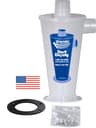
Oneida Air Systems Dust Deputy DIY Anti-Static Cyclone Separator
The single best upgrade to any shop vacuum. A cyclone drops the overwhelming majority of the dust into a bucket before it ever reaches the filter, so suction stays constant and filters last for years instead of weeks.
A real dust collector, not a vacuum. Where a shop vac gives high suction through a small hose, a collector moves a large volume of air through a wide one — which is what a bandsaw, planer or table saw actually needs.
Craftsman CMXEVBE17925 5-Gallon 5.0 Peak HP Wet/Dry Vac
The right size for a garage shop: big enough to empty weekly rather than hourly, small enough to move with one hand. A shop vac is the closest thing a beginner has to dust collection, and it doubles as the cleanup crew.
Strengths
+5 gallons hits the sweet spot between capacity and portability
+Connects to sander and saw dust ports with standard adapters
+Handles wet spills, which no dust collector will
Trade-offs
−Loud — often louder than the tool you are attaching it to
−Fine dust clogs the filter fast unless you add a cyclone separator
Type
Wet/dry shop vacuum
In the set
Single tool
Material / build
Polypropylene tank
Key spec
5 gal, 5.0 peak HP
Best for
Best overall shop vacuum
Worth knowing. Peak HP on a shop vac is a marketing figure measured at stall, not a continuous rating. Airflow (CFM) and sealed suction matter more, but almost nobody publishes them at this price point — treat peak HP as a rough class indicator only.
Specs read from the product listing, on August 11, 2026. “Not listed” means the listing doesn’t state that figure.
#2Best budget
Vacmaster VOC508S 5-Gallon 4 Peak HP Stainless Wet/Dry Vac
The budget pick, and a stainless tank at this price is unusual — it will not crack the way a knocked-about plastic tank eventually does. Slightly less peak power, in a way you will never notice sweeping sawdust.
Strengths
+Stainless tank survives garage abuse better than plastic
+Roughly half the price of the name-brand 5-gallon vacs
+Same 5-gallon capacity as vacs costing considerably more
Trade-offs
−Filter and accessory range is narrower than the big brands
−Hose is on the short side for reaching across a garage bay
Type
Wet/dry shop vacuum
In the set
Single tool
Material / build
Stainless steel tank
Key spec
5 gal, 4 peak HP
Best for
Best budget shop vacuum
Worth knowing. Hose diameter is the spec that decides whether a vac works with your tools. Most sander and saw ports expect a 1-1/4 or 2-1/2 inch fitting — check yours before buying adapters blind.
Specs read from the product listing, on August 11, 2026. “Not listed” means the listing doesn’t state that figure.
#3Best value on capacity
Craftsman CMXEVBE17584 6-Gallon 3.5 Peak HP Wet/Dry Vac
More tank for less money — the sensible middle if the vacuum will live in one corner of the garage rather than being carried around. A bigger drum simply means fewer interruptions.
Strengths
+6 gallons means longer between empties on a big sanding session
+Cheaper than the 5-gallon 5.0 peak HP models
+Onboard accessory storage keeps the nozzles with the vac instead of lost
Trade-offs
−3.5 peak HP is a step down in suction from the 5.0 models
−Bigger drum is more awkward to carry up steps or into a car
Type
Wet/dry shop vacuum
In the set
Single tool
Material / build
Polypropylene tank
Key spec
6 gal, 3.5 peak HP
Best for
Best value on capacity
Worth knowing. Tank capacity affects convenience, not performance. Suction comes from the motor and a clean filter, so a bigger drum with a clogged filter still performs worse than a small vac with a clean one.
Specs read from the product listing, on August 11, 2026. “Not listed” means the listing doesn’t state that figure.
#4Best upgrade for any vac
Oneida Air Systems Dust Deputy DIY Anti-Static Cyclone Separator
The single best upgrade to any shop vacuum. A cyclone drops the overwhelming majority of the dust into a bucket before it ever reaches the filter, so suction stays constant and filters last for years instead of weeks.
Strengths
+Keeps suction constant through a whole session instead of fading as the filter loads
+Filter life goes from a consumable to an afterthought
+Anti-static construction reduces the shocks a plastic cyclone can build up
Trade-offs
−Needs a bucket and hose to complete it — this is a component, not a finished product
−Takes up floor space next to the vac and adds another thing to wheel around
Type
Cyclone dust separator
In the set
Single tool
Material / build
Anti-static molded polymer
Key spec
Retrofits standard wet/dry vacs
Best for
Best add-on for any shop vac
Worth knowing. Cyclonic separation uses the air's own spiral to fling heavy particles outward and down. It is the same principle as a bagless household vacuum, just scaled to the volume a sander produces.
Specs read from the product listing, on August 11, 2026. “Not listed” means the listing doesn’t state that figure.
#5When a vacuum isn't enough
WEN DC3474 Woodworking Dust Collector, 15-Gallon
A real dust collector, not a vacuum. Where a shop vac gives high suction through a small hose, a collector moves a large volume of air through a wide one — which is what a bandsaw, planer or table saw actually needs.
Strengths
+Moves far more air than any shop vac, which is what big machines require
+15-gallon bag holds a serious volume of chips
+Mobile base, plus an optional wall mount to save floor space
Trade-offs
−A stock bag filters far less finely than a shop vac — the fine dust is what harms lungs
−Bulky and loud; a real commitment of garage space
Type
Single-stage dust collector
In the set
Single tool
Material / build
Steel body, fabric collection bag
Key spec
7.4 A induction motor, 15 gal bag
Best for
The upgrade when a shop vac stops keeping up
Worth knowing. Collectors and vacuums are not interchangeable. High CFM at low pressure (a collector) clears chips from a machine port; high pressure at low CFM (a vacuum) pulls dust through a small sander port. Most small shops eventually own both.
Specs read from the product listing, on August 11, 2026. “Not listed” means the listing doesn’t state that figure.
The upgrade that matters more than the vacuum
Here is the thing every experienced woodworker knows and every beginner learns the hard way: a shop vacuum’s suction does not fade because the tank is full. It fades because the filter loads up with fine dust, and that happens surprisingly fast when you are sanding. Twenty minutes in, the vacuum is working half as well as it was, and you probably have not noticed.
A cyclone separator fixes this completely. It sits between the tool and the vacuum, spins the incoming air so heavy particles fly outward and drop into a bucket, and passes only the very finest dust through to the vacuum itself. In practice the overwhelming majority of what you collect never reaches the filter at all.
The result: constant suction through an entire session, filters that last years instead of weeks, and emptying a bucket instead of wrestling a clogged pleated filter. It costs a fraction of the vacuum. If you buy one accessory for your shop this year, buy this one.
Vacuum or dust collector? They are not the same thing
This confuses a lot of beginners, and the distinction is simple once you see it.
A shop vacuum produces high suction pressure through a small hose but moves a relatively small volume of air. That is exactly right for pulling dust through the small port on a sander, a router or a circular saw.
A dust collector does the opposite: low pressure, huge air volume, through a four-inch hose. That is what a planer, a bandsaw or a table saw needs, because those machines produce chips faster than a small hose can carry them.
For a beginner with hand-held tools, a shop vacuum is the correct answer and a dust collector is overkill. The moment you own a floor-standing machine with a four-inch port, that flips. Most small shops eventually own both.
Getting it connected
The most common frustration here is fit. Tool dust ports come in a range of sizes, and vacuum hoses come in a range of sizes, and they rarely match straight out of the box.
Buy a small set of stepped adapters and keep them with the vacuum. A short length of the right-diameter hose and a couple of adapters solves nearly every connection, and it turns your vacuum from a cleanup tool into a dust collection system.
One more accessory worth knowing about: an auto-start switch, which powers the vacuum when the tool draws current, so you are not reaching for two switches on every cut. It is the difference between using dust collection always and using it when you remember.
Filters and bags
Two consumables affect how much fine dust your vacuum actually captures rather than recirculates.
A fine-dust cartridge filter rather than the standard one is worth it if you sand often; standard filters pass a meaningful amount of the finest particles straight back into the room. Collection bagsinside the drum make emptying far less dusty, which matters — emptying a bare drum of fine sanding dust puts a cloud of exactly the wrong particle size straight into your breathing zone.
With a cyclone in front, both consumables last dramatically longer, which is another reason it pays for itself.
Noise
Shop vacuums are loud — often louder than the sander they are attached to. That is a real reason people stop using them, so treat it as a design problem rather than something to endure. Put the vacuum on the far side of the garage with a longer hose, or simply keep your hearing protection on for the whole session rather than just the cutting.
Frequently asked questions
What size shop vacuum do I need for a small woodworking shop?+
Around 5 gallons. That is large enough that you empty it occasionally rather than mid-project, and small enough to lift and carry across a garage with one hand. Bigger drums are cheaper per gallon but awkward to move; smaller ones fill too fast to be useful for sanding.
What is a cyclone separator and do I need one?+
It sits between the tool and the vacuum and spins the air so heavy particles drop into a bucket before reaching the vacuum's filter. It keeps suction constant through a whole session and makes filters last years instead of weeks. It is the single best upgrade you can make to any shop vacuum.
Is a shop vacuum the same as a dust collector?+
No. A shop vacuum gives high suction through a small hose — right for sanders, routers and hand-held saws. A dust collector moves a much larger volume of air through a 4-inch hose — right for planers, bandsaws and table saws. They solve different problems and most small shops eventually own both.
Why does my shop vac lose suction while I'm sanding?+
The filter is clogging with fine dust, not the tank filling. It happens within about twenty minutes of continuous sanding. A cyclone separator in front of the vacuum stops nearly all of that dust ever reaching the filter, which keeps suction constant.
Can I use a household vacuum for wood dust?+
You should not. Fine wood dust passes through domestic filters and damages the motor, and household vacuums are not rated for the volumes a shop produces. They also lack the hose fittings to connect to tool dust ports, which is where a shop vacuum earns its keep.
Sources
OSHA — Woodworking eTool — OSHA guidance on woodworking hazards, guarding and safe work practices (accessed July 24, 2026)