The machine you buy when hand-drilling stops being good enough. Seven benchtop presses compared on the four specs that actually decide it for wood - slowest speed, spindle travel, table size and chuck - with the numbers their listings leave out named as missing.
Start with the uncomfortable part: you probably do not need one of these yet. This site has said so twice already — how to drill straight holes shows you the two-square trick that does most of a drill press’s job for free, and woodworking tools you don’t need files a drill press under “specialist” alongside a bandsaw and a lathe. Nothing on this page retracts that. Both of those pages end on the same sentence, though: buy one when repeat accurate holes become the thing slowing you down. This page is for the week that sentence becomes true, and it had nowhere to send you until now.
Here is the lens, and it is deliberately not the one on the box. Slowest speed comes first, because the bits that make a drill press worth owning — large Forstner bits, hole saws, big spade bits — burn the wood and dull themselves above roughly a thousand RPM, so a machine that bottoms out at 750 RPM is more useful for wood than one with a bigger motor that bottoms out at 1,100. Spindle travel second, because it is the cap on how deep you can bore in one pull, and almost every benchtop machine gives you two inches whatever else it claims. Table size third, because the cast-iron table these arrive with is sized for a metalworking vise and a bar of steel, not a cabinet side. And chuck capacity fourth, because a 1/2-inch chuck refuses the 5/8-inch shanks that big bits ship with. Horsepower is nearly last. You are drilling wood.
One thing to know before you read the cards: drill press listings are the most incomplete we have worked with on this site. Three of the seven machines below publish no spindle travel, no chuck capacity and no table size — three of the four numbers that decide the purchase. We have not filled those gaps in with plausible figures. Where a listing says nothing, the card says “Not listed” and the cons say so plainly, because a manufacturer who will not publish a spindle travel is telling you something. Two listings also contradict themselves and we record both figures rather than the flattering one. Here is exactly what we do instead of testing.
How this is funded: we earn a commission if you buy through our links, at no extra cost to you. It never changes which tool we recommend, and we’ll tell you plainly when to skip one. Full disclosure.
Quick picks
Ranked on the specs that matter for a beginner and honest buyer fit. Select a row to jump to the full write-up. We haven’t hands-on-tested these — here is exactly what we do instead.
#
Product
Best for
Price
1
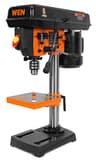
WEN 4206T 8-Inch 5-Speed Benchtop Drill Press
The cheapest honest answer to "my holes are not square to the face". It is small, it is a belt-change machine, and its table is barely bigger than a drinks coaster — but its slowest speed is 750 RPM, which is slow enough for the Forstner bits a first shop actually struggles with, and it costs less than a decent cordless drill. If a drill press is a maybe rather than a plan, this is the one to find out on.
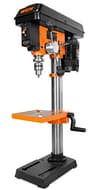
The upgrade worth paying for is not the extra two inches of swing, it is the speed dial. Mechanical variable speed from 530 to 3100 RPM with a digital readout means you set the speed for the bit instead of accepting whatever belt position you last used, and 530 RPM is slow enough for the large Forstner bits that make a drill press worth owning. What it does not give you is more depth: the spindle still travels two inches.
The only machine in this roundup whose listing says a fence comes with it, and a fence is the single accessory that turns a drill press from a metalworker's tool into a woodworker's one. It is what lets you bore a row of shelf-pin holes at a repeatable distance from an edge instead of measuring each one. Everything else about it is a competent 10-inch machine from a brand with no US service presence.
A 5/8-inch chuck and a rack-and-pinion table crank at a ten-inch price. Those two features normally live on the 12-inch machines, and both change daily use: the bigger chuck swallows fat Forstner and hole-saw shanks, and a geared table crank means you set table height with a handle instead of wrestling a collar with one hand under a 50-pound head. The motor is the smallest here and the listing states no speeds at all.
The one with the safety feature nobody else lists. A bump-off switch is a paddle big enough to shut the machine down with a hip or a forearm, which is what you have available when both hands are holding a part that has started to spin. Add a tilting table that goes 45 degrees either way and an LED light, and this is the most thoughtfully equipped 10-inch machine here. Its listing is also the least forthcoming about numbers.
The only machine here that fixes the specification everyone ignores. Three and an eighth inches of spindle travel against two means you can bore through a thick leg, sink a deep hole for a dowel or run a hole saw without raising the table mid-cut — and the 5/8-inch chuck takes the fat shanks that big Forstner bits and hole saws arrive with. It is also 85 pounds of cast iron that needs a bench built for it.
The lightest machine here by a wide margin — 48 pounds against 57 to 85 — which sounds like a weakness and is often the opposite in a garage. A drill press you can lift onto a bench alone, or move when the car has to come in, is a drill press you will keep. You pay a brand premium for a JET and the listing is thin on specifications, so buy this one for the weight, the dealer network and the 630 to 3300 RPM range, not for a spec sheet win.
The cheapest honest answer to "my holes are not square to the face". It is small, it is a belt-change machine, and its table is barely bigger than a drinks coaster — but its slowest speed is 750 RPM, which is slow enough for the Forstner bits a first shop actually struggles with, and it costs less than a decent cordless drill. If a drill press is a maybe rather than a plan, this is the one to find out on.
Strengths
+Five stated speeds from 750 to 3200 RPM, and the 750 RPM bottom end is the number that matters - big flat-bottomed bits burn at high speed
+The listing's own 7 by 11 inch base is small enough to live on the end of a bench without surrendering a whole station
+1/2-inch keyed chuck with onboard key storage, which is the difference between a chuck key on the bench and a chuck key lost under it
Trade-offs
−2 inches of spindle travel caps how deep you can bore in a single pull - deeper holes mean raising the table and re-registering, which is exactly the repeatability you bought the machine for
−The 6.5 by 6.5 inch worktable is too small for most furniture parts. Budget for a shop-made plywood table from day one, because the aftermarket kits need a 12-inch table to bolt to
−An 8-inch swing means roughly 4 inches from column to bit center by the listing's own figure, so the middle of a wide panel is permanently out of reach
−Speed changes mean opening the cover and moving a belt, so in practice most people pick one speed and leave it
Type
Benchtop drill press
In the set
Single tool
Material / build
Cast iron
Key spec
8 in swing; 2 in spindle travel; 5 speeds, 750-3200 RPM; 1/2 in chuck
Best for
Best overall for a first garage shop
Worth knowing. The listing states "a 2.3A induction motor, an 8-inch swing, and a 2-inch spindle travel", a "1/2-inch keyed chuck and onboard key storage", five speeds of "750, 1100, 1500, 2100, or 3200 RPM", a "6.5 by 6.5 inch height adjustable worktable" that "bevels up to 45 degrees in each direction", and that it "measures in at 23 inches tall with a 7 by 11-inch base". Its product-info block gives a shipping weight of 32 pounds. Part number 4206T. No table-to-chuck distance and no runout figure is published.
Specs read from the product listing, on October 9, 2026. “Not listed” means the listing doesn’t state that figure.
The upgrade worth paying for is not the extra two inches of swing, it is the speed dial. Mechanical variable speed from 530 to 3100 RPM with a digital readout means you set the speed for the bit instead of accepting whatever belt position you last used, and 530 RPM is slow enough for the large Forstner bits that make a drill press worth owning. What it does not give you is more depth: the spindle still travels two inches.
Strengths
+Mechanical variable speed across a stated 530 to 3100 RPM, set with a dial rather than by lifting the cover and moving a belt
+Digital speed readout, so "slow for a big bit" becomes a number you can repeat rather than a guess
+Adjustable depth stop, laser and a 1/2-inch keyed chuck with onboard key storage are all in the box per the listing, plus a stated two-year warranty
Trade-offs
−Still only 2 inches of spindle travel - identical to the 8-inch machine at roughly two and a half times the price. If depth per pull is your problem, this is not the fix
−The 8 by 7.5 inch beveling table is still small for furniture parts, so an aftermarket or shop-made table is still on the list
−The listing contradicts itself on weight: the feature bullets say 57 pounds, the product-info block says about 66. Either way it is a two-person lift onto a bench
−The laser is a Class IIIA 2.5 mW unit by the listing's own figure. Treat it as a rough centering aid, not a reason to stop using a center punch
Type
Benchtop drill press
In the set
Single tool
Material / build
Cast iron
Key spec
10 in swing; 2 in spindle travel; variable 530-3100 RPM; 1/2 in chuck
Best for
Best variable speed
Worth knowing. The listing states "a 6.2-amp induction motor, a 10-inch swing, and a 2-inch spindle travel", that you "adjust the mechanical variable speed anywhere from 530 to 3100 RPM", a "digital speed readout", a size of "13.2 by 19.3 by 33.9 inches" with "a weight of 57 pounds", and that the box includes "a class IIIA 2.5mW laser, adjustable depth stop, beveling 8 by 7.5-inch work table, 1/2-inch capacity keyed chuck, a chuck key with onboard storage, and a two-year warranty". Part number DP1062V. The product-info block gives the weight as roughly 66 pounds, which disagrees with the bullets; both figures are recorded here rather than choosing one. No runout figure is published.
Specs read from the product listing, on October 9, 2026. “Not listed” means the listing doesn’t state that figure.
#3Best value with a fence
Bucktool DP25016A2 10-Inch Benchtop Drill Press
The only machine in this roundup whose listing says a fence comes with it, and a fence is the single accessory that turns a drill press from a metalworker's tool into a woodworker's one. It is what lets you bore a row of shelf-pin holes at a repeatable distance from an edge instead of measuring each one. Everything else about it is a competent 10-inch machine from a brand with no US service presence.
Strengths
+The listing states a fence and head assembly that "helps to support stock on the edge" ship with the machine - the woodworking accessory you otherwise buy separately for a meaningful fraction of the price
+Five stated speeds from 650 to 3100 RPM, with the slow end where big flat-bottomed bits want to run
+Removable switch keys, which the listing says "prevent unintentional starts" - the cheapest real safety feature on any machine here
+CSA certification is named on the listing, which is more than most budget machines claim
Trade-offs
−The listing itself calls the 10-inch swing suitable for "light-duty drilling tasks" - the maker is telling you its limits and it is worth believing
−2 inches of spindle travel, the same depth cap as the cheapest machine here
−Bucktool has no meaningful US dealer or service network, so a failed switch or motor is an Amazon return rather than a parts order
−No table size and no machine weight is published, so you are planning bench space and a lift blind
Type
Benchtop drill press
In the set
Single tool
Material / build
Cast iron base
Key spec
10 in swing; 2 in spindle travel; 5 speeds, 650-3100 RPM; 1/2 in chuck; fence included
Best for
Best value with a fence included
Worth knowing. The listing states "CSA Certification, 3/4HP 6.2-Amp motor, 2-inch spindle travel, 1/2-inch keyed chuck, 30-inch total height, 120VAC" and that the "10-inch swings suit for a variety of light-duty drilling tasks"; five speeds of "650/1100/1700/2300/3100 RPM" changed "by changing the belt position on the pulleys located under the top cover"; a worktable that "bevel 45 degrees" with "built-in LED lights"; that "the fence and head assembly fit our drill press table, helps to support stock on the edge, and provide chunk clearance"; "Removable switch keys prevent unintentional starts"; and "a robust cast iron base". Part number DP25016A2, size field "10 Inch, 6.0 A, 3/4 HP, 5-Speed" - which disagrees with the 6.2-amp figure in the bullets, and both are recorded here. No table size and no weight is published.
Specs read from the product listing, on October 9, 2026. “Not listed” means the listing doesn’t state that figure.
#4Best big chuck for the money
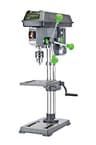
Genesis GDP1005A 10-Inch 5-Speed Drill Press
A 5/8-inch chuck and a rack-and-pinion table crank at a ten-inch price. Those two features normally live on the 12-inch machines, and both change daily use: the bigger chuck swallows fat Forstner and hole-saw shanks, and a geared table crank means you set table height with a handle instead of wrestling a collar with one hand under a 50-pound head. The motor is the smallest here and the listing states no speeds at all.
Strengths
+5/8-inch chuck on a 10-inch machine, which is where the large-diameter bits that justify a drill press actually fit
+Rack-and-pinion table height adjustment by the listing's own wording - a crank, not a clamp collar you fight one-handed
+Table rotates a full 360 degrees as well as tilting 0 to 45, so it swings clear for long or awkward stock
Trade-offs
−4.1 amps is the smallest motor in this roundup, so expect it to bog in a deep hole in hardwood with a big bit - the exact job its 5/8-inch chuck invites
−The listing publishes no RPM figures whatsoever. It says "5 speed gear box" and leaves the actual speed range unstated, which on a machine bought for slow drilling is a real omission
−"5 speed gear box" also conflicts with the belt-and-pulley arrangement these machines normally use, and nothing on the listing clarifies which it is
−No spindle travel published, so the depth-per-pull limit is unknown before it arrives
Type
Benchtop drill press
In the set
Single tool
Material / build
Not listed
Key spec
10 in swing; 5 speeds (range not listed); 5/8 in chuck; 4.1 A motor
Best for
Best big chuck for the money
Worth knowing. The listing states a "4.1 amp induction motor for quiet, smooth performance", a "5 speed gear box", a "5/8\" chuck handles larger bits", a "Table rotates 360 and tilts 0-45", "Easy to use Rack-and-pinion table height adjustment" and an "Integrated work light to illuminate the drill press table". Part number GDP1005A, size field "10 Inch", product-info weight 52 pounds. No RPM range, no spindle travel and no table size is published - hence the nulls above.
Specs read from the product listing, on October 9, 2026. “Not listed” means the listing doesn’t state that figure.
The one with the safety feature nobody else lists. A bump-off switch is a paddle big enough to shut the machine down with a hip or a forearm, which is what you have available when both hands are holding a part that has started to spin. Add a tilting table that goes 45 degrees either way and an LED light, and this is the most thoughtfully equipped 10-inch machine here. Its listing is also the least forthcoming about numbers.
Strengths
+Bump-off switch - a large paddle you can hit with a hip or a forearm when both hands are occupied, which is exactly when you need it
+Table tilts 0 to 45 degrees left AND right by the listing's own wording, so angled holes do not depend on which side the work sits
+Laser alignment and an LED worklight, with the laser's own figures published (Class II, 0.83 mW maximum average radiant power) rather than left vague
Trade-offs
−Five belt-change speeds from 610 to 2800 RPM, not variable - and 2800 RPM is the lowest top speed here, which only matters for very small bits
−The listing publishes no spindle travel, no chuck capacity and no table size, so three of the four specs that decide a drill press purchase are simply absent
−Its product-info dimensions read 1 by 1 by 1 inch, an obvious placeholder, so there is no shipping weight to plan a bench around
−Priced level with machines that do publish their numbers, which is a lot of faith to extend
Type
Benchtop drill press
In the set
Single tool
Material / build
Not listed
Key spec
10 in swing; 5 speeds, 610-2800 RPM; spindle travel and chuck not listed
Best for
Best safety features
Worth knowing. The listing states a "POWERFUL 6.2 AMP INDUCTION MOTOR", a "5-SPEED SYSTEM - Take advantage of 5 speeds from 610 to 2800 RPM", a "LASER ALIGNMENT SYSTEM" with "Laser Class: II; Maximum Average Radiant Power: 0.83mW", an "ADJUSTABLE DEPTH STOP", "ADJUSTABLE TABLE HEIGHT", an "LED WORKLIGHT", a "BUMP-OFF SWITCH" and a "TILTING WORK SURFACE" with "0- to 45-degree left and right tilting". Part number DP9505-00. Spindle travel, chuck capacity, table size and weight are not published anywhere on the listing, and its product-info dimensions are a 1 by 1 by 1 inch placeholder - hence the nulls above.
Specs read from the product listing, on October 9, 2026. “Not listed” means the listing doesn’t state that figure.
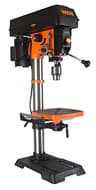
The only machine here that fixes the specification everyone ignores. Three and an eighth inches of spindle travel against two means you can bore through a thick leg, sink a deep hole for a dowel or run a hole saw without raising the table mid-cut — and the 5/8-inch chuck takes the fat shanks that big Forstner bits and hole saws arrive with. It is also 85 pounds of cast iron that needs a bench built for it.
Strengths
+3-1/8 inches of spindle travel by the listing's own figure, more than half again what every other machine here offers - this is the spec that changes what you can actually bore
+5/8-inch keyed chuck, so large Forstner bits and hole saws with heavy shanks fit without an adapter
+9-1/2 by 9-1/2 inch beveling table plus a stated table roller extension for long stock, which is the first table here big enough to be useful unmodified
Trade-offs
−85 pounds by the listing's bullets (its product-info block says about 88), so the bench has to be properly built before the machine arrives
−A 12-inch swing is a deep machine, and on a 24-inch bench it dominates the back edge
−Its stated slowest speed is 580 RPM against the 10-inch model's 530, so the biggest bits run marginally faster than on the cheaper machine - a small but real step backwards
−Still a mechanical variable-speed drive, not an electronic one, so expect the speed to sag under a heavy cut
Type
Benchtop drill press
In the set
Single tool
Material / build
Cast iron
Key spec
12 in swing; 3-1/8 in spindle travel; variable 580-3100 RPM; 5/8 in chuck
Best for
Best for depth and big bits
Worth knowing. The listing states "a 6.2-amp induction motor, a 12-inch swing, and a 3-1/8-inch spindle travel", variable speed "anywhere from 580 to 3100 RPM", a "digital speed readout", a size of "16.8 by 13.5 by 36.6 inches" with "a weight of 85 pounds", and a box containing "a class IIIA 2.5mW laser, overhead light, adjustable depth stop, table roller extension, beveling 9-1/2 by 9-1/2-inch work table, 5/8-inch capacity keyed chuck, a chuck key with onboard storage, and a two-year warranty". Part number DP1263V. The product-info block gives about 88 pounds; both figures are recorded. No runout figure is published.
Specs read from the product listing, on October 9, 2026. “Not listed” means the listing doesn’t state that figure.
#7Best if you have to move it
JET JWDP-10 10-Inch Benchtop Drill Press
The lightest machine here by a wide margin — 48 pounds against 57 to 85 — which sounds like a weakness and is often the opposite in a garage. A drill press you can lift onto a bench alone, or move when the car has to come in, is a drill press you will keep. You pay a brand premium for a JET and the listing is thin on specifications, so buy this one for the weight, the dealer network and the 630 to 3300 RPM range, not for a spec sheet win.
Strengths
+48.5 pounds by the listing's own figure - the only machine here one person can lift onto a bench without a second pair of hands
+A stated 630 to 3300 RPM across five speeds, the widest published range in this roundup
+JET sells through woodworking dealers rather than only online, so parts and a service conversation exist - which over a ten-year machine is worth real money
Trade-offs
−The most expensive 10-inch machine here, and the premium buys brand and support rather than capability
−The listing publishes no spindle travel, no chuck capacity and no table size, which is three of the four numbers you would want to compare
−Lighter means less mass to absorb vibration. Bolt it down - a 48-pound machine will walk on a bench top under a big bit far sooner than an 85-pound one
−The listing's own part-number field reads JWBS-10, which is a bandsaw designation, so the model had to be confirmed from the title and the feature bullets instead
Type
Benchtop drill press
In the set
Single tool
Material / build
Not listed
Key spec
10 in swing; 5 speeds, 630-3300 RPM; 48.5 lb; spindle travel not listed
Best for
Best if you have to move it
Worth knowing. The listing's title is "JWDP-10 JET 10\" DRILL PRESS (JT1-3162)" and its bullets state a "10 Inch Swing", a "630 to 3300 RPM Speed Range - Supports 5 optimized drilling speeds", that the "Table Tilts +/-45", "120V Operation" and "Only 48 lbs.", with a product-info weight of 48.5 pounds. Spindle travel, chuck capacity and table size are not published. The listing's manufacturer part-number field returns JWBS-10, a bandsaw model designation that contradicts its own title; the model written up here is taken from the title and the feature bullets, and the discrepancy is recorded rather than smoothed over.
Specs read from the product listing, on October 9, 2026. “Not listed” means the listing doesn’t state that figure.
Why the slowest speed matters more than the motor
This is the specification beginners skip and regret. A drill press earns its place in a wood shop on exactly the bits a cordless drill handles badly: Forstner bits that bore a flat-bottomed hole, large spade bits, and hole saws. All three are large in diameter, and diameter is what decides the right speed.
Which of those bits you need for a given hole is its own decision, and it is the one to settle before buying a machine — Forstner vs spade bits sets out what each cuts, and plenty of large holes do not need a press at all.
The reason is rim speed. The outer edge of a 2-inch bit travels roughly four times as far per revolution as the edge of a 1/2-inch bit, so at the same RPM it is cutting four times faster — and wood responds to being cut too fast by burning. A scorched hole is not cosmetic: the burnished surface will not take glue properly and the heat takes the temper out of a cheap bit. So the useful question about a drill press is not “how fast does it go?” but “how slow does it go?”
Among the machines here that publish a figure, the bottom ends run 530 RPM (the 10-inch WEN), 580 (the 12-inch WEN), 610 (the SKIL), 630 (the JET), 650 (the Bucktool) and 750 (the 8-inch WEN). The Genesis publishes no speed range at all, which on a machine bought largely for slow drilling is a genuine omission rather than a quibble. Notice the ordering: the cheapest machine has the highest floor, and the two variable-speed machines have the lowest — and that, not the swing number, is what the extra money buys.
It is also worth knowing that a variable-speed drive on a benchtop press is mechanical, not electronic, on every machine listed here. You are moving a variable-diameter pulley with a dial rather than changing the motor’s electrical speed, which is why the speed sags when a big bit loads up. It is still vastly better than opening the cover and moving a belt, because the honest truth about a belt-change machine is that most people set one speed and never change it again.
Spindle travel: the spec everyone ignores
Spindle travel — sometimes called quill stroke — is how far the chuck comes down in one pull of the handles. It is the hard cap on how deep a hole you can bore without stopping, raising the table and re-finding your mark, and re-finding your mark is precisely the repeatability you bought the machine for.
Six of the seven machines here give you two inches, or do not say. One gives you 3-1/8 inches: the 12-inch WEN. Two inches will bore through 3/4-inch stock all day and will handle a shelf-pin hole, a dowel hole and most hardware mortises. It will not get cleanly through a 2x4 laid flat, a thick table leg, or a stack of two boards, and it runs out just as a hole saw is getting started. If your project list is boxes, cabinets and shelves, two inches is fine. If it is benches, stools and anything with thick legs, that extra inch is the only upgrade on this page that changes what you can make.
The table is the problem, and the table is the fix
Every machine here arrives with a small cast-iron table with a hole in the middle. That table is a metalworking table. It is the right size to bolt a vise to and the wrong size for anything with wood grain in it: the 8-inch WEN’s is 6.5 inches square by its own listing, the 10-inch WEN’s is 8 by 7.5, and three listings do not say at all.
Two consequences follow, and both are fixable for very little money. The first is support: a cabinet side resting on a 6-inch table is cantilevered out into space and will tip as the bit bites. The second is breakout. A bit exiting through the hole in the middle of a cast-iron table has nothing supporting the fibers on the far face, so it blows a crater out of the show side — the same failure the straight-holes guide fixes with a sacrificial backer under a hand drill.
The fix is an auxiliary wooden table with a fence. You can buy one, or you can make one from 3/4-inch plywood in an afternoon — and unless you are buying the 12-inch machine, making one is the better value, because the bought kit below needs a 12-inch cast-iron table to bolt to and will not fit the cheap machines. A fence is the part that matters most: it is what turns “drill a hole roughly 1 inch from the edge” into a row of shelf-pin holes that all sit at exactly the same setback.
The four things to buy with it
Live prices, from the same feed as the cards above. The table and the vise are the two accessories that change what the machine can do; the two bit sets are the reason you wanted a drill press in the first place.
Tool
Why you need it
Price
POWERTEC 71539 Drill Press Table Kit, 14 x 24 in with T-Track Fence
Table, fence, stops and hold-downs in one box - but check the fit note, it needs a 12 in table to bolt to
Live Amazon prices as of October 21, 2026; they change, and we don’t display stale numbers — a tool with no live price shows “Check price” and is left out of the subtotal. #adHow we’re funded.
Three safety rules specific to this machine
A drill press feels tame next to a table saw and it is not. The hazard is different: nothing is coming at you, but a spinning bit can catch a workpiece and turn it into a propeller with your fingers in the arc.
Bolt it down. OSHA’s general machine-guarding standard is blunt about this: “Machines designed for a fixed location shall be securely anchored to prevent walking or moving.” That is 1910.212(b), and it exists because a top-heavy machine with a grabbing bit does walk. It matters most on the lightest machine here — the 48-pound JET — and it matters on all of them.
Clamp the work, never hold it. The same standard requires guarding that will “prevent the operator from having any part of his body in the danger zone during the operating cycle”, and on a drill press the practical form of that is a vise or a hold-down rather than your hand. The rule of thumb that keeps people whole: if the part is small enough that your fingers would be within a couple of inches of the bit, it goes in the vise. Round stock — a dowel, a knob, a length of closet rod — goes in the vise always, because a round part has nothing to resist rotation.
The chuck key never lives in the chuck. 1910.212(a)(1) names “rotating parts” and “flying chips” as hazards to be guarded against, and a chuck key left in a chuck when the motor starts is a steel projectile. Every machine here except the SKIL and the Genesis explicitly lists onboard key storage; use it. And roll your sleeves, lose the gloves and tie back long hair, for the same reason the safety gear page says to keep gloves away from spinning blades.
What a drill press will not fix
Two honest limits, because a new machine is a tempting answer to the wrong question.
It will not help you drill a hole in the middle of a panel. The “swing” number is twice the distance from the column to the center of the chuck, so an 8-inch machine reaches roughly 4 inches in from an edge and a 12-inch machine roughly 6. A shelf-pin row near an edge is in range; the middle of a cabinet back is not, and never will be. That job stays with a hand drill and a guide, as in the straight-holes guide.
And it will not square up your parts. If your boxes do not close, the problem is almost always that the parts were not square or not the same length before the holes went in — squaring up a board and the common beginner mistakes are both cheaper reading than a new machine.
The verdict
Buy the 8-inch WEN if you are buying your first drill press and are not sure how much you will use it. It bores a perpendicular hole as well as anything here, its 750 RPM floor is slow enough for the bits that matter, and the money you save covers the plywood table and the Forstner set that make it genuinely useful.
Buy the 10-inch WEN if you already know you will use it weekly. The speed dial and the digital readout change how you work — you set the speed to the bit instead of accepting the belt position you last used — and it is the cheapest route to a 530 RPM floor.
Buy the 12-inch WEN if your projects have thick parts in them. The 3-1/8-inch spindle travel is the only upgrade on this page that expands what you can physically bore, and the 9-1/2-inch square table is the only one you will not immediately want to replace.
And whatever you buy: bolt it to the bench, clamp the work, and keep the chuck key in its holder. The machine is only as accurate as the setup you put under it.
Frequently asked questions
Do I need a drill press for woodworking?+
No, not to start. A clamped workpiece, a brad point bit and two squares held against the drill get you close enough for almost everything a first shop builds, and that method costs nothing. A drill press earns its place when repeat accurate holes become the thing slowing you down - a row of shelf-pin holes at an identical setback, a stack of parts that all need the same hole in the same place, or large Forstner bits that a hand drill cannot steer or slow down enough.
What size drill press do I need for woodworking?+
A benchtop machine of 8 to 12 inches covers nearly all beginner woodworking. The swing number is twice the distance from the column to the center of the chuck, so an 8-inch machine reaches about 4 inches in from an edge and a 12-inch about 6 - and almost every hole a beginner drills is near an edge. Pay attention to spindle travel and table size instead: those two decide what you can actually bore and support.
What speed should a drill press run for wood?+
Slow for big bits, fast for small ones. Large Forstner bits, hole saws and spade bits burn the wood and dull themselves at high RPM because the rim of a wide bit travels much further per revolution than the rim of a narrow one, so the lowest speed a machine offers is the specification that matters most for wood. Among the machines on this page that publish a figure, the floors run from 530 to 750 RPM - and the cheapest machine has the highest floor.
Benchtop or floor-standing drill press for a home shop?+
Benchtop, for anyone working out of a garage. A floor model buys throat depth and spindle travel most woodworkers will not use for years, and it claims a permanent footprint in a space that usually still has a car in it. A benchtop press can share the end of a workbench, and the lightest machines here can be lifted onto a bench by one person and put away.
What is spindle travel and how much do I need?+
Spindle travel is how far the chuck descends in a single pull of the handles, and it caps how deep you can bore without stopping to raise the table and re-find your mark. Two inches - which is what most benchtop machines offer - handles 3/4-inch stock, shelf pins, dowels and hardware mortises. Thick table legs, a 2x4 laid flat, or anything a hole saw is cutting want more, and only one machine on this page offers it at 3-1/8 inches.
Do I need a drill press table and fence?+
Effectively yes, though you can make one. The cast-iron table a drill press ships with is sized for a metalworking vise, which means it does not support a wide workpiece and offers nothing behind the hole to stop the bit blowing out the far face. A plywood auxiliary table with a hardwood fence solves both for the cost of a scrap, and the fence is what makes repeat holes repeatable. Bought kits generally need a 12-inch cast-iron table to bolt to, so check the fit before ordering one for a small machine.
Is a drill press safe to use?+
It is safe when the work is clamped and the machine is anchored, and genuinely dangerous when neither is true. OSHA's general machine-guarding standard requires that machines designed for a fixed location be securely anchored to prevent walking or moving, and that guarding prevent any part of the body entering the danger zone. In a home shop that means bolting the press to the bench, holding small and round parts in a vise rather than your fingers, keeping the chuck key in its holder, and not wearing gloves or loose sleeves near the spindle.
Sources
OSHA — 1910.212, General requirements for all machines — The general machine-guarding standard, which is what applies to a drill press — 1910.213 covers woodworking machinery and does not list one. (a)(1): "One or more methods of machine guarding shall be provided to protect the operator and other employees in the machine area from hazards such as those created by point of operation, ingoing nip points, rotating parts, flying chips and sparks." (a)(3)(ii): "The point of operation of machines whose operation exposes an employee to injury, shall be guarded. The guarding device shall be in conformity with any appropriate standards therefor, or, in the absence of applicable specific standards, shall be so designed and constructed as to prevent the operator from having any part of his body in the danger zone during the operating cycle." (b), Anchoring fixed machinery: "Machines designed for a fixed location shall be securely anchored to prevent walking or moving." (accessed October 9, 2026)
OSHA — Woodworking eTool — OSHA guidance on woodworking hazards, guarding and safe work practices (accessed July 24, 2026)