Buying Used Woodworking Tools
Which tools are a bargain second-hand, which are a trap, and the two-minute inspection that tells you which one you are holding.
How this is funded: we earn a commission if you buy through our links, at no extra cost to you. It never changes which tool we recommend, and we’ll tell you plainly when to skip one. Full disclosure.
Woodworking is unusual among hobbies in that a great deal of its equipment genuinely does not wear out. A hand plane made in 1955 has one moving part and no electronics. A chisel is a piece of steel. A cast-iron machine body is essentially permanent. Which means the second-hand market here is not the compromise it is in most hobbies — it is frequently the better buy.
It is also full of traps, and beginners fall into the same three every time: paying antique-shop prices for a common tool, buying a cracked casting because the rust hid it, and buying a power tool whose guard is missing. This page is the whole decision — what is worth buying used, what never is, and the two-minute inspection that separates them while you are standing in someone else’s driveway.
The one-line rule
Buy used when the tool has nothing in it that can wear out. Buy new when it has a motor, a battery or a bearing.
Almost every specific case below is that sentence applied. A plane has no bearings; a random orbital sander is essentially a bearing with a handle. A chisel cannot degrade in a drawer; a lithium battery degrades whether it is used or not.
What is genuinely worth buying used
- Hand planes. The single best used buy in woodworking. Old bench planes are common, often excellent, and frequently sell for a quarter of what an equivalent new one costs. The irons in older planes are usually good steel, and every part that commonly fails is replaceable.
- Chisels. Old chisels are almost always good, and often better than modern budget ones. The only thing that kills a chisel is running out of length, and most used ones have decades left.
- Marking and layout tools. Marking gauges, mortise gauges, dividers, bevel gauges and old combination squares. Nothing to fail, and often beautifully made.
- Cast-iron machines. Older table saws, bandsaws, drill presses and jointers were built with far more iron than modern ones. Bearings and belts are consumables you can replace. This is the one power-tool category where used can be a genuine bargain — with the safety caveat below.
- Vises and clamps. A cast-iron vise or a steel bar clamp is essentially indestructible, and both are expensive new. Buy every decent used clamp you find.
- Hand saws, with a condition. A traditional saw with sharpenable teeth is an excellent buy if you can sharpen it or will pay to have it done. If you cannot, a saw that needs re-toothing is a project you will not finish.
- Mallets, braces, spokeshaves, scrapers. All cheap, all durable, all commonly found for very little.
What is not worth buying used
- Anything cordless. The batteries are most of what you are paying for and they lose capacity with age regardless of use. A used cordless kit is a gamble on the single most expensive consumable in the box. Our battery platform guide explains why the battery, not the tool, is the purchase.
- Sanders. Fine dust is corrosive to bearings and gets everywhere. A used random orbital sander has usually had a hard, dusty life for the sake of saving twenty dollars.
- Routers, unless very cheap. Bearings and collets take the abuse and both are critical. If the bearings rumble, walk away.
- Cheap plastic-bodied tools. A used budget jigsaw costs almost what a new one does, and comes with no warranty and unknown history.
- Anything with a missing guard. Non-negotiable. See below.
- Kinked saws. A bend can be corrected; a kink — a sharp crease in the plate — cannot be reliably straightened, and the saw will never track a line.
The safety rule that overrides everything
Never buy a power tool with a guard removed, missing, broken or tied back. Not to fix later. Not because it was cheap. Walk away.
There are two reasons. The first is direct: guarding on woodworking machinery is the subject of its own federal standard, OSHA 1910.213, precisely because the injuries these machines cause without it are catastrophic and permanent. Retrofitting a correct guard to an old machine is often difficult and sometimes impossible.
The second is diagnostic. A missing guard tells you how the previous owner worked, and therefore how everything else on that machine was treated. If the blade guard is gone, so is the riving knife, and probably the manual, and probably any maintenance. Whatever else you are buying, you are also buying their habits.
The same applies to a frayed cord, a defeated safety switch, or a plug with the earth pin removed. Our shop safety basics page covers why these are not details.
Inspecting a hand plane
Two minutes, in this order. The first check is the only one that can be fatal.
- Look for cracks. Cast iron cracks, and a cracked body cannot be trusted. Check across the mouth (the slot the iron comes through), the base of both sidewalls, and around the frog seating inside. Rust and old paint hide hairline cracks — run a thumbnail along suspicious lines, and hold it up to the light. A crack means put it down, whatever the price.
- Check the iron has life left. Pull the iron out. There should be plenty of length above the slot. Then look at the flat back within an inch of the edge: deep pitting there is the deal-breaker, because you cannot sharpen past it and the back must be flat to take an edge. Replacement irons are available for common planes but they are not free.
- Work the adjusters. The depth adjuster should turn through its range. Some backlash is completely normal on old planes and is not a fault. The lateral lever should move side to side without force.
- Check the parts belong together. Mismatched frogs, lever caps and irons from different planes are extremely common in flea market bins and often will not seat properly. If a part looks like a different color, finish or era from the rest, be suspicious.
- Ignore the cosmetics. Surface rust, chipped japanning, a cracked or replaced tote, and a blunt iron are all normal and all fixable. So, usually, is the sole — our plane sole guide covers how much flatness genuinely matters, which is less than the internet claims.
Inspecting a chisel
- How much steel is left? Compare the blade length against a new chisel of the same size. A chisel sharpened down to a stub has little working life and, more practically, the bevel gets awkward as the blade shortens.
- Pitting on the back, near the edge. The single most important check. The back of a chisel must be flat and polished within half an inch of the edge, and pits there cannot be removed without grinding the whole edge back past them. Rust elsewhere on the blade is cosmetic.
- Chips and dings. Not a problem in themselves — they grind out. A large chip simply costs you a fraction of an inch of length, which brings you back to check one.
- Handles. A mushroomed, split or missing handle is a non-issue. Wooden handles are replaceable and turning a new one is a nice small project.
Inspecting squares and layout tools
One test, and it takes ten seconds. Hold the square against a straight edge and draw a line. Flip the square over, register it on the same edge at the same point, and draw a second line. If the two lines are not exactly on top of each other, the square is not square, and any error is doubled by the flip so it becomes obvious.
A square that fails this test is decoration. It does not matter who made it or how nice it looks — every joint you lay out with it will be wrong. Our squares roundup covers what a good new one costs, which is not much.
Inspecting a cast-iron machine
This is where the biggest savings and the biggest risks both live.
- Ask to hear it run. Non-negotiable. A motor that hums, trips a breaker, smells hot or takes several seconds to reach speed is a motor with a problem. Bearings should be a smooth whirr, not a rumble or a grind.
- Spin everything by hand with the power off. Arbors, wheels and shafts should turn freely and quietly with no side-to-side play.
- Surface rust versus pitting. Rust on a cast-iron table wipes off with abrasive and a rust remover, then waxes over. Pitting is missing metal and is permanent — on a table surface it will catch workpieces forever.
- The fence and the trunnions. On a table saw, the fence is most of the tool. A fence that will not lock parallel makes the saw close to useless, and replacements are expensive. Check that the blade tilts and raises smoothly through the whole range.
- The complete guard set. Blade guard, riving knife or splitter, anti-kickback pawls. All present, all working. See the safety rule above.
- Power requirements. Old industrial machines are often three phase or 240 volt. Check what it needs before you agree a price, not after you have it in the car.
What to pay
There is no universal price list, and anyone who gives you one is guessing — used prices vary enormously by region, by season and by how motivated the seller is. What does work is a method:
- Look up the new price first. On your phone, standing there. Every roundup on this site shows a live price for exactly this reason.
- Add up the rehab. Replacement iron, new handle, rust remover, your evening. Some of these are cheap; an evening is not free.
- Compare against new, honestly. If used plus rehab lands above about two-thirds of new, buy new — you get a warranty, a known quantity, and your evening back.
The corollary matters as much: a used tool is only a bargain if the equivalent new tool is expensive. Saving 40 percent on something that costs very little new is not a win, and this is where beginners lose the most time.
The three that are usually cheaper new
These are common flea market items and, at current new prices, are rarely worth the hunt, the rust or the uncertainty.
| Tool | Why you need it | Price |
|---|---|---|
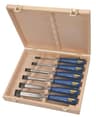 | A full new bench set, sharp-ready, with no pitting to grind out. Old chisels are good; a matched set of unknown ones is a project. | $69.99 |
 | New block planes are cheap enough that a rusted one with a mismatched cap is not a saving. | $42.98 |
 | The tool that makes every used edge tool usable. Buy this new whatever else you buy second-hand. | $16.99 |
| Starter kit subtotal | $129.96 | |
Live Amazon prices as of October 21, 2026; they change, and we don’t display stale numbers — a tool with no live price shows “Check price” and is left out of the subtotal. #ad How we’re funded.
Note the last one especially. Every second-hand edge tool you buy arrives blunt, and a sharpening setup is what converts a rusty bargain into a working tool. If you are going to buy used at all, own the means to sharpen first — our sharpening kit roundup covers the whole setup, and sharpening a plane iron covers the plane-specific part.
Where to look, ranked honestly
- Estate sales. Usually the best combination of quality and price. An entire shop is being cleared by people who want it gone, and hand tools are frequently priced as a job lot. Go early for selection, go late for price.
- Facebook Marketplace and local classifieds. The most volume, and the widest range of both prices and honesty. Search for the specific tool rather than browsing, and be ready to travel.
- Garage and yard sales. Hit and miss, occasionally extraordinary. This is where tools are priced by someone who does not know what they are.
- Dedicated tool auctions and tool meets. The best selection and the most knowledgeable competition, so prices are fair rather than cheap. A good place to learn what things are actually worth.
- Antique shops and flea markets. Generally the worst value. Hand planes here are priced as decoration, not as tools, and are often bought as such.
- Family and neighbors. Genuinely the most overlooked source. A surprising number of garages contain a grandfather’s tools that nobody has a use for. Ask.
The rehab, realistically
Assume every used edge tool needs sharpening before it will cut — that is normal, not a fault. Beyond that:
- Rust removal: abrasive pads and oil for light surface rust, a soak in a proprietary rust remover for heavier work. Finish by waxing bare metal so it does not immediately start again.
- Wear eye protection while you do it. Wire wheels throw bristles, and abrasive and rust flakes go straight for your eyes — the American Academy of Ophthalmology puts workshop eye injuries firmly in the preventable category.
- Do not overdo it. A tool does not need to look new. Cleaning off active rust and waxing is the job; polishing a plane back to a mirror is a hobby in itself and buys you nothing at the bench.
The takeaway
Buy used where nothing can wear out: planes, chisels, layout tools, vises, clamps, cast iron. Buy new where something can: batteries, bearings, motors, and anything cheap enough that the hunt is not worth your evening. Check for cracks first, then for pitting on the working surfaces, then everything else. And walk away from any machine whose guards are missing, at any price.
Do that and the second-hand market becomes what it should be for a beginner: the way a modest budget gets tools that are better than new ones at the same money. If you would rather buy everything new and be done, our tools under $100 guide builds the same shop out of the box.
Used is one of four places to buy, and each tool has a place that suits it best. Where to buy woodworking tools covers online against the home center against a specialist dealer against the second-hand market — including the three tools you should never buy sight unseen, which is the flip side of everything on this page.
One safety note. Power tools deserve respect, not fear. Read the manual, keep the guards on, wear ANSI-rated eye protection every time, and never rush a cut. When something feels wrong, stop and reset — there is no deadline in a home shop.
Frequently asked questions
Are used woodworking tools worth buying?
For hand tools, very often yes. A hand plane, a chisel, a marking gauge or a cast-iron machine has almost nothing in it to wear out, and the steel in a mid-century plane iron is frequently better than what a budget plane ships with today. For anything with a motor, a battery or a bearing, the calculation flips — you are buying an unknown remaining life at a price that is rarely low enough to justify it.
What should I never buy used?
Cordless tools, because the batteries are most of the value and they degrade whether they are used or not. Anything with a guard removed, missing or tied back, because that is both a hazard and a sign of how the previous owner worked. Cheap plastic-bodied tools, where a used one costs nearly as much as a new one. And any saw with a kinked plate, which cannot be reliably straightened.
How do I check a used hand plane?
Look for cracks first — most importantly across the mouth, at the base of the sidewalls, and around the frog seating. A crack in the casting is the one fault that makes a plane firewood. After that, check the iron has plenty of length left and no deep pitting on its flat back near the edge, that the depth adjuster and lateral lever move, and that the frog and lever cap actually belong to the plane. Rust, chipped japanning, a cracked handle and a dull iron are all easy fixes.
Is surface rust a problem?
Surface rust is cosmetic and comes off with abrasive, a rust remover, or an evening of work. Pitting is different — that is metal that has already gone, and it is permanent. Pitting matters enormously in one specific place: the flat back of a chisel or plane iron within an inch of the cutting edge, because you cannot sharpen past it. Pitting on a plane body or the side of a chisel is only ugly.
Where is the best place to buy used woodworking tools?
Estate sales tend to have the best combination of quality and price, because a whole shop is being sold at once by people who mostly want it gone. Facebook Marketplace has the volume and the widest price range. Flea markets and antique shops carry hand tools priced as decor, which is usually the worst value. Dedicated tool auctions have the best selection and the most competition. Wherever you buy, assume no returns and inspect accordingly.
Sources
- OSHA — Woodworking eTool — OSHA guidance on woodworking hazards, guarding and safe work practices (accessed July 24, 2026)
- OSHA — 1910.213, Woodworking machinery requirements — The federal standard for guarding on saws, routers and other woodworking machines (accessed July 24, 2026)
- American Academy of Ophthalmology — Home workshop eye safety — AAO guidance on protecting your eyes with power and hand tools at home (accessed July 24, 2026)
Keep reading
Where to buy woodworking tools
Online, home center, specialist or second-hand - which tools belong in which channel.
Read the guideBest hand planes for beginners
What a new one costs, so you know whether the used one in front of you is actually a bargain.
See the plane picksHow to flatten a plane sole
The main rehab job on a second-hand plane, with an honest account of when it is worth doing.
Read the guideHow to sharpen a hand plane iron
Every used edge tool arrives blunt. This is how you fix that in twenty minutes.
Read the guideBest chisels for beginners
The new-price benchmark for the most commonly bought second-hand tool there is.
See the chisel picksBest woodworking tools under $100
The complete first kit at the budget end — the other route to a cheap shop.
See the budget picksWoodworking tool brands explained
Which names on an old tool mean something, and where the brand stops mattering.
Read the guide