Nobody gets excited about a marking gauge. But if you handed a beginner $60 and asked what would most improve their work, the honest answer is not a better saw or a better chisel — it is the six inexpensive tools on this page. Almost every joint that does not fit failed at layout, not at the cut. You cannot saw accurately to a line that was never accurate.
Here is the lens we compare on. How fine a line it leaves— a sharp pencil line is roughly half a millimeter wide, and you still have to choose which side of it to cut to; a knife line has no width at all. Whether it repeats— can you set it once and mark the same distance forty times identically? Whether it registers against an edge, which is what removes human wobble. And whether a beginner will actually use it, because a tool that takes three minutes to set gets skipped.
None of these is expensive. Together they cost less than one mid-range power tool, and they are the difference between joinery that closes up and joinery that has gaps you fill with glue and hope.
How this is funded: we earn a commission if you buy through our links, at no extra cost to you. It never changes which tool we recommend, and we’ll tell you plainly when to skip one. Full disclosure.
Quick picks
Ranked on the specs that matter for a beginner and honest buyer fit. Select a row to jump to the full write-up. We haven’t hands-on-tested these — here is exactly what we do instead.
#
Product
Best for
Price
1
Clarke Brothers Wheel Marking Gauge Kit
A marking gauge scribes a line a set distance from an edge, over and over, identically. That is the entire trick behind joints that fit: you are not measuring twice, you are marking once and cutting to the same line every time.
The single cheapest upgrade to your accuracy. A pencil line is about a millimeter wide and you have to choose which side to cut; a knife line is a zero-width groove your chisel or saw physically drops into.
Stanley PowerLock II 33-425 Tape Measure, 1 in x 25 ft
The tape that has been in every toolbox for fifty years, and still the safest default. A Mylar-coated blade, a three-rivet hook rated by the listing for inside and outside measurements, and a lock that holds. It is a construction tape - the stud markings and the lack of any write-on surface say so - but it is a very good one, and it is the tape every other tape gets compared to.
The workhorse layout square: a cast zinc head on a 12-inch stainless rule that works as a try square, miter square, depth gauge and straightedge. The beginner-friendly price makes it the one to learn on before spending Starrett money.
For the measurements a tape measure genuinely cannot do: actual board thickness, the real diameter of a drill bit, whether that "3/4 inch" plywood is 23/32. Cheap, and it settles arguments instantly.
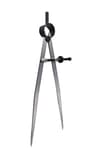
The old-fashioned answer to "divide this board into five equal parts" — no arithmetic, no rounding errors, no 3.7 inches. Dividers step off equal spaces directly on the work, and they cost less than a takeaway coffee.
A marking gauge scribes a line a set distance from an edge, over and over, identically. That is the entire trick behind joints that fit: you are not measuring twice, you are marking once and cutting to the same line every time.
Strengths
+Cutting wheel severs wood fibers instead of tearing them, so the line stays crisp across the grain
+Graduated inch and mm scale on the bar for quick setting
+Ships with two spare cutters — the wear part is covered from day one
Trade-offs
−The wheel wants a light touch; press hard and it follows grain instead of your setting
−Round bar can roll on the bench (a fence-style gauge will not)
Type
Wheel marking gauge
In the set
Single tool
Material / build
Solid metal bar, hardened cutting wheel
Key spec
Graduated inch + mm bar, 2 spare cutters
Best for
Repeatable layout lines for joinery
Worth knowing. Wheel gauges beat old pin gauges for beginners because a pin drags along the grain and wanders. A wheel cuts a clean severed line that a chisel or saw can drop straight into.
Specs read from the product listing, on August 11, 2026. “Not listed” means the listing doesn’t state that figure.
#2Biggest accuracy upgrade
Narex 822302 Dual Double-Bevel Marking Knife
The single cheapest upgrade to your accuracy. A pencil line is about a millimeter wide and you have to choose which side to cut; a knife line is a zero-width groove your chisel or saw physically drops into.
Strengths
+Mn-V steel hardened to a listed HRc 61 — it holds a keen point
+Double-bevel grind works from either side, so one knife covers both hands and both directions
+Thin blade reaches into corners a pencil cannot
Trade-offs
−A knife line is permanent — mismark and you are sanding or re-cutting
−Double bevel is slightly less precise against a square than a single-bevel knife
Type
Marking knife
In the set
Single tool
Material / build
Hardened Mn-V steel, wooden handle
Key spec
Double bevel, HRc 61 listed
Best for
Accurate joinery layout
Worth knowing. The technique that makes this pay: knife the line, then pare a tiny V-groove on the waste side with a chisel. Your saw or chisel now has a physical wall to register against and simply cannot start in the wrong place.
Specs read from the product listing, on August 11, 2026. “Not listed” means the listing doesn’t state that figure.
#3Best tape measure
Stanley PowerLock II 33-425 Tape Measure, 1 in x 25 ft
The tape that has been in every toolbox for fifty years, and still the safest default. A Mylar-coated blade, a three-rivet hook rated by the listing for inside and outside measurements, and a lock that holds. It is a construction tape - the stud markings and the lack of any write-on surface say so - but it is a very good one, and it is the tape every other tape gets compared to.
Strengths
+Three-rivet corrosion-resistant hook described by the listing as giving accurate inside AND outside measurements - the true-zero design working as intended
+Mylar-coated blade, which is what has kept this tape's printing legible in toolboxes for decades
+A secure lock the listing says "helps prevent blade from creeping during use" - the failure mode that ruins a one-person measurement
+The Tru-Zero hook doubles as a pivot for drawing circles and arcs, per the listing, which is a genuinely handy shop trick
Trade-offs
−A framing tape at heart: the 16 inch and 19.2 inch stud center markings the listing advertises are print you read past on every woodworking measurement
−No write-on surface anywhere on the case or blade, so the number has to survive the walk to the saw in your head
−The scale reads one way only - there is no reverse or dual-direction printing, which is the wrong orientation for measuring a part on a bench
−The listing publishes no graduation interval and no standout figure, so neither can be confirmed before it arrives
Type
Tape measure
In the set
Single tool
Material / build
Mylar-coated steel blade, chrome ABS case
Key spec
25 ft; 1 in blade; secure blade lock; stud markings at 16 and 19.2 in
Best for
The measuring tool you buy first
Worth knowing. The listing states a "Secure lock helps prevent blade from creeping during use", "16\" and 19.2\" stud center markings", a "Special Tru-Zero hook" that "does double-duty as a pivot for drawing circles and arcs", a "Three-rivet, corrosion-resistant hook for accurate inside/outside measurements" and a "Mylar coated blade for extra durability". Title "Stanley 33425 Powerlock II Power Return Rule, 1-Inch x 25ft, Chrome ABS/Yellow", part number 33-425, product-info weight about 0.86 pounds. The listing's brand field reads Bostitch rather than Stanley - both are Stanley Black & Decker marques, and the model is confirmed from the title and the 33-425 part number. Availability and a live price were re-confirmed on October 9, 2026. No graduation interval, no standout and no accuracy class is published.
Specs read from the product listing, on October 9, 2026. “Not listed” means the listing doesn’t state that figure.
#4Best combination square
Swanson TC132 12-Inch Combination Square
The workhorse layout square: a cast zinc head on a 12-inch stainless rule that works as a try square, miter square, depth gauge and straightedge. The beginner-friendly price makes it the one to learn on before spending Starrett money.
Strengths
+One tool that works as a try square, miter square, depth gauge and straightedge
+Stainless rule with etched graduations down to 1/32 in, plus metric
+Brass lock hardware, a level vial, and a steel scriber stored in the handle
Trade-offs
−No accuracy tolerance is published — check it with the flip test before trusting it
−One-year warranty, shorter than the lifetime cover some rival squares carry
Worth knowing. A combination square is the layout tool you'll use on every project. Buy the affordable one now, verify it's square (draw a line, flip the head, draw again — the lines should overlap), and upgrade only if you find it lacking.
Specs read from the product listing, on September 10, 2026. “Not listed” means the listing doesn’t state that figure.
#5Best for real thicknesses
Neiko 01401A 6-Inch Electronic Digital Caliper
For the measurements a tape measure genuinely cannot do: actual board thickness, the real diameter of a drill bit, whether that "3/4 inch" plywood is 23/32. Cheap, and it settles arguments instantly.
Strengths
+One button switches between inch, fraction and millimeter — no mental conversion
+Two sets of jaws plus a depth probe cover inside, outside, depth and step measurements
+Extra-large LCD is readable in a dim garage
Trade-offs
−Battery-powered: it will be flat the day you need it unless you keep a spare
−Listed accuracy is 0.001 in — plenty for wood, not a machinist's metrology tool
Type
Digital caliper
In the set
Single tool
Material / build
Polished, hardened stainless steel
Key spec
0-6 in / 0-150 mm, 0.001 in accuracy, inch / fraction / mm
Best for
Measuring thickness, diameters and real plywood sizes
Worth knowing. The plywood thing is not a joke: nominal 3/4 in sheet goods usually measure about 23/32 in. If you cut dados to 3/4 in, your plywood rattles in them. A caliper is how you stop that happening twice.
Specs read from the product listing, on September 29, 2026. “Not listed” means the listing doesn’t state that figure.
#6Best cheap layout tool
ZLKSKER 8 in Lockable Steel Wing Divider
The old-fashioned answer to "divide this board into five equal parts" — no arithmetic, no rounding errors, no 3.7 inches. Dividers step off equal spaces directly on the work, and they cost less than a takeaway coffee.
Strengths
+Locking wing holds a setting through repeated stepping
+Solves equal-division problems that produce ugly fractions on a tape measure
+Also scribes arcs and circles for curved work
Trade-offs
−Sharp points will scratch a finished surface — mark before you finish, not after
−Budget build: the adjuster thread is coarse, so very fine settings take patience
Type
Wing dividers
In the set
Single tool
Material / build
Steel
Key spec
8 in, lockable wing
Best for
Stepping off equal spacings and scribing circles
Worth knowing. Dividers are how dovetails were laid out for centuries before anyone owned a calculator. Set them by trial, walk them across the board, adjust, repeat — three tries and the spacing is exact.
Specs read from the product listing, on August 11, 2026. “Not listed” means the listing doesn’t state that figure.
Why a knife beats a pencil
This is the single idea that changes a beginner’s accuracy. A pencil line has width. When you cut “to the line” you are already choosing between three possible positions — on it, beside it, or through it — and across a joint with four shoulders that error compounds.
A knife line has no width. Better than that, it is a physical groove. Pare a shallow V on the waste side with a chisel and your saw or chisel now has a wall it can register against — the tool literally cannot start in the wrong place. This is why hand-tool woodworkers talk about “knifing a line” as if it were a technique rather than a marking preference. It is a technique, and it takes about ten seconds to learn.
Use a pencil for rough layout and cut lists. Use a knife everywhere a joint has to close.
Measure less, transfer more
The second habit worth building early: stop measuring things twice. Rather than reading a tape measure at one board and then reading it again at another, hold the actual parts together and mark directly. Set a marking gauge from the real thickness of the real board. Step off five equal spaces with dividers instead of dividing 13-7/8 by five.
Every measurement is an opportunity to misread a number, and every misread number is a joint that does not close. Direct transfer removes the arithmetic entirely, which is exactly why woodworkers were doing it long before anyone owned a calculator.
None of which helps if the tape itself is the part you find difficult. How to read a tape measure covers reading to a sixteenth by halving rather than counting, why the hook is supposed to slide, and what the black diamonds are for. And if the tape is the tool you want to upgrade, the tape measure roundup compares eight of them on the bench features — no-play hooks, reverse scales, write-on surfaces — that jobsite tapes do not have.
The plywood problem
Here is a specific trap that catches nearly everyone once. Sheet goods sold as “3/4 inch” plywood usually measure closer to 23/32 of an inch. If you cut a dado exactly 3/4 inch wide, the plywood rattles around inside it. If you measure the sheet first with a caliper and cut the dado to match, it fits.
This is why a cheap digital caliper earns its place: it tells you what you actually have rather than what the label claims. Wood moves with moisture too, so even solid stock is rarely the nominal dimension — the same material behavior that makes seasonal movement a real design consideration.
Square is not optional
A combination square does three jobs at once: it checks 90 and 45 degrees, it marks lines square to an edge, and its sliding rule sets depths. It is the tool you will pick up more than any other on this page. If you already have one from our squares roundup, you are covered — and if you do not, that page explains which type does what and when precision genuinely matters. For the tool itself, how to use a combination square covers the depth-gauge and center-finding setups most people never discover.
One check worth doing the day it arrives: mark a line square from a known straight edge, flip the square over, and mark again from the same point. If the two lines diverge, the square is not square. Budget squares occasionally are not, and it is far better to find out now than in the middle of a project.
Frequently asked questions
What marking and measuring tools does a beginner actually need?+
Four: a tape measure for rough sizing, a combination square for squareness and short measurements, a marking knife for lines that joints will be cut to, and a marking gauge for repeatable distances from an edge. Dividers and a digital caliper are cheap additions that solve specific problems well.
Why use a marking knife instead of a pencil?+
A pencil line is roughly half a millimeter wide, so 'cutting to the line' is ambiguous. A knife line has no width and is a physical groove — pare a small V on the waste side and your chisel or saw registers against that wall, so the cut physically cannot start in the wrong place.
What does a marking gauge do?+
It scribes a line a fixed distance from an edge, repeatably. Set it once from the actual thickness of your workpiece and every piece gets the identical line — which is how mortise-and-tenon and dovetail shoulders end up matching without measuring each one.
Do I need a digital caliper for woodworking?+
Not strictly, but it is cheap and it settles real questions: the true thickness of 'three-quarter inch' plywood (usually about 23/32), the actual diameter of a drill bit, or whether two parts match. Wood moves with humidity, so caliper readings are a snapshot, not a permanent truth.
How do I check whether my square is actually square?+
Butt it against a known straight edge and draw a line. Flip the square over, register from the same point, and draw again. If the two lines lie on top of each other the square is true; if they form a narrow V, it is not — and no amount of careful marking will fix that.