Where to Buy Woodworking Tools
Online, home center, specialist dealer or second-hand — which tools to buy where, and the three you should never buy sight unseen.
How this is funded: we earn a commission if you buy through our links, at no extra cost to you. It never changes which tool we recommend, and we’ll tell you plainly when to skip one. Full disclosure.
There are five places a beginner can buy woodworking tools, and each one is genuinely the best answer for something. The mistake is not choosing the wrong shop — it is using one shop for everything, which means overpaying on some things and buying blind on others.
Here is what each channel is actually good at, which tools belong in each, and the short list of purchases where buying unseen is a bad idea whatever the price says.
1. Online marketplaces
Best for: branded consumables, commodity hand tools, and anything where you already know exactly what you want.
The advantage is not really price, it is identifiability. When you can name the item — a specific blade, a specific chisel set, a specific bit — buying online is fast, well-priced, and the reviews will tell you about the failure modes that a shop assistant will not. Consumables in particular are hard to beat: sandpaper, saw blades, router bits, glue, drill bits.
The disadvantage is that you cannot feel it, and for a beginner “feels right” is doing real work. You also cannot inspect a square for square, which matters more than anything else on this page.
These three are the safest possible unseen purchases — standardized, consistent, and impossible to get wrong once you have the model number:
| Tool | Why you need it | Price |
|---|---|---|
 | A saw blade is a spec, not a feel. Diameter, tooth count and arbor size fully describe it. | $17.49 |
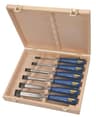 | Same set in every shop in the world, and the beginner benchmark for a reason. | $69.99 |
 | Consumables are where online genuinely wins. Buy the 50-pack; you will use it. | Check price |
| Starter kit subtotal (2 of 3 items with a live price) | $87.48 | |
Live Amazon prices as of October 21, 2026; they change, and we don’t display stale numbers — a tool with no live price shows “Check price” and is left out of the subtotal. #ad How we’re funded.
2. The home center
Best for: lumber, clamps, fasteners, safety gear, and the thing you need in the next twenty minutes.
Home centers are aimed at construction rather than furniture, so their tool selection is broad and shallow: plenty of drills and circular saws, very few chisels worth owning. But two things make them indispensable to a beginner.
First, the lumber. Home center boards are kiln-dried, dressed on four sides, and sold in lengths you can get in a car. They cost more per board foot than a real lumberyard and they are worth it until you own something that can flatten rough stock. Our home center lumber guide covers picking straight boards off a bad rack.
Second, immediacy. Running out of screws at 4pm on a Sunday is not a reason to abandon a project. Clamps, fasteners, glue, sandpaper, eye protection and blades are all worth buying locally at a small premium just to keep moving.
3. Specialist woodworking dealers
Best for: hand tools you want to hold first, hardwood, and advice from someone who actually woodworks.
The specialist retailers — Rockler, Woodcraft, Lee Valley, Highland Woodworking and the regional independents — stock things a home center never will: bench planes, marking gauges, dovetail saws, hardware, real hardwood. Prices are higher than online, sometimes noticeably.
What you are buying is curation and hands-on time. Being able to pick up three block planes and feel the difference is worth an afternoon early on. So is being able to ask a genuine question and get a genuine answer, which is not something a marketplace listing can provide.
Use them for the tools where fit and feel matter — planes, saws, marking tools, anything with a handle you will hold for hours — and for hardwood in small quantities. Our hand plane guide and marking and measuring guide cover what to look at when you get there.
4. Second-hand: marketplaces, estate sales, car boot
Best for: hand planes, chisels, cast iron machinery, clamps, and anything where age is not a fault.
This is where the real money is saved, and it is also where a beginner is most likely to buy a problem. The dividing line is simple: things that were made well and have no consumable parts age brilliantly. A pre-war hand plane with surface rust is a good buy; a five-year-old cordless drill with an unknown battery is not.
Clamps are the sleeper category. Nobody sells clamps as a collectible, they cannot really wear out, and you will always want more of them — buying used is the cheapest route to owning enough. Our full guide to buying used woodworking tools covers the two-minute inspection for each category.
5. Auctions and business liquidations
Best for: machinery, at real risk.
A closing cabinet shop is where the genuinely cheap machinery is, and it is also the least beginner-friendly channel there is. Lots are sold as seen, removal is your problem, a three-phase motor is useless in a garage, and you are bidding against people who have done this before.
Worth watching once you know exactly what you are looking for and can lift it. Not worth attending in month one.
Which channel for which tool
- Measuring and marking — specialist or in person. A square that is not square is worse than no square, and you can only check that by holding it.
- Chisels and planes — specialist to try, online or used to buy. Feel first, then decide how much to pay for it.
- Clamps — used first, home center second. Buy every decent used clamp you see.
- Power tools — online or home center. Watch the battery platform, not the tool.
- Consumables — online, in bulk. Blades, discs, bits, glue.
- Lumber — home center now, lumberyard later.
- Safety gear — anywhere, immediately, before the tool that needs it.
Three things not to buy sight unseen
- A square. Accuracy is the entire product. Check it in the shop by marking a line against one edge, flipping the square, and marking again from the same point — the two lines must sit on top of each other.
- A used machine you cannot power up. Bearings, arbor runout and a burnt motor are all invisible until it runs. If the seller cannot plug it in, the price should reflect a repair.
- A workbench. Height and rigidity are personal and physical. Stand at it, lean on it, and see whether it moves.
The order that saves the most money
Buy the small accurate things new and in person. Buy the heavy dumb things used. Buy the consumables online in bulk. Buy lumber locally until you own a machine that makes rough stock worth it.
Do that and the same shop costs roughly half what it does if you buy everything from one place — and, more usefully, you end up with the accurate tools being the good ones, which is where accuracy actually comes from. The beginner tool roundup has the live prices to shop against.
Frequently asked questions
Is it cheaper to buy woodworking tools online or in a store?
Online is usually cheaper on branded consumables and commodity hand tools, because you are comparing identical items and shipping is cheap relative to the price. Stores win on anything heavy, anything where you want to feel the tool first, and anything you need today. The saving online is real but smaller than people expect once a return goes wrong.
Are cheap woodworking tools worth buying?
For measuring and marking, no — a square that is not square teaches you nothing but frustration. For striking tools, clamps and most consumables, yes: a cheap clamp holds almost as well as an expensive one. The rule that holds up is to spend on anything that defines accuracy or holds an edge, and save on anything that just applies force.
Should I buy a tool set or individual tools?
Individual tools for hand tools, sets for consumables. Hand tool sets pad the piece count with items you will never use, and the money is spread too thin across too many pieces. Drill bits, router bits, sanding discs and screwdriver bits are the opposite — sets are genuinely better value there.
Where do you buy lumber as a beginner?
The home center for your first few projects: the boards are dry, straight enough, already dressed on four sides, and sold in short lengths you can carry. Move to a real lumberyard once you own something that can flatten and thickness a rough board, because that is where the price advantage lives.
Is it safe to buy used woodworking tools?
For hand tools, machinery bodies and cast iron, yes — those are the bargains. For anything with a cordless battery, a sealed motor or an unknown history of abuse, be much more careful. Our guide to buying used woodworking tools covers the two-minute inspection that separates the two.
Sources
- The Wood Database — Reference data on species, hardness, workability and movement (accessed July 24, 2026)
- OSHA — Woodworking eTool — OSHA guidance on woodworking hazards, guarding and safe work practices (accessed July 24, 2026)
Keep reading
Buying used woodworking tools
What holds up second-hand, what never does, and the two-minute inspection to do before you hand over cash.
Read the guideBest woodworking tools for beginners
The complete starter kit with live prices, so you know what a fair number looks like before you shop.
See the picksWoodworking tool brands explained
Who actually makes what, which badges share a factory, and where the brand premium is real.
Read the explainerHow to buy lumber at the home center
Picking straight boards off a bad rack, reading the grade stamps, and what to reject.
Read the lumber guideHow much does it cost to start woodworking?
Three starter budgets priced from live retail data — the numbers to shop against.
See the budgets