The shaping tools nobody tells a beginner to buy - five rasps and files compared, what teeth per inch actually means, and why a bare tang is the one thing to fix first.
There is a gap in almost every beginner’s tool kit, and it sits between the saw and the sandpaper. The saw gets a part close to the line. Sandpaper makes a surface smooth. Neither one changes a shape. So the first time you cut a curve, round a corner properly, or fit a part that is a whisker too fat, you reach for sandpaper — and forty minutes later you have a rounded-over, slightly wavy version of the shape you started with.
A rasp is the tool for that job. It removes wood fast and under control, it follows a curve, and it lets you sneak up on a line instead of grinding at it. A file does the same thing more gently, cleaning up what the rasp left. These are cheap tools that solve a problem beginners usually solve badly, which is exactly the kind of purchase this site exists to point at.
Here is the lens we compare on, in order. The cut — how many teeth per inch, because that single number decides whether a tool shapes wood or finishes it, and nothing else about the tool matters as much. The shape — flat, half-round or a set of small profiles, which decides what the tool can physically reach. Reach and length — a long tool spans a long edge and cuts it straight; a short one gets into places a long one cannot. And whether it arrives usable — several classic rasps ship as a bare steel tang with no handle at all, which is both unpleasant and genuinely unsafe.
One thing this page is not: a claim that we have run these tools. We have not. Every specification below was read from the seller’s own listing on the date shown on each card, and where a listing does not state a figure the card says “Not listed” rather than guessing. Here is exactly what we do instead of testing.
How this is funded: we earn a commission if you buy through our links, at no extra cost to you. It never changes which tool we recommend, and we’ll tell you plainly when to skip one. Full disclosure.
Quick picks
Ranked on the specs that matter for a beginner and honest buyer fit. Select a row to jump to the full write-up. We haven’t hands-on-tested these — here is exactly what we do instead.
#
Product
Best for
Price
1
Shinto Saw File S (E1101), 200 mm
Two tools in one handle: a 10-teeth-per-inch face that takes wood off fast and a 24-teeth-per-inch face that tidies up what the first one did. For a beginner that means one purchase covers both halves of shaping, which is exactly what a first shop needs.
Nicholson 9 in Four-In-Hand Rasp and File (21870NNN)
The cheapest honest way to own every shaping cut at once. It is half-round, and the listing states a file section and a rasp section on both the flat side and the curved side — four working surfaces on a tool that costs less than a bag of sandpaper.
Nicholson Cabinet Rasp, Half-Round, Medium Cut, 10 in (17683N)
The proper cabinet rasp: ten inches of half-round with a large radius on the curved face, a medium cut that the listing describes as leaving a medium-smooth finish, and single-cut teeth along the edges for smoothing. This is the tool the other picks are compromises against.
Iwasaki 110 mm Half-Round File, Extreme-Fine Cut (IW-8CPHREF)
A Japanese file whose teeth are milled and chemically etched rather than punched, with chip-breakers built into the cut to stop it loading up. It is the tool you use when the shape is right and the surface is not, and it is the one pick here that a beginner should buy last rather than first.
Eight double-ended rifflers — sixteen small shaped cutting ends — for the coves, transitions and inside corners that a ten-inch rasp physically cannot reach. Cheap, specific, and the pick that turns 'close enough' into the shape you actually drew.
Two tools in one handle: a 10-teeth-per-inch face that takes wood off fast and a 24-teeth-per-inch face that tidies up what the first one did. For a beginner that means one purchase covers both halves of shaping, which is exactly what a first shop needs.
Strengths
+Coarse and fine on opposite faces — flip the tool instead of buying a second one
+10 TPI takes stock off quickly; 24 TPI leaves a surface worth sanding
+Comes handled, so nothing extra is needed before the first cut
Trade-offs
−Flat only — it cannot get into a tight inside curve the way a half-round rasp can
−200 mm of cut is a modest working length on a long edge
−The listing states neither a hardness figure nor a coarseness grade
Type
Saw rasp
In the set
Single tool
Material / build
SK tool steel, plastic and elastomer handle
Key spec
200 mm blade; 10 TPI coarse face, 24 TPI fine face
Best for
Best overall shaping tool for a first shop
Worth knowing. Teeth per inch is the whole specification on a shaping tool. Ten per inch is a stock-removal cut and will leave scratches you must work out; twenty-four per inch is a tidying cut. Having both on one tool is why this is the sensible first buy rather than the interesting third one.
Specs read from the product listing, on August 31, 2026. “Not listed” means the listing doesn’t state that figure.
#2Best budget
Nicholson 9 in Four-In-Hand Rasp and File (21870NNN)
The cheapest honest way to own every shaping cut at once. It is half-round, and the listing states a file section and a rasp section on both the flat side and the curved side — four working surfaces on a tool that costs less than a bag of sandpaper.
Strengths
+Rasp and file sections on both the flat and the half-round face
+The half-round face reaches inside curves a flat tool cannot touch
+Cheap enough that there is no reason to put off owning one
Trade-offs
−Four short surfaces means each one is shorter than a dedicated tool's
−The listing states no coarseness grade, so how aggressive each section is has to be found by using it
−A jack-of-all-trades: fine for shaping, not the tool you reach for on a finished surface
Type
Combination rasp and file
In the set
Single tool
Material / build
Not listed
Key spec
9 in, half-round; rasp and file sections on both faces
Best for
Best budget — four surfaces on one tool
Worth knowing. A rasp cuts with individual raised teeth punched into the steel; a file cuts with continuous rows. The rasp is for shaping, the file for cleaning up the shape. Having both on one bar is why this pattern has survived essentially unchanged for a century.
Specs read from the product listing, on August 31, 2026. “Not listed” means the listing doesn’t state that figure.
#3Best cabinet rasp
Nicholson Cabinet Rasp, Half-Round, Medium Cut, 10 in (17683N)
The proper cabinet rasp: ten inches of half-round with a large radius on the curved face, a medium cut that the listing describes as leaving a medium-smooth finish, and single-cut teeth along the edges for smoothing. This is the tool the other picks are compromises against.
Strengths
+Large-radius half-round face handles the inside curves a flat tool cannot
+Medium cut, described by the listing as leaving a medium-smooth finish
+Single-cut teeth along the edges, so an edge can smooth rather than gouge
Trade-offs
−Ships as a bare tang — the listing says the handle is sold separately, and a bare tang is a genuine hazard
−Medium cut removes stock more slowly than a coarse or bastard rasp
−One shape and one grade; a second, coarser rasp eventually joins it
Type
Cabinet rasp
In the set
Single tool
Material / build
Not listed
Key spec
10 in half-round, medium cut, bare tang
Best for
Best dedicated cabinet rasp
Worth knowing. American pattern rasps are graded bastard, second cut and smooth. Medium sits where a beginner wants to be: coarse enough to move wood at a useful rate, fine enough that the scratches it leaves come out with a card scraper or 120-grit rather than a long fight.
Specs read from the product listing, on August 31, 2026. “Not listed” means the listing doesn’t state that figure.
#4Best for a finished surface
Iwasaki 110 mm Half-Round File, Extreme-Fine Cut (IW-8CPHREF)
A Japanese file whose teeth are milled and chemically etched rather than punched, with chip-breakers built into the cut to stop it loading up. It is the tool you use when the shape is right and the surface is not, and it is the one pick here that a beginner should buy last rather than first.
Strengths
+Milled and etched teeth with built-in chip-breakers to resist clogging
+Extreme-fine cut, which is the point — it finishes rather than shapes
+Safety edge, so you can work into a corner without the edge cutting the adjoining face
Trade-offs
−Costs several times what the budget picks do, for a job you can start without
−110 mm of cut is short; bulk removal still needs a rasp
−An extreme-fine cut is slow by design — the wrong tool if the shape is not already close
Type
Fine finishing file
In the set
Single tool
Material / build
Not listed
Key spec
110 mm cut, half-round, extreme-fine
Best for
Best for the surface you leave behind
Worth knowing. The listing says these suit all types of wood and plastics and are made in medium, fine and extra-fine cuts. Extra-fine is the one that earns its keep in a wood shop: it leaves a surface you can finish from, which is the whole argument for owning a file this expensive.
Specs read from the product listing, on August 31, 2026. “Not listed” means the listing doesn’t state that figure.
#5Best for detail work
Steelex D2476 Riffler Rasp Set, 8-Piece
Eight double-ended rifflers — sixteen small shaped cutting ends — for the coves, transitions and inside corners that a ten-inch rasp physically cannot reach. Cheap, specific, and the pick that turns 'close enough' into the shape you actually drew.
Strengths
+Eight double-ended profiles, so sixteen different shapes for the price of one rasp
+Reaches inside corners, coves and transitions no full-size rasp fits
+Cheap enough to buy alongside a main rasp rather than instead of one
Trade-offs
−The listing calls the tooth cut aggressive — these shape, they do not finish
−Neither steel type nor coarseness grade is stated on the listing
−Small working faces mean slow going on anything larger than a detail
Type
Riffler rasp set
In the set
8 pieces
Material / build
Not listed
Key spec
8 double-ended rifflers, 16 shaped cutting ends
Best for
Best for tight curves and detail work
Worth knowing. Rifflers exist because a straight tool cannot cut a concave shape smaller than its own width. Every curved profile in the set is really the answer to one question: what is the smallest radius this end can sit inside?
Specs read from the product listing, on August 31, 2026. “Not listed” means the listing doesn’t state that figure.
What a rasp does that sandpaper cannot
Sandpaper abrades. It takes the high spots and the low spots down together at roughly the same rate, backed by something soft — usually your fingers — which is why sanding a curve for long enough gives you a smooth, subtly wrong curve. It is a finishing process wearing a shaping process’s clothes.
A rasp cuts. Each tooth is an individual raised point punched out of the steel, and each one takes a small chip. Because the teeth stand proud and are staggered rather than lined up in rows, they do not track in each other’s scratches and they do not clog the way a fine file does in wood. The result is a tool that removes material at a rate you can feel and steer, on a rigid steel bar that holds its own shape rather than following the shape already there.
That is the whole argument. Shape with a rasp, refine with a file, then sand — and the sanding stage becomes ten minutes of grit progression instead of an hour of hoping.
Rasp, file, riffler: which is which
Rasp. Individual triangular teeth punched into the steel, standing well clear of the surface. Cuts fast, leaves deep scratches you must remove afterwards. This is the shaping tool.
File. Continuous rows of teeth cut into the steel in parallel lines. Cuts far more gently and leaves a much better surface. In wood, a file is a refining tool, not a shaping one — and a fine metalworking file will clog solid in softwood within a minute.
Saw rasp. A hybrid: the cutting edges are formed like saw teeth with open gullets between them, so waste clears instead of packing. This is why the Shinto is the easy recommendation for a beginner — the failure mode that frustrates people most, a tool that stops cutting because it is full, mostly does not happen.
Riffler. A small, double-ended, shaped rasp for places a full-size tool physically cannot enter. Coves, inside corners, the transition where two curves meet. Not a first purchase, and cheap enough to be a second one.
How to choose: the four things that matter
1. Teeth per inch decides everything else
This is the specification to read first, and on cheap tools it is often the only one published. Roughly ten teeth per inch is a stock-removal cut: it moves wood quickly and leaves scratches deep enough that you will spend real time getting them out. Somewhere around twenty-five is a refining cut that tidies a shape without changing it much. An extra-fine file — the Iwasaki here is one — barely changes the shape at all and exists purely to leave a surface you can finish from.
The beginner mistake is owning only the coarse end of that range and trying to finish with it. That is why our top pick puts both cuts on one tool, and why the four-in-hand pattern — a file section and a rasp section on each of its two faces — has outlived nearly every other tool design of its era.
2. Shape decides what you can reach
A flat tool can cut a convex curve, a flat, or an outside corner. It cannot cut a concave curve smaller than infinity, because the tool is straight and the work is not. For inside curves you need a half-round face, and the radius of that face sets the tightest curve it will fit. Every half-round pick on this page — the four-in-hand, the cabinet rasp, the Iwasaki — is on it for that reason. When the curve is tighter than any of them, that is what the rifflers are for.
3. Length is a straightness tool
A long rasp bridges the hollows in a long edge and cuts the high spots first, so it tends to make an edge straighter as you work. A short one follows whatever is already there. If you are shaping the edge of a tabletop, length is your friend; if you are cleaning up a 2-inch radius, it is in the way. It is the same principle behind a long bench plane versus a block plane, and it is worth understanding once rather than re-learning per tool.
4. Check whether it comes with a handle
This is the specification most beginners do not know to check. Traditional American-pattern rasps and files are sold as a bare bar with a pointed steel tang on the end, and the handle is a separate purchase — the Nicholson cabinet rasp listing says so in as many words. A tang is a spike. It slips, it stabs, and it gives you no control over the tool.
OSHA’s hand tool standard is blunt about the general principle: unsafe hand tools must not be used, and wooden handles have to be free of splinters and cracks and kept tight in the tool. That is a workplace rule, but the reason behind it applies to a garage bench without modification. Fit a handle, and check it is still tight before you lean on it.
The two accessories that make the difference
Neither of these shapes anything. Both of them decide whether the tools above keep working, and together they cost less than the cheapest rasp on the page.
Tool
Why you need it
Price
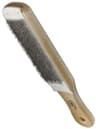
Nicholson File and Rasp Cleaner, 10 in (21458)
Pulls packed wood out of the teeth. A loaded rasp burnishes instead of cutting - this is why yours feels dull.
Live Amazon prices as of October 21, 2026; they change, and we don’t display stale numbers — a tool with no live price shows “Check price” and is left out of the subtotal. #adHow we’re funded.
How to actually use one
Rasps reward a small amount of technique more than almost any hand tool, and most people never get told any of it.
Cut on the push stroke only. Lift the tool on the return. Dragging teeth backwards over the work dulls them and tears the surface, and it achieves nothing on the way.
Skew the tool. Hold it at an angle to the direction of travel rather than square on. More teeth engage, the cut is smoother, and the tool is far less inclined to chatter.
Two hands, always. One on the handle driving, one on the far end steering and controlling pressure. This is what stops a rasp rocking and rounding a shape you wanted flat.
Work down to the line, then stop. A rasp removes wood much faster than most beginners expect. Mark the line, cut close, and let the file or the scraper take the last fraction.
Mind the grain. Cutting into rising grain tears it out. On end grain and near the corners of a curve, ease off the pressure and work from the corner inwards so the fibers are supported. Our note on how species behave is worth a read if a board keeps tearing when you expected it not to.
Card the teeth often. Especially in pine and anything resinous. A clogged rasp stops cutting and starts polishing.
Wear eye protection. Rasping throws fine, hard chips upward and towards you, and a lifetime of eye protection costs less than one visit to an emergency room. The basics are cheap.
What the whole category costs
This is one of the least expensive corners of a shop. A four-in-hand, a saw rasp, a file card and a pack of handles together sit comfortably below what a single mid-range power tool costs, and none of them wear out in any timeframe you need to plan for. The one genuinely expensive item here is the Japanese file, and it is expensive because of what it leaves behind rather than what it removes.
Above the tools on this page there is a further tier: hand-stitched rasps, where every tooth is raised individually by hand rather than by machine. They cut faster and leave a better surface than a machine-cut rasp, and they cost several times as much. They are a wonderful thing to own and a silly thing to buy first, in the same way that premium chisels are. Learn on the cheap ones, and you will know what you actually want before you spend.
The one to buy first
Buy the Shinto. Two cuts, one handle, no accessories needed, and it does the job the day it arrives. It is the single purchase that closes the gap between your saw and your sandpaper.
If the money matters more than the convenience, buy the Nicholson four-in-hand instead. It costs less than the Shinto, it adds a half-round face the Shinto does not have, and its four surfaces cover more ground than any one tool at that price has a right to.
Then, when you have used one for a month and know what you keep wanting it to do, add the piece it was missing: the cabinet rasp for real inside curves with a handle to go on it, the rifflers for detail, or the Iwasaki if what you want is a surface rather than a shape.
Frequently asked questions
What is the difference between a rasp and a file?+
A rasp has individual triangular teeth punched into the steel, standing well clear of the surface. It removes wood quickly and leaves deep scratches. A file has continuous rows of teeth cut in parallel lines; it cuts far more gently and leaves a much better surface. In wood, you shape with the rasp and refine with the file — using a fine file to do a rasp's job just clogs it.
What rasp should a beginner buy first?+
One tool with a coarse face and a fine face, so you can shape and then tidy up without a second purchase. A saw rasp does this in a single handled tool; the classic four-in-hand pattern does it with a rasp section and a file section on each of two faces, and adds a half-round side for inside curves. Either is a sensible first buy, and both are inexpensive.
Do rasps come with a handle?+
Often not. Traditional American-pattern rasps and files are sold as a bare bar with a pointed steel tang, and the handle is a separate purchase — the listings usually say so in small print. A bare tang gives you no control and can slip into your hand. Handles are sold in cheap multi-packs; buy one pack and fit the whole drawer at once.
How do I stop a rasp from clogging?+
Clean it often with a file card — a wire brush on a handle that pulls packed shavings out of the teeth. Pine, cedar and anything resinous load a tool fastest, so card it every few minutes in softwood. A saw rasp, whose teeth have open gullets between them, clogs much less than a fine file in the first place.
Can I use a metal file on wood?+
You can, but a fine metalworking file will pack solid with wood dust almost immediately and then burnish rather than cut. Coarser files work better, and a proper wood rasp works better still. If the only file you own is a mill file, keep a file card beside it and expect to use it constantly.
Which way do you push a rasp?+
Forward only, and lift it on the return. The teeth are angled to cut on the push stroke, so dragging them back over the work dulls them and tears the surface without removing anything. Skewing the tool slightly to the direction of travel gets more teeth into the cut and leaves a smoother result.
Do I still need sandpaper if I own a rasp?+
Yes — they do different jobs. The rasp gets the shape right, and it leaves scratches. Sandpaper, or a card scraper, removes those scratches. What changes is how long the sanding takes: shaping with a rasp first turns a long, uncertain sanding session into a short grit progression on a shape that is already correct.
Are expensive hand-stitched rasps worth it for a beginner?+
Not as a first purchase. Hand-stitched rasps have every tooth raised individually rather than by machine, which makes them cut faster and leave a better surface — and they cost several times what a machine-cut rasp does. Learn the technique on an inexpensive tool. If shaping becomes something you do often, you will know exactly which shape and cut to spend on.
Sources
OSHA — 1926.301, Hand tools — Paragraph (a): unsafe hand tools must not be issued or used. Paragraph (d): the wooden handles of tools must be kept free of splinters and cracks, and kept tight in the tool — which is the standard behind fitting a handle to a bare rasp tang (accessed August 31, 2026)