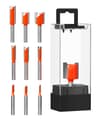
A router is the tool that most changes what a beginner can build, and a router without bits is a very loud paperweight. The problem is that the bit aisle is designed to sell you a case of twenty-four profiles when you need four, and the four you need are not the interesting-looking ones.
Here is what we compare on. Carbide quality— the single biggest difference between bits, and it shows up as burning and chatter rather than as an edge you can see is dull. Shank size— 1/4-inch shanks fit every router including compact ones; 1/2-inch shanks are stiffer and only fit larger routers. Bearing quality on guided bits, which is where cheap bits fail first. And whether the profile does a job or a decoration— beginners need edges eased and grooves cut far more often than they need an ogee.
One honest thing up front: bit quality matters more than router quality for the finish you get. A budget router with a good bit produces a cleaner edge than a premium router with a poor one. If your budget is tight, buy the cheaper router and better bits — our router guide has the picks.
How this is funded: we earn a commission if you buy through our links, at no extra cost to you. It never changes which tool we recommend, and we’ll tell you plainly when to skip one. Full disclosure.
Quick picks
Ranked on the specs that matter for a beginner and honest buyer fit. Select a row to jump to the full write-up. We haven’t hands-on-tested these — here is exactly what we do instead.
#
Product
Best for
Price
1
Whiteside 404 Compact Router Bit Set (1/4-Inch Shank)
American-made carbide in the four profiles a beginner actually uses, sized for a compact router. It costs more than a 15-piece bargain set and it will still be cutting cleanly when that set is in the bin.
Utrustto 15-Piece 1/4-Inch Shank Tungsten Carbide Router Bit Set
The honest budget answer. Fifteen profiles for the price of one premium bit, and while the carbide will not hold an edge like Whiteside, it is a cheap way to find out which profiles you actually reach for before spending real money.
Feanron 6-Piece Round-Over Router Bit Set (1/4-Inch Shank)
Round-over is the profile that makes a beginner's project stop looking like raw lumber, and a set of radii means you can match the edge to the piece instead of putting the same 1/4-inch bullnose on everything.
Yonico 13906q 45-Degree Chamfer Router Bit (1/4-Inch Shank)
One bit, one job, done well. A 45-degree chamfer gives a crisp modern edge that suits plywood and construction lumber far better than a round-over does — and it hides the ply layers on an exposed edge.
Crosstar 9-Piece Straight Router Bit Set (1/4-Inch Shank)
Straight bits are the unglamorous workhorses — dados for shelves, grooves for backs, rabbets for panels. A range of diameters means you can match the cut to the material instead of making two passes at the wrong width.
Whiteside 404 Compact Router Bit Set (1/4-Inch Shank)
American-made carbide in the four profiles a beginner actually uses, sized for a compact router. It costs more than a 15-piece bargain set and it will still be cutting cleanly when that set is in the bin.
Strengths
+Whiteside carbide is the benchmark for finish quality at this size
+Chosen profiles (flush trim, round-over, straight) match real beginner jobs
+1/4-inch shanks fit compact and full-size routers alike
Trade-offs
−Several times the price of a big bargain set
−Only a handful of profiles — no ogees, no coves
Type
Router bit set
In the set
Single tool
Material / build
Carbide-tipped
Key spec
1/4 in shank, compact-router profiles
Best for
Best quality — buy these once
Worth knowing. Bit quality shows up as burning and chatter, not as a dull edge you can see. A good bit leaves a surface that needs almost no sanding; a poor one leaves scorch marks you then have to remove.
Specs read from the product listing, on August 11, 2026. “Not listed” means the listing doesn’t state that figure.
#2Best budget starter set
Utrustto 15-Piece 1/4-Inch Shank Tungsten Carbide Router Bit Set
The honest budget answer. Fifteen profiles for the price of one premium bit, and while the carbide will not hold an edge like Whiteside, it is a cheap way to find out which profiles you actually reach for before spending real money.
Strengths
+Covers round-over, cove, chamfer, straight, rabbet and flush trim in one box
+Cheap enough that a ruined bit is not a disaster
+Storage case keeps them sorted and out of a drawer
Trade-offs
−Carbide quality varies bit to bit — expect a couple of duds
−You will use four of the fifteen; the rest is discovery, not value
Type
Router bit set
In the set
15 pieces
Material / build
Tungsten carbide tipped
Key spec
1/4 in shank, 15 profiles
Best for
Best budget starter set
Worth knowing. Treat a set like this as a survey. Note which three or four bits you keep reaching for, then replace exactly those with premium versions — that is a far cheaper path to good bits than buying quality across the board.
Specs read from the product listing, on August 11, 2026. “Not listed” means the listing doesn’t state that figure.
#3Best round-over set
Feanron 6-Piece Round-Over Router Bit Set (1/4-Inch Shank)
Round-over is the profile that makes a beginner's project stop looking like raw lumber, and a set of radii means you can match the edge to the piece instead of putting the same 1/4-inch bullnose on everything.
Strengths
+Six radii cover everything from a barely-there ease to a full bullnose
+Bearing-guided, so no fence setup is needed
+Cheap enough to own the whole range rather than one compromise size
Trade-offs
−Bearings are the weak point on budget bits — check them for play
−Small radii burn easily in maple and cherry if you move too slowly
Type
Round-over router bit set
In the set
6 pieces
Material / build
Carbide tipped with guide bearings
Key spec
1/4 in shank, radii 1/8 to 1/2 in
Best for
Best round-over set — the profile you'll use most
Worth knowing. A 1/8-inch round-over is the safest default on almost any project edge. It kills the sharpness that catches clothing and splinters, without reading as a deliberate decorative profile.
Specs read from the product listing, on August 11, 2026. “Not listed” means the listing doesn’t state that figure.
#4Best single edge bit
Yonico 13906q 45-Degree Chamfer Router Bit (1/4-Inch Shank)
One bit, one job, done well. A 45-degree chamfer gives a crisp modern edge that suits plywood and construction lumber far better than a round-over does — and it hides the ply layers on an exposed edge.
Strengths
+Bearing-guided, so it works freehand on straight and curved edges
+One of the few profiles that flatters plywood
+Costs about the same as a takeaway meal
Trade-offs
−A single fixed angle — no adjustment
−Chamfers show tear-out more obviously than round-overs do
Type
Chamfer router bit
In the set
Single tool
Material / build
Carbide tipped with guide bearing
Key spec
45 degrees, 1/4 in shank
Best for
Best single bit for a crisp modern edge
Worth knowing. Take a chamfer in two shallow passes rather than one deep one. The last light pass is what removes the burn marks and the fuzz, and it costs thirty seconds.
Specs read from the product listing, on September 10, 2026. “Not listed” means the listing doesn’t state that figure.
#5Best for dados and grooves
Crosstar 9-Piece Straight Router Bit Set (1/4-Inch Shank)
Straight bits are the unglamorous workhorses — dados for shelves, grooves for backs, rabbets for panels. A range of diameters means you can match the cut to the material instead of making two passes at the wrong width.
Strengths
+Range of diameters covers plywood thicknesses and shelf dados
+Double-flute design cuts cleanly with a guided straightedge
+Cheap enough to keep a spare of the size you use most
Trade-offs
−Nominal sizes will not match real plywood thickness — plywood is undersized
−Straight bits clear chips poorly in deep cuts; take shallow passes
Type
Straight router bit set
In the set
9 pieces
Material / build
Carbide tipped, double flute
Key spec
1/4 in shank, multiple diameters
Best for
Best for dados, grooves and joinery
Worth knowing. Plywood sold as 3/4 inch is usually closer to 23/32. A 3/4-inch straight bit therefore cuts a dado that is loose — which is exactly why undersized plywood bits exist as a separate product.
Specs read from the product listing, on August 11, 2026. “Not listed” means the listing doesn’t state that figure.
The four bits that earn their place
1. Round-over
Eases a square edge to a radius. Use the smallest radius that reads as deliberate — 1/8 inch is a safe default on almost anything. Larger radii look great on thick stock and can look bulbous on thin. A bearing rides the face below the cut, so no setup is required beyond depth.
2. Straight bit
The workhorse. Cuts dados for shelves, grooves for cabinet backs, and rabbets for panels. Straight bits need a guide — a clamped straightedge or an edge guide — because there is no bearing telling them where to go. Sizes matter here: see the plywood note below.
3. Chamfer
A 45-degree bevel instead of a radius. This is the profile that suits plywood and construction lumber better than a round-over does, because it gives a crisp modern line and disguises the ply layers on an exposed edge. Also bearing-guided.
4. Flush trim
A straight bit with a bearing the same diameter as the cutter, so it copies whatever the bearing rides against. It is the bit that makes template routing possible: attach a template, run the bit around it, and get an identical part. This is how you make four identical curved legs without measuring four times.
Shank size: 1/4 or 1/2 inch?
The shank is the shaft that goes into the collet. 1/4-inch shanks fit essentially every router, including compact and trim routers, which is what most beginners own. 1/2-inch shanks are four times stiffer in bending, run with less vibration, and only fit routers with a 1/2-inch collet.
For a first shop the answer is 1/4 inch, because it fits the router you have. If you own a full-size router with both collets, prefer 1/2-inch shanks for large-diameter bits — a wide profile on a thin shank is where deflection and chatter come from.
One safety note: push the bit fully into the collet, then withdraw it about a sixteenth of an inch before tightening. Bottoming a bit hard against the base of the collet can cause it to work loose in use, which is the failure mode you least want at 20,000 rpm.
The plywood thickness trap
Cut a dado with a 3/4-inch straight bit, slide in a piece of 3/4-inch plywood, and it will be loose. That is not your error: modern plywood sold as 3/4 inch typically measures nearer 23/32, so a nominal-sized dado is always slightly oversized.
There are three fixes. Buy undersized plywood bits, made specifically to match real sheet thickness. Cut the dado in two passes with a smaller bit, creeping up on the fit. Or measure your actual material and choose a bit to suit. Our lumber buying guide covers why nominal sizes lie in the first place.
How to get a clean cut
Take shallow passes. Two or three light passes produce a cleaner edge, less burning and far less strain on the router than one deep cut. This is the difference between a professional-looking edge and a scorched one.
Move at a steady rate.Too slow burns — the bit rubs instead of cutting and the friction scorches the wood. Too fast tears out. Listen to the motor: it should stay at a constant pitch.
Route in the right direction.On an outside edge, move the router left to right as you face the work, so the bit’s rotation pulls it into the wood rather than pushing it away. Going the wrong way is called climb cutting and the router will try to run away from you.
Rout end grain first. End grain blows out at the exit corner. Do the two ends first, then the long edges, and the long-grain cuts remove the blowout.
Keep the bit clean. Pitch and resin build up on carbide and make it behave like a dull bit. A little resin remover restores it in minutes.
Safety, briefly and seriously
A router bit spins at up to 25,000 rpm and is fully exposed. Always disconnect the router at the wall before changing a bit — not just switch it off. Wear ANSI-rated eye protection every time; routing throws chips at speed. Never start the router with the bit touching the wood. And clamp the workpiece: a router grabbing a loose board is how hands end up where bits are.
Frequently asked questions
What router bits does a beginner actually need?+
Four: a round-over to ease edges, a straight bit for dados and grooves, a chamfer for crisp modern edges and plywood, and a flush-trim bit for template work. Those four cover essentially every beginner project. Everything else is a profile you buy when a specific project asks for it.
Are cheap router bit sets any good?+
As a survey, yes. A budget set is a cheap way to discover which profiles you actually reach for, and the carbide is adequate for softwood and light use. What you should not expect is consistency — a couple of bits in any bargain set will burn or chatter. Replace the two or three you use most with premium versions.
Should I buy 1/4-inch or 1/2-inch shank bits?+
1/4-inch, unless you own a router with a 1/2-inch collet. Quarter-inch shanks fit every router including compact ones. Half-inch shanks are considerably stiffer and better for large-diameter bits, but they are useless if your router cannot hold them.
Why is my router burning the wood?+
Almost always feed rate or bit condition. Moving too slowly makes the bit rub instead of cut, and friction scorches — cherry and maple burn especially readily. A resin-coated or dull bit does the same thing. Take shallow passes, keep moving at a steady rate, and clean pitch off the carbide.
Can I use router bits in a drill?+
No, and it is genuinely dangerous. Router bits are designed for tens of thousands of rpm with the cutter held rigidly in a collet. A drill chuck cannot grip a router shank securely at speed, and drill speeds are far too low to cut cleanly. The bit can come loose or shatter.