Garage Shop Power and Extension Cords
Why your saw bogs down on a long cord, what one 15-amp circuit will actually run at once, and the GFCI question every concrete floor raises.
How this is funded: we earn a commission if you buy through our links, at no extra cost to you. It never changes which tool we recommend, and we’ll tell you plainly when to skip one. Full disclosure.
Most garages were wired to run a light, a garage door opener and an occasional drill. Then somebody puts a shop in one, plugs a 15-amp saw into a thin orange cord from the back of a cupboard, and spends a year assuming their tools are underpowered.
They are usually not. This is the least glamorous subject in shop setup and one of the highest-return, because it costs very little and it fixes problems people otherwise try to solve by buying a bigger tool.
Why the cord matters more than the tool
A cord is a wire, and every wire has resistance. Push current through it and some of the supply voltage is used up getting to the far end — that is voltage drop, and two things make it worse: a thinner conductor and a longer run.
Here is why that matters for a motor specifically. A universal or induction motor asked to do a fixed amount of work at a lower voltage responds by drawing more current. More current through the same undersized cord means more voltage drop, which means more current again. The motor runs hot, has noticeably less punch, and its life is shortened.
So the symptoms of a bad cord look exactly like a weak tool: it bogs in a cut that should be easy, it smells hot, and the cord itself is warm to the touch after a few minutes. A warm cord is the tell.
Reading the numbers
Three numbers, and all three are printed on things you already own.
- Amps, on the tool. The nameplate on any corded tool states its current draw. Most full-size corded saws, routers and benchtop planers are 12 to 15 amps; sanders and jigsaws are much less.
- Gauge and rating, on the cord. The jacket is printed with the gauge and the number of conductors — 12/3 means 12 AWG, three-conductor. Gauge numbers run backwards: 12 AWG is thicker than 14, which is thicker than 16. Cords are also marked with an amp rating, often on the packaging.
- Amps, on the breaker. The number on the breaker handle in the panel — usually 15 or 20 for a garage receptacle circuit.
The rule is simply that the cord’s rating must exceed the tool’s draw at the length you are actually using, and that ratings fall as cords get longer. When in doubt, use the thicker cord: an oversized cord is never a problem, it is only heavier and more expensive.
What one 15-amp circuit actually runs
This is where most garage shops hit their real ceiling.
A single 15-amp circuit will comfortably run one large tool at a time. It will usually not run a 15-amp saw and a shop vac together, and the moment of failure is almost always the start-up surge as a second motor spins up.
Practical answers, in order of cost:
- Start motors one at a time. Vac first, let it settle, then the saw. Free, and often enough.
- Use two circuits. Garages often have receptacles on more than one circuit — find out which by switching one breaker off and seeing what dies. Put the vac on the other one.
- Go cordless for the small tools. A cordless drill, sander or jigsaw draws nothing from the wall. See corded vs cordless for a home shop.
- Have a circuit added. Electrician work, priced per job, and the correct answer if you own a planer or a full-size table saw.
A breaker that trips is doing its job. Repeatedly resetting one is a habit worth breaking — it means the circuit is loaded past what it was designed for.
GFCI: the garage-specific one
A ground fault circuit interrupter watches the current going out and the current coming back. If they differ — because some of it is going somewhere it should not, such as through a person — it disconnects in a fraction of a second.
It matters more in a garage than almost anywhere else, because a concrete floor is a decent path to earth and is often damp. A fault that would give you an unpleasant surprise standing on a wooden floor upstairs is a much more serious event standing barefoot-adjacent on concrete.
The workplace standard makes the same point: OSHA 1910.304(b)(3)(ii)(A) requires GFCI protection for 125-volt, single-phase 15, 20 and 30 amp receptacle outlets that are not part of a building’s permanent wiring and are in use by personnel — and it explicitly treats a cord connector on an extension cord set as a receptacle outlet. Your garage is not a workplace under that rule, but the reasoning transfers exactly.
If your outlets are older and have no GFCI, a plug-in adapter costs very little and moves with you. Press its test button before each session; that is the whole maintenance routine.
Cord habits that matter
- Uncoil it completely. A coiled cord under load heats itself — the turns warm one another and the heat has nowhere to go. This is the specific reason to pull a reel out fully rather than using the first six feet.
- Never daisy-chain. Each joint adds resistance and a failure point, and joined cords are almost always mismatched gauges, so the run behaves like its thinnest section.
- Do not run cords under a workpiece or across a walkway. The commonest garage shop injury is a trip, not a cut.
- Check the plug for heat after a long cut. Warm is a warning; hot is a stop-now.
- Retire damaged cords. A nicked jacket in a shop full of metal, moisture and bare feet is not worth taping over.
Getting cords off the floor
In a shop the width of half a garage, cords across the floor are both the biggest trip hazard and the thing most likely to be run over by a mobile machine base.
A ceiling-mounted retractable reel drops power where you actually work and pulls out of the way afterwards. Check the gauge inside any reel before running a high-draw machine from it — reels are sold as convenience products and the cord inside is often thinner than one you would choose yourself. For a planer or a table saw, use a proper 12-gauge cord straight from the outlet instead.
When to call an electrician
Everything above is plug-in. These are not:
- Adding a circuit or a subpanel.
- Installing a 240-volt outlet for a garage heater or a large machine.
- Replacing outlets or wiring, including fitting GFCI receptacles.
- Anything at all if the panel is old, corroded, or you are not certain what you are looking at.
Adding a dedicated circuit is a small job for an electrician, and it is the upgrade that most changes what a garage shop can do. If you are having anyone in anyway, it is worth asking for more outlets at bench height while they are there — outlets at knee height under a bench are functionally useless.
What to buy
One good cord, one GFCI adapter and, if the floor is crowded, a reel. Under a hundred dollars for the lot, and it removes an entire category of problem.
| Tool | Why you need it | Price |
|---|---|---|
 | A 12-gauge cord holds voltage at the tool. This is the fix for a saw that seems underpowered. | $44.99 |
 | Adds ground fault protection to an older garage outlet without any rewiring. Test it each session. | $16.99 |
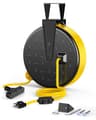 | Drops power where you work and keeps the floor clear. Check the internal gauge before running a big machine. | $43.99 |
 | The other early electrical job. Linkable LED strips run from one outlet and transform a dark bay. | $35.09 |
| Starter kit subtotal | $141.06 | |
Live Amazon prices as of October 21, 2026; they change, and we don’t display stale numbers — a tool with no live price shows “Check price” and is left out of the subtotal. #ad How we’re funded.
The short version
Buy one 12-gauge cord and use it for everything. Uncoil it fully. Run one big motor at a time. Add a GFCI adapter if your outlets do not have protection. And if the breaker keeps tripping, that is not a nuisance to work around — it is the circuit telling you what it can do.
Get those four right and your existing tools will feel better than they did, for less than the price of a decent saw blade.
One safety note. Power tools deserve respect, not fear. Read the manual, keep the guards on, wear ANSI-rated eye protection every time, and never rush a cut. When something feels wrong, stop and reset — there is no deadline in a home shop.
Frequently asked questions
What gauge extension cord do I need for power tools?
Thicker than the household cord you already own, and thicker the longer the run gets. Gauge numbers run backwards — 12 AWG is thicker than 16 AWG. Every cord is printed with its gauge, length and amp rating on the jacket; match that rating against the amps on your tool's nameplate, and if the run is long, size up.
Why does my saw lose power on an extension cord?
Voltage drop. A cord has resistance, so some of the voltage is lost in the wire before it reaches the tool — more with a thinner cord and more with a longer one. A motor supplied with less voltage draws more current to do the same work, which makes it run hot and feel gutless. It is not the saw; it is the cord.
Can I run a table saw and a shop vac on the same circuit?
Often not. A 15-amp saw and a shop vac started together can exceed a 15-amp circuit, especially with the surge as each motor starts. The usual answers are to start them one at a time, put the vac on a different circuit, or fit a dedicated circuit for the machine. Repeatedly tripping a breaker is a warning, not an inconvenience.
Do I need GFCI protection in a garage workshop?
It is a very good idea, and in newer construction garage receptacles are generally required to have it. A concrete floor is a good path to earth, so a fault that would be a shock elsewhere can be far more serious in a garage. A plug-in GFCI adapter costs very little and adds the protection to any outlet without rewiring.
Is it safe to daisy-chain extension cords?
No. Each connection adds resistance and another failure point, and joined cords are almost always different gauges, so the whole run performs like the thinnest one. Use a single cord of the right length. If you need more reach than any cord you own, that is a sign the shop needs another outlet rather than another cord.
Should I uncoil an extension cord before using it?
Yes, fully. A coiled cord under load behaves like a heating element — the turns warm each other and heat cannot escape, which can soften the insulation. This applies most to cord reels, where the temptation is to pull out only a few feet.
Sources
- OSHA — 1910.304, Wiring design and protection — Paragraph (b)(3)(ii)(A): temporary 125-volt 15, 20 and 30 amp receptacle outlets in use by personnel require GFCI protection — an extension cord connector counts as a receptacle outlet (accessed August 19, 2026)
- OSHA — Woodworking eTool — OSHA guidance on woodworking hazards, guarding and safe work practices (accessed July 24, 2026)
- OSHA — 1926.56, Illumination — Minimum foot-candle levels by area — 10 foot-candles for carpenter shops (Table D-3) (accessed August 11, 2026)
Keep reading
Set up a garage woodworking shop
Where power fits in the wider setup: layout, storage and keeping the car in the garage.
Read the setup guideGarage shop lighting
The other electrical project worth doing early, and the one with the biggest daily payoff.
Read the guideCorded vs cordless for a home shop
Which tools should have a cord — and how much of this problem cordless simply removes.
Read the comparisonBest shop vacuum for a small shop
The second motor that shares your circuit, and how to stop it tripping the breaker.
See the picksDo you need a planer or a jointer?
The machine most likely to expose an undersized circuit in a garage shop.
Read the comparisonShop safety basics for beginners
Guards, habits and the wider safety picture a garage shop needs.
Read the guide