Bar clamps pull in a straight line, and plenty of glue-ups are not straight. Six things that do the job another way - straps, a corner clamp, a face clamp, grippers and the glue that clamps itself.
How this is funded: we earn a commission if you buy through our links, at no extra cost to you. It never changes which tool we recommend, and we’ll tell you plainly when to skip one. Full disclosure.
The short answer. For frames, boxes and carcasses, the Bessey VAS-23 strap clamp. For chairs, stools and anything round, the Rockler 15 ft band clamp. For a single corner that must be held square and squeezed, the Bessey WS-3 angle clamp. If the fastener is going to do the clamping, the Kreg KHC3 face clamp. To hold a workpiece for sanding or routing without any clamp in the way, Rockler Bench Cookies. And for a repair that cannot be clamped at all, thick CA glue.
Here is what a bar clamp actually is, because knowing it tells you what can replace it: a bar with a fixed jaw and a sliding jaw that pulls two faces together along one straight axis. That is ideal for a panel glue-up and for pulling a butt joint tight. It is awkward or useless on a mitred frame (four corners, no straight axis through them), on a chair (nothing parallel anywhere), on a wide carcass (the bar is never long enough), and on an edge you want to sand or rout (the clamp head is exactly where the tool needs to go).
So the question “what can I use instead of a bar clamp?” has four honest answers, and the shape of the job picks the answer. Wrap it with a strap or band. Corner it with an angle clamp. Fasten it— a screw is a clamp that stays in the joint. Or grip it rather than clamping it.
Prices on the cards are from the live feed, stamped November 23, 2026. If your real problem is that you own some bar clamps and not enough of them, read how to clamp without enough clamps first — the technique page is free and often solves it.
Quick picks
Ranked on the specs that matter for a beginner and honest buyer fit. Select a row to jump to the full write-up. We haven’t hands-on-tested these — here is exactly what we do instead.
#
Product
Best for
Price
1
Bessey VAS-23+2K-CB Variable Angle Strap Clamp, 23 ft, with 4 Vario Clips
The one tool on this page that closes all four corners of a frame at once with even pressure, and the only strap clamp here whose corner pieces pivot rather than sitting at a fixed 90 degrees. That matters more than it sounds: a frame with four slightly-off miters needs the corners to find their own angle, and a fixed plastic corner fights that instead of absorbing it.
Rockler Band Clamp, 1 in x 15 ft, with Permanently Attached Ratchet Handle
A ratcheting band with no corner brackets at all, and that is the point: it is the band clamp for a chair, a stool, a barrel or anything whose shape a plastic corner cannot help with. The handle is stitched to the strap so the two cannot be separated, which solves the one genuine annoyance of cheaper band clamps - the ratchet and the webbing living in different drawers.
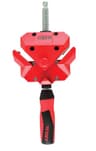
This is a corner clamp in the strict sense - a screw spindle that squeezes two boards together while holding them at 90 degrees, rather than a jig that merely holds them near 90 degrees while you fasten them. The die-cast jaws are built with clearance for dowels, screws or staples, which means you can drive the fastener with the clamp still on, and that is the whole argument for owning one.
A face clamp holds two boards dead flush while the screw pulls them together, and without one the joint steps at the seam no matter how good the jig is. If your jig did not come with a clamp, this is not optional.
Four rubber pucks that grip the bench on one face and the workpiece on the other. They lift the work clear of the bench so you can sand or rout an edge, and they hold it still without a single clamp in the way.
Starbond Thick Super Glue Pro Kit, 2 oz (Gap-Filling CA)
The woodworker's answer to a hairline gap, a chipped edge or a torn-out splinter: thick CA glue, flooded into the defect and sanded flush, optionally packed with sanding dust from the same board so the repair is literally the same wood. Nothing else here fixes a crack in minutes.
Bessey VAS-23+2K-CB Variable Angle Strap Clamp, 23 ft, with 4 Vario Clips
The one tool on this page that closes all four corners of a frame at once with even pressure, and the only strap clamp here whose corner pieces pivot rather than sitting at a fixed 90 degrees. That matters more than it sounds: a frame with four slightly-off miters needs the corners to find their own angle, and a fixed plastic corner fights that instead of absorbing it.
Strengths
+The four Vario clips are stated to auto-adjust from 60 to 180 degrees, so the clamp holds hexagons and odd angles as well as squares
+23 ft of woven polyester strap is the longest here by a wide margin, which is what lets it go around a carcass or a chair as well as a frame
+Listing states a built-in take-up reel for the excess strap, which is the difference between a tool you use and a tangle you avoid
+Removable corners mean you can run it as a bare strap on a round or irregular glue-up
Trade-offs
−No clamping force figure is published anywhere on the listing, so you cannot compare it numerically with the band clamps that do state one
−A strap pulls inward, which is exactly wrong for a joint that needs to be pushed apart to seat - it will happily pull an out-of-square frame tighter into being out of square
−The most expensive band clamp here, and the pivoting corners are the only thing you are paying extra for
−Steel wire loop and composite handle; this is not a tool you tension by feel against a published load limit
23 ft strap; 4 pivoting Vario corner clips, 60-180 degrees
Best for
Best overall for frames, boxes and anything with four corners
Worth knowing. The listing states "23 ft Variable Angle Strap Clamp with 4 Pivoting Vario Clips for even pressure clamping around square, round, rectangular or irregular shaped objects", that the "removable Vario corners auto adjust from 60 deg to 180 deg", a "special woven polyester band" with "high resistance to tearing", and a "built-in take up reel to neatly store the excess strap". Part number VAS-23+2K-CB. No clamping force or working load figure is published.
Specs read from the product listing, on October 23, 2026. “Not listed” means the listing doesn’t state that figure.
#2Best for chairs and round work
Rockler Band Clamp, 1 in x 15 ft, with Permanently Attached Ratchet Handle
A ratcheting band with no corner brackets at all, and that is the point: it is the band clamp for a chair, a stool, a barrel or anything whose shape a plastic corner cannot help with. The handle is stitched to the strap so the two cannot be separated, which solves the one genuine annoyance of cheaper band clamps - the ratchet and the webbing living in different drawers.
Strengths
+Handle is permanently attached to the band, so there is no loose ratchet to lose and nothing to thread before you can use it
+Listing states nylon webbing that will not stretch under tension, reinforced with a herringbone weave, and that the strap is stitched to the ratchet post to reduce slipping
+Narrow 1 in band works into the rungs and stretchers of a chair where a wide strap would bridge across
+Priced below the Bessey while using the same ratcheting principle
Trade-offs
−No corner brackets are included, so on a square frame the band bites the miters unless you cut your own corner blocks - a five-minute job, but a job
−15 ft of strap is less than half the Bessey's reach; a large carcass glue-up will run out
−No clamping force figure, no part number and no stated material grade are published on the listing
−A ratchet applies a lot of force through a thin band, and over-tightening a mitered frame is easy and invisible until the glue sets
Type
Band clamp
In the set
Single tool
Material / build
Nylon webbing, herringbone weave
Key spec
1 in x 15 ft band; attached ratcheting handle; no corner brackets
Best for
Best for chairs, stools and round or odd-shaped glue-ups
Worth knowing. The listing states "Longer, Durable 1”x15” Quick Grip Clamps & Permanently Attached Ratchet Handle", that it is "made up of nylon material that won't stretch under tension", that "the ratchet clamp strap is reinforced with a herringbone weave", and that "the strap of these wood clamps for woodworking is stitched to the ratchet post". Size field: 1" x 15". No part number, model number or clamping force figure is published.
Specs read from the product listing, on October 23, 2026. “Not listed” means the listing doesn’t state that figure.
#3Best true corner clamp
Bessey WS-3+2K-CB 90-Degree Angle Clamp
This is a corner clamp in the strict sense - a screw spindle that squeezes two boards together while holding them at 90 degrees, rather than a jig that merely holds them near 90 degrees while you fasten them. The die-cast jaws are built with clearance for dowels, screws or staples, which means you can drive the fastener with the clamp still on, and that is the whole argument for owning one.
Strengths
+Applies real clamping pressure across the joint, not just alignment - the only pick here that does both at once
+Listing states the jaws are designed for clearance of dowels, screws or staples while gluing, so the fastener goes in without unclamping
+Adjusts automatically to different stock thicknesses rather than needing a reset per board
+Plastic-coated die-cast jaws protect the work; 1.125 in stated throat depth
Trade-offs
−1.125 in throat depth is the hard limit. It will not reach into anything wider than nominal 1x stock from the corner
−You need two to hold both ends of a workpiece, which doubles an already high price per corner
−Heaviest tool here at a stated 1.99 lb, and the handle sticks out exactly where your hand wants to go
−Die-cast aluminum, made in China per the listing - the price buys the Bessey mechanism, not a forged body
Type
Corner / angle clamp
In the set
Single tool
Material / build
Die-cast aluminum, plastic-coated jaws
Key spec
90 degrees fixed; 1.125 in throat depth; auto-adjusts to stock thickness
Best for
Best true corner clamp for T-joints and miters
Worth knowing. The listing states that the clamp "secures 2 pieces of wood together at a perfect 90-degree angle", that "die-cast jaws are plastic coated to protect work", that it "adjusts automatically to different wood thickness" and that the jaws "are designed for clearance of dowels, screws or staples while gluing". The title block states "Throat Depth 1.125" and "Diecast Aluminum material"; part number and model WS-3; product weight 1.99 lb.
Specs read from the product listing, on October 23, 2026. “Not listed” means the listing doesn’t state that figure.
#4Best when a screw does the clamping
Kreg Wood Project Clamp, 3 in Reach (KHC3)
A face clamp holds two boards dead flush while the screw pulls them together, and without one the joint steps at the seam no matter how good the jig is. If your jig did not come with a clamp, this is not optional.
Strengths
+Auto-adjusting head snaps to the material thickness instead of needing to be wound in
+Fits material up to 3 in thick, so it also handles doubled-up stock
+Wide pads spread pressure and keep the two faces flush, which is the whole job
+The listing states compatibility with Kreg pocket-hole jigs, the R3 and the portable base
Trade-offs
−Costs about as much as the budget jig it is holding
−A plain 3 in C-clamp will do the same job more slowly for a fraction of the price
−Redundant if you bought the 320 bundle or the Milescraft kit, which already include a clamp
Type
Auto-adjusting face clamp
In the set
Single tool
Material / build
Not listed
Key spec
3 in reach; fits material up to 3 in thick
Best for
Best face clamp for a jig that came without one
Worth knowing. The listing states a 3 in reach, that it fits material up to 3 in thick, that Automaxx adjusts it instantly to material thickness, that pressure is set by twisting a thumbscrew, and that it is compatible with Kreg pocket-hole jigs, the R3 and the Kreg Pocket-Hole Jig Portable Base. Its own dimensions block gives 1 lb.
Specs read from the product listing, on September 4, 2026. “Not listed” means the listing doesn’t state that figure.
#5Best for holding without clamping
Rockler Bench Cookies Plus Work Grippers, 4-Pack
Four rubber pucks that grip the bench on one face and the workpiece on the other. They lift the work clear of the bench so you can sand or rout an edge, and they hold it still without a single clamp in the way.
Strengths
+Nothing protrudes above the work, so a sander pad or router base never collides with a clamp
+Raises the piece off the bench, so you can ease all four edges in one go
+Works on any flat bench — no dog holes required
Trade-offs
−Grip only — they resist sliding, not lifting, so they are no use for heavy planing
−The rubber collects sawdust and needs an occasional wipe to stay grippy
Type
Work grippers
In the set
4 pieces
Material / build
Not listed
Key spec
4-pack, non-marring rubber faces
Best for
Sanding and routing without clamps in the way
Worth knowing. These solve the specific problem of a router base or sander pad hitting a clamp head, which is the reason most beginners end up holding a workpiece with one hand and regretting it.
Specs read from the product listing, on August 19, 2026. “Not listed” means the listing doesn’t state that figure.
#6Best budget pick
Starbond Thick Super Glue Pro Kit, 2 oz (Gap-Filling CA)
The woodworker's answer to a hairline gap, a chipped edge or a torn-out splinter: thick CA glue, flooded into the defect and sanded flush, optionally packed with sanding dust from the same board so the repair is literally the same wood. Nothing else here fixes a crack in minutes.
Strengths
+The listing describes it as gap-filling CA glue with a clog-resistant applicator - thick enough to stay in a crack rather than running out of it
+Packed with sanding dust from the same board, it gives a repair that matches the wood instead of approximating it
+Cures in minutes, so a chipped edge is fixed inside the same work session rather than the next one
Trade-offs
−It cures hard and glossy, so it takes stain and finish quite differently from the wood around it - better under a clear finish than a stained one
−CA glue bonds skin instantly and the fumes sting eyes in a closed garage - gloves and ventilation, not optional
−A 2 oz bottle is small and has a limited shelf life once opened, so it is not the product for a project full of nail holes
Type
Gap-filling cyanoacrylate (CA) glue
In the set
Single tool
Material / build
Thick cyanoacrylate adhesive
Key spec
2 oz; thick/gap-filling viscosity; minutes to cure
Best for
Best for hairline cracks, tearout and chipped edges
Worth knowing. Everything claimed here is from the Amazon listing, read October 16, 2026: "Starbond Thick Super Glue Pro Kit (2 oz) - Gap-Filling CA Glue (Cyanoacrylate Adhesive) - with Clog-Resistant Applicator Cap". No Starbond spec page was fetched, so no cure-time figure, viscosity number or shelf-life figure is quoted on this card.
Specs read from the product listing, on October 16, 2026. “Not listed” means the listing doesn’t state that figure.
Bands for the shapes a bar cannot reach
A band clamp with no corner bracketsis a different tool from a strap clamp with them, and the Rockler is the one to own if your work is not square: a chair, a stool, a barrel, a round tabletop apron. Its 1 in nylon webbing works into rungs and stretchers where a wide strap would simply bridge across, and the ratchet handle is stitched to the band, so there is no loose ratchet to lose and nothing to thread before use.
Two honest limits. There are no corner brackets, so on a square frame the band bites into the miters unless you cut your own corner blocks from scrap — a five-minute job, but a job. And 15 ft is less than half the Bessey’s reach, so a large carcass glue-up will run out of strap.
One warning that applies to every ratcheting band: a ratchet applies a lot of force through a thin band, and over-tightening is how a mitred frame gets crushed or racked. Snug, then check, then a click more if needed. Our corner and band clamp roundup compares every strap, band and corner clamp we stock side by side.
Corner it, or let the fastener do the clamping
The Bessey WS-3 is a corner clamp in the strict sense: a screw spindle that squeezes two boards together whileholding them at 90 degrees, rather than a jig that merely holds them near 90 degrees while you fasten. Its die-cast jaws are built with clearance for dowels, screws or staples, so you can drive the fastener with the clamp still on — which is the whole argument for owning one. The hard limit is a stated 1.125 in throat depth: it will not reach into anything wider than nominal 1x stock, and you need two to hold both ends of a workpiece.
The cheaper and often better answer for casework is to stop clamping the joint and start clamping the fastener. A face clampholds two boards dead flush while a pocket screw pulls them together; without one, the joint steps at the seam no matter how good the jig is. The Kreg KHC3’s auto-adjusting head snaps to material thickness instead of needing to be wound in, and it fits stock up to 3 in thick. It costs about as much as a budget jig, and a plain C-clamp does the same job more slowly for a fraction of the price — that is the honest comparison.
Grip instead of clamp, and glue that clamps itself
Some of the time you do not need pressure at all — you need the workpiece to stop moving while a sander or router does its job. Bench Cookiesare four rubber pucks that grip the bench on one face and the work on the other, lifting the piece clear so you can ease all four edges in one go with nothing protruding above the surface to collide with a router base or a sander pad. They resist sliding, not lifting, so they are no use for heavy hand planing — and the rubber collects sawdust and wants an occasional wipe.
And then there is glue chemistry, which is a legitimate alternative to clamping that nobody lists as one. Thick gap-filling CA gluecures in minutes, so a hairline crack, a torn-out splinter or a small part can be held by hand until it holds itself. Packed with sanding dust from the same board, the repair is literally the same wood. It cures hard and glossy, so it takes stain differently from the surrounding timber — better under a clear finish than a stained one — and it bonds skin instantly, so gloves and ventilation are not optional.
For a joint rather than a repair, a thick fast-grabbing PVA like Titebond Quick & Thick tacks a miter or a trim piece in minutes instead of the half hour a standard PVA wants under clamps — which is often all the clamping time you were missing.
The one to buy
If you are building frames or boxes: the Bessey strap clamp, and it will do things your bar clamps cannot. If you are building chairs or anything round: the Rockler band. If you are building cabinets with pocket screws: the face clamp, and skip the rest. If you are sanding and routing small parts: Bench Cookies. And if what you actually have is a crack, a chip or a part too small to clamp: the CA glue, which is the cheapest pick here and the only one that needs no clamp at all.
Frequently asked questions
What can I use instead of bar clamps?+
It depends on the shape. For frames and boxes, a strap or band clamp pulls all four corners at once. For chairs and round work, a bracket-free band clamp. For a single corner, a true corner clamp that squeezes as well as aligns. For casework, a face clamp plus pocket screws - the screw becomes the clamp. For holding work while sanding or routing, bench grippers. For a crack or a chip, thick CA glue, which needs no clamp at all.
Are strap clamps as good as bar clamps?+
They are better at some jobs and worse at others. A strap closes every corner of a frame or a carcass at once with even pressure, which bar clamps cannot do in one pull. But a strap only pulls inward, so it cannot push a joint apart to seat it, and it will tighten an out-of-square assembly into being more out of square - check the diagonals before the final pull.
Can I glue wood without clamps?+
Sometimes, with the right adhesive and realistic expectations. Thick gap-filling CA glue cures in minutes, so small parts and repairs can be held by hand. A thick fast-grab PVA tacks miters and trim far faster than standard glue. A rub joint - two freshly glued faces rubbed together until the glue grabs - works on small edge joints. None of these replaces clamps on a load-bearing panel glue-up.
Do screws work instead of clamps?+
Yes, and that is the standard answer in cabinet work: a pocket screw pulls the joint together and stays there, so the clamp is only needed for the seconds while the screw is driven. The one thing you still need is a face clamp to hold the two boards flush while you drive it - without that, the joint steps at the seam regardless of how good the jig is.
What is a clamping square and is it an alternative to bar clamps?+
No - it is an accessory for them. A clamping square is a right-angle block with notches your own bar or trigger clamps grip, holding a carcass square across a span a corner clamp cannot reach. It supplies no clamping force of its own, so it makes the clamps you own more useful rather than replacing them.
How many clamps do I actually need?+
For a first shop, four one-handed 6-inch clamps will glue up small boxes and frames; a panel glue-up wants a clamp roughly every 8 to 10 inches along the joint, which is why panel work drives clamp counts up fast. Before buying more, try cauls, blue tape and staged glue-ups - the technique often removes the need for half the clamps people assume they need.
Sources
Titebond — Titebond II Premium Wood Glue product page — Cross-linking polyvinyl acetate. Application temperature above 55°F; open assembly time 3-5 minutes and total assembly time 10-15 minutes at 70°F/50% RH; passes ANSI Type II water resistance; "U.S. FDA approved for indirect food contact (cutting boards)"; dried film translucent yellow; shelf life 24 months. Not for continuous submersion, below the waterline, or structural or load-bearing use. Item 5004 is the 16 oz bottle (accessed September 18, 2026)
Titebond — Titebond Quick & Thick Multi-Surface Glue product page — Application temperature above 50°F; open assembly time 3-5 minutes and total assembly time 10-15 minutes at 70°F/50% RH; viscosity 36,500 cps; dries clear; fills small gaps; for wood, pottery, ceramic, stone, glass, fabric and leather. "Not recommended for exterior use or where moisture is likely" — interior projects only. Item 2404 is the 16 oz bottle (accessed September 18, 2026)
USDA Forest Service, Forest Products Laboratory — Wood Handbook (FPL-GTR-190), Chapter 8: Fastenings — The "Wood Screws" section, pages 8-10 to 8-12. "The root diameter for most sizes of screws averages about two-thirds the shank diameter." Withdrawal "varies directly with the square of the specific gravity of the wood" and, within limits, "directly with the depth of penetration of the threaded portion and the diameter of the screw" — so "the longer lengths of standard screws are therefore superfluous in dense hardwoods." The withdrawal equation "is applicable when screw lead holes have a diameter of about 70% of the root diameter of the threads in softwoods, and about 90% in hardwoods." End-grain withdrawal, "when splitting is avoided," averages 75% of side-grain. For lateral load the screw must penetrate the member holding the point by at least seven times the shank diameter, and the side member should be about half that depth. "Screws should always be turned in. They should never be started or driven with a hammer because this practice tears the wood fibers and injures the screw threads, seriously reducing the load carrying capacity of the screw." Soap or a similar lubricant "is recommended to facilitate insertion, especially in dense woods, and it will have little effect on ultimate withdrawal resistance." Table 8-9 gives shank diameters by gauge: #6 0.138 in, #8 0.164 in, #10 0.190 in, #12 0.216 in. In particleboard, withdrawal "is not significantly different for lead holes of 50% to 90% of the root diameter," and "care must be taken when tightening screws in particleboard to avoid stripping the threads" (accessed October 2, 2026)