Bar clamps cannot close a mitered corner. Eight corner clamps, band clamps and clamping squares compared on the one question that decides which you need - does it actually squeeze the joint, or only hold it near square while you fasten it?
Here is the fact that explains why this category exists at all. Titebond Original gives you four to six minutes of open assembly time and ten to fifteen minutes of total assembly time at 70°F — those are the manufacturer’s own published numbers, cited at the foot of this page. A four-sided picture frame has four joints. If you are still hunting for the second bar clamp at minute seven, the glue has already started to set and the joint you close will be a glue line, not a bond.
That is the actual problem with clamping a corner, and it is not the one people expect. A mitered frame is not hard to clamp because bar clamps are weak. It is hard because a bar clamp pushes in one direction, and a 45-degree miter wants to slide sideways the instant you apply pressure. Everything on this page exists to solve that in one of two completely different ways, and buying the wrong one is the most common mistake here.
The lens, in order. Does it clamp or only align? A screw-spindle corner clamp squeezes the joint; a spring clip or a clamping square holds the parts near square while you drive a screw or apply pressure from somewhere else. Both are useful and they are not interchangeable. Capacity second, because the figures are brutally small — the throat depths and stock limits below run from 3/4 inch to 1-1/4 inch, which means most corner clamps physically cannot touch anything thicker than nominal 1x material. How many you need third: one corner clamp holds one corner, and a frame has four, which changes the real price of a pick by a factor of four. Whether it fights an out-of-square joint fourth — a band clamp with fixed plastic corners will happily pull a frame tighter into being wrong, and the one pick here with pivoting corners is the one that will not.
Prices are live and brackets in the prose are qualitative, because they move. Every spec on every card below was read from that seller’s own listing on the date shown on the card, and clamp listings publish remarkably little — no clamping force on five of the eight, no material at all on two, and not one squareness tolerance anywhere. Where a listing states no figure the card says “Not listed” rather than guessing. Here is exactly what we do instead of testing.
How this is funded: we earn a commission if you buy through our links, at no extra cost to you. It never changes which tool we recommend, and we’ll tell you plainly when to skip one. Full disclosure.
Quick picks
Ranked on the specs that matter for a beginner and honest buyer fit. Select a row to jump to the full write-up. We haven’t hands-on-tested these — here is exactly what we do instead.
#
Product
Best for
Price
1
Bessey VAS-23+2K-CB Variable Angle Strap Clamp, 23 ft, with 4 Vario Clips
The one tool on this page that closes all four corners of a frame at once with even pressure, and the only strap clamp here whose corner pieces pivot rather than sitting at a fixed 90 degrees. That matters more than it sounds: a frame with four slightly-off miters needs the corners to find their own angle, and a fixed plastic corner fights that instead of absorbing it.
POWERTEC 72071 Adjustable Band Clamp, 15 ft, with Non-Marring Corners
The cheapest way to own a ratcheting band clamp WITH corner pieces, and the only one on this page that publishes a working load figure - 1,000 lb, which is also what Pony claims for its lever-action band. If you are buying a first band clamp for frames and small boxes, this is the entry point and it does the job.
Pony Jorgensen 1225 Rapid Acting Band Clamp, 1 in x 15 ft
The old-pattern band clamp: a PVC body with metal levers you flip rather than a ratchet you crank, and 1-by-1-inch non-marring jaws cast into the corners. It tensions faster than any ratchet on this page and it releases in one motion, which is what you want when the glue has four minutes of open time and the frame is not sitting right.
Rockler Band Clamp, 1 in x 15 ft, with Permanently Attached Ratchet Handle
A ratcheting band with no corner brackets at all, and that is the point: it is the band clamp for a chair, a stool, a barrel or anything whose shape a plastic corner cannot help with. The handle is stitched to the strap so the two cannot be separated, which solves the one genuine annoyance of cheaper band clamps - the ratchet and the webbing living in different drawers.
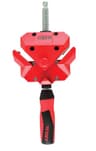
This is a corner clamp in the strict sense - a screw spindle that squeezes two boards together while holding them at 90 degrees, rather than a jig that merely holds them near 90 degrees while you fasten them. The die-cast jaws are built with clearance for dowels, screws or staples, which means you can drive the fastener with the clamp still on, and that is the whole argument for owning one.
Milescraft 4005 90-Degree Corner Clamp with Swivel Head
The corner clamp aimed squarely at pocket-hole assembly, which is this site's default beginner joinery, and it is the one to reach for when a cabinet side keeps sliding out of line as the screw bites. A swivel head lets it sit on a joint that is not perfectly presented, and the listing is unusually honest that you should buy two.
Four spring-loaded plastic corner clamps for less than the price of one metal one, and the honest way to describe them is as alignment clips rather than clamps. On thin stock - a drawer box, a small case, a shop jig - four of them hold a square while the glue grabs, and that is a genuinely useful thing to own even if it is not a precision tool.
Not a clamp at all - a pair of 8-inch right-angle blocks that your own bar clamps grip, which is why they cost a fraction of what a set of corner clamps does. For cabinet and shelf assembly they are the most useful thing on this page: they hold a carcass square across a span no corner clamp can reach, and they turn clamps you already own into a corner fixture.
Bessey VAS-23+2K-CB Variable Angle Strap Clamp, 23 ft, with 4 Vario Clips
The one tool on this page that closes all four corners of a frame at once with even pressure, and the only strap clamp here whose corner pieces pivot rather than sitting at a fixed 90 degrees. That matters more than it sounds: a frame with four slightly-off miters needs the corners to find their own angle, and a fixed plastic corner fights that instead of absorbing it.
Strengths
+The four Vario clips are stated to auto-adjust from 60 to 180 degrees, so the clamp holds hexagons and odd angles as well as squares
+23 ft of woven polyester strap is the longest here by a wide margin, which is what lets it go around a carcass or a chair as well as a frame
+Listing states a built-in take-up reel for the excess strap, which is the difference between a tool you use and a tangle you avoid
+Removable corners mean you can run it as a bare strap on a round or irregular glue-up
Trade-offs
−No clamping force figure is published anywhere on the listing, so you cannot compare it numerically with the band clamps that do state one
−A strap pulls inward, which is exactly wrong for a joint that needs to be pushed apart to seat - it will happily pull an out-of-square frame tighter into being out of square
−The most expensive band clamp here, and the pivoting corners are the only thing you are paying extra for
−Steel wire loop and composite handle; this is not a tool you tension by feel against a published load limit
23 ft strap; 4 pivoting Vario corner clips, 60-180 degrees
Best for
Best overall for frames, boxes and anything with four corners
Worth knowing. The listing states "23 ft Variable Angle Strap Clamp with 4 Pivoting Vario Clips for even pressure clamping around square, round, rectangular or irregular shaped objects", that the "removable Vario corners auto adjust from 60 deg to 180 deg", a "special woven polyester band" with "high resistance to tearing", and a "built-in take up reel to neatly store the excess strap". Part number VAS-23+2K-CB. No clamping force or working load figure is published.
Specs read from the product listing, on October 23, 2026. “Not listed” means the listing doesn’t state that figure.
#2Best budget band clamp
POWERTEC 72071 Adjustable Band Clamp, 15 ft, with Non-Marring Corners
The cheapest way to own a ratcheting band clamp WITH corner pieces, and the only one on this page that publishes a working load figure - 1,000 lb, which is also what Pony claims for its lever-action band. If you are buying a first band clamp for frames and small boxes, this is the entry point and it does the job.
Strengths
+A stated 1,000 lb working load on a 15 ft nylon strap, which is a real published number rather than a marketing adjective
+Four non-marring plastic corners are in the box, so a mitered frame can be closed on day one with nothing shop-made
+Self-locking steel ratchet with an instant-release cam buckle - tension creeps on in small increments instead of all at once
+The least expensive band clamp here that arrives ready to close a square frame
Trade-offs
−The corners are fixed 90-degree plastic, so a frame whose miters are a degree out gets forced rather than coaxed
−No strap width is stated on the listing, only the 15 ft length
−Plastic corners on a 1,000 lb strap is a mismatch; they are the first thing that will break and they are not sold separately
−A rust-resistant finish is claimed on the ratchet but the grade of steel is not stated
Type
Band clamp
In the set
Single tool
Material / build
Nylon webbing, steel ratchet, plastic corners
Key spec
15 ft strap; 1,000 lb working load; 4 non-marring corners
Best for
Best budget band clamp with corners included
Worth knowing. The listing states "15 ft. Adjustable Strap Clamp with Ratcheting Handle, Non-Marring Corners, 1000 lbs Capacity", a "self-locking steel ratcheting lock and cam buckle", that "the four plastic corners ensure a secure fit during gluing without damaging your workpiece", and that "the 15-foot high-strength nylon webbing strap provides exceptional clamping force (1,000 lbs working load)". Part number 72071; product weight 0.6 lb. Strap width is not stated.
Specs read from the product listing, on October 23, 2026. “Not listed” means the listing doesn’t state that figure.
#3Best lever-action band clamp
Pony Jorgensen 1225 Rapid Acting Band Clamp, 1 in x 15 ft
The old-pattern band clamp: a PVC body with metal levers you flip rather than a ratchet you crank, and 1-by-1-inch non-marring jaws cast into the corners. It tensions faster than any ratchet on this page and it releases in one motion, which is what you want when the glue has four minutes of open time and the frame is not sitting right.
Strengths
+Metal levers for rapid adjustment - one flip tensions, one flip releases, no ratcheting back and forth while the glue skins over
+States the same 1,000 lb clamping capability as the POWERTEC, on a 1 in x 15 ft nylon band
+Non-marring 1 x 1 in jaws are described as giving a good fit on corners during glue-up, so no separate corner blocks are needed
+Jorgensen has made this pattern for decades, so it is a known quantity rather than a new pattern
Trade-offs
−PVC body. It is the lightest-feeling tool on this page and the one most likely to crack if it is dropped on a concrete floor
−A lever has two states, tensioned and not; you cannot ease pressure on in small steps the way a ratchet lets you
−15 ft band and fixed 90-degree jaws, so it carries the same two limits as the budget band clamps at twice the price of the cheapest
−The most expensive band clamp here apart from the Bessey, and the extra money buys speed, not reach
Type
Band clamp
In the set
Single tool
Material / build
PVC body, nylon band, metal levers
Key spec
1 in x 15 ft band; 1,000 lb clamping; 1 x 1 in non-marring jaws
Best for
Best lever-action band clamp for fast glue-ups
Worth knowing. The listing title states "Band Clamps, Rapid Acting Clamps, Woodworking Clamps, 1000 lb Clamping, 15 ft Max Opening, PVC Body" and the feature bullets state that the "non-marring 1-by-1-inch jaws allow for great fit on corners when gluing-up", "metal levers for rapid adjustment; large comfortable handle" and a "1-inch by 15-foot nylon band". Part number POJ1225, model 1225, manufacturer Adjustable Clamp Company.
Specs read from the product listing, on October 23, 2026. “Not listed” means the listing doesn’t state that figure.
#4Best for chairs and odd shapes
Rockler Band Clamp, 1 in x 15 ft, with Permanently Attached Ratchet Handle
A ratcheting band with no corner brackets at all, and that is the point: it is the band clamp for a chair, a stool, a barrel or anything whose shape a plastic corner cannot help with. The handle is stitched to the strap so the two cannot be separated, which solves the one genuine annoyance of cheaper band clamps - the ratchet and the webbing living in different drawers.
Strengths
+Handle is permanently attached to the band, so there is no loose ratchet to lose and nothing to thread before you can use it
+Listing states nylon webbing that will not stretch under tension, reinforced with a herringbone weave, and that the strap is stitched to the ratchet post to reduce slipping
+Narrow 1 in band works into the rungs and stretchers of a chair where a wide strap would bridge across
+Priced below the Bessey while using the same ratcheting principle
Trade-offs
−No corner brackets are included, so on a square frame the band bites the miters unless you cut your own corner blocks - a five-minute job, but a job
−15 ft of strap is less than half the Bessey's reach; a large carcass glue-up will run out
−No clamping force figure, no part number and no stated material grade are published on the listing
−A ratchet applies a lot of force through a thin band, and over-tightening a mitered frame is easy and invisible until the glue sets
Type
Band clamp
In the set
Single tool
Material / build
Nylon webbing, herringbone weave
Key spec
1 in x 15 ft band; attached ratcheting handle; no corner brackets
Best for
Best for chairs, stools and round or odd-shaped glue-ups
Worth knowing. The listing states "Longer, Durable 1”x15” Quick Grip Clamps & Permanently Attached Ratchet Handle", that it is "made up of nylon material that won't stretch under tension", that "the ratchet clamp strap is reinforced with a herringbone weave", and that "the strap of these wood clamps for woodworking is stitched to the ratchet post". Size field: 1" x 15". No part number, model number or clamping force figure is published.
Specs read from the product listing, on October 23, 2026. “Not listed” means the listing doesn’t state that figure.
#5Best true corner clamp
Bessey WS-3+2K-CB 90-Degree Angle Clamp
This is a corner clamp in the strict sense - a screw spindle that squeezes two boards together while holding them at 90 degrees, rather than a jig that merely holds them near 90 degrees while you fasten them. The die-cast jaws are built with clearance for dowels, screws or staples, which means you can drive the fastener with the clamp still on, and that is the whole argument for owning one.
Strengths
+Applies real clamping pressure across the joint, not just alignment - the only pick here that does both at once
+Listing states the jaws are designed for clearance of dowels, screws or staples while gluing, so the fastener goes in without unclamping
+Adjusts automatically to different stock thicknesses rather than needing a reset per board
+Plastic-coated die-cast jaws protect the work; 1.125 in stated throat depth
Trade-offs
−1.125 in throat depth is the hard limit. It will not reach into anything wider than nominal 1x stock from the corner
−You need two to hold both ends of a workpiece, which doubles an already high price per corner
−Heaviest tool here at a stated 1.99 lb, and the handle sticks out exactly where your hand wants to go
−Die-cast aluminum, made in China per the listing - the price buys the Bessey mechanism, not a forged body
Type
Corner / angle clamp
In the set
Single tool
Material / build
Die-cast aluminum, plastic-coated jaws
Key spec
90 degrees fixed; 1.125 in throat depth; auto-adjusts to stock thickness
Best for
Best true corner clamp for T-joints and miters
Worth knowing. The listing states that the clamp "secures 2 pieces of wood together at a perfect 90-degree angle", that "die-cast jaws are plastic coated to protect work", that it "adjusts automatically to different wood thickness" and that the jaws "are designed for clearance of dowels, screws or staples while gluing". The title block states "Throat Depth 1.125" and "Diecast Aluminum material"; part number and model WS-3; product weight 1.99 lb.
Specs read from the product listing, on October 23, 2026. “Not listed” means the listing doesn’t state that figure.
#6Best for pocket-hole assembly
Milescraft 4005 90-Degree Corner Clamp with Swivel Head
The corner clamp aimed squarely at pocket-hole assembly, which is this site's default beginner joinery, and it is the one to reach for when a cabinet side keeps sliding out of line as the screw bites. A swivel head lets it sit on a joint that is not perfectly presented, and the listing is unusually honest that you should buy two.
Strengths
+Handles both 90-degree corners and T-joints, which is what cabinet and drawer assembly actually needs
+Swivel head design means the clamp finds the joint instead of fighting it
+1.25 in stated maximum capacity - a shade more than the Bessey's throat
+Cheaper than the Bessey while doing the same job on sheet-goods-thickness stock
Trade-offs
−1.25 in capacity rules out anything thicker than nominal 1x, so a 2x frame or a laminated top is out
−The listing itself says to buy a pair to clamp both ends, so the real price is double the sticker
−No material grade, jaw coating or clamping force is published, only a color and a 1.7 lb weight
−A swivel head is one more thing to go slack, and nothing on the listing describes how the swivel is retained
Type
Corner / angle clamp
In the set
Single tool
Material / build
Not listed
Key spec
90 degrees and T-joints; 1.25 in (31.75 mm) max capacity; swivel head
Best for
Best corner clamp for pocket-hole and box assembly
Worth knowing. The listing states that the clamp "allows you to easily hold corners and T Joints together securely when you assemble boxes, cabinets and drawers", a "unique swivel head design that enhances ease of use", suitability for "pocket hole joinery, construction of woodworking, project construction, welding, repairs", and a "1.25in (31.75mm) maximum capacity". It also states "purchase a set so you can clamp each end of the work piece securely". Part number and model 4005; weight 1.7 lb. No material grade is published.
Specs read from the product listing, on October 23, 2026. “Not listed” means the listing doesn’t state that figure.
#7Best cheap set of four
WETOLS WE404 90-Degree Corner Clamp Set, 4-Piece
Four spring-loaded plastic corner clamps for less than the price of one metal one, and the honest way to describe them is as alignment clips rather than clamps. On thin stock - a drawer box, a small case, a shop jig - four of them hold a square while the glue grabs, and that is a genuinely useful thing to own even if it is not a precision tool.
Strengths
+Four in the box, which is the number a square assembly actually needs, for less than a single metal corner clamp
+Spring tension means one-handed operation - you are not turning a screw while holding two boards
+Stated to fit stock from 3/16 in to 3/4 in and to work on both 90-degree corners and T-joints
+Polyamide bodies will not mark or dent a finished edge
Trade-offs
−Spring pressure is fixed and light. These align a joint; they do not squeeze it, so a glue-only joint still needs a real clamp across the assembly
−3/4 in maximum capacity. Nominal 1x stock at a true 3/4 in is right at the limit and anything thicker will not fit at all
−Plastic is the whole tool - no metal, no adjustment, nothing to tighten when the spring softens
−No spring force figure is published, so the listing's claim of strong spring tension is the only description you get
Type
Corner clamp set
In the set
4 pieces
Material / build
Polyamide
Key spec
Fits 3/16-3/4 in stock; 90 degrees and T-joints; spring tension
Best for
Best cheap set of four for small boxes and drawers
Worth knowing. The listing states "4-Piece Set, 90 deg Corner Clamps, Fits 3/16\"-3/4\" Wood, Strong Spring, Easy One-Hand Operation, Durable Polyamide", that they are "suitable for both 90-degree corners and T-joints", and that the clamp "can be easily operated with one hand". Model WE404; unit count 4; weight 0.84 lb. No spring force figure is published.
Specs read from the product listing, on October 23, 2026. “Not listed” means the listing doesn’t state that figure.
#8Best for cabinets and casework
Milescraft 4011 Clamp Squares, 8 in, Set of 2
Not a clamp at all - a pair of 8-inch right-angle blocks that your own bar clamps grip, which is why they cost a fraction of what a set of corner clamps does. For cabinet and shelf assembly they are the most useful thing on this page: they hold a carcass square across a span no corner clamp can reach, and they turn clamps you already own into a corner fixture.
Strengths
+8 x 8 in body reaches far enough into a carcass to actually control square, which a 1.25 in corner clamp cannot
+Bar clamp notches are molded in so your clamp cannot slide off the block mid-tighten
+3/8 in fence-clamp holes and dovetail tracks let them take Milescraft track clamps if you later want a fixed setup
+Cheapest pick here by a distance, and two in the pack
Trade-offs
−Supplies no clamping force whatsoever. You need bar or trigger clamps already, which is the real cost
−No material is stated beyond a durable body and a 1 lb pack weight, so squareness over time is unverifiable from the listing
−Nothing on the listing states a squareness tolerance, which for a positioning square is the one number that matters
−Fixed 8 in size - too big for small boxes, too small to control a tall bookcase on its own
Type
Clamping square (positioning)
In the set
2 pieces
Material / build
Not listed
Key spec
8 x 8 in; bar clamp notches; 3/8 in fence clamp holes; dovetail tracks
Best for
Best for holding cabinets and casework square
Worth knowing. The listing states an "8in x 8in durable body, perfect for projects where 90 degree clamping is needed", that "3/8in Fence clamp holes allow you to use with fence clamps", that "bar clamp notches prevent your clamps from shifting, providing precise alignment", and that it "has dovetail tracks, which is a patented feature that is compatible with Milescraft track Clamps". Part number and model 4011; unit count 2; weight 1 lb. No material and no squareness tolerance are published.
Specs read from the product listing, on October 23, 2026. “Not listed” means the listing doesn’t state that figure.
Clamping versus aligning: the distinction that decides your purchase
Three of the eight picks here apply no meaningful clamping pressure at all, and this is not a criticism — it is their design. The difference matters because of what glue needs. A PVA glue joint wants the two surfaces pressed together firmly enough to squeeze out a thin, continuous bead, and Titebond’s own guidance is to clamp an unstressed joint for thirty minutes to an hour, and a stressed joint for 24 hours. Nothing that merely holds two boards at 90 degrees delivers that pressure.
So the honest division is this. The Bessey WS-3 and the Milescraft 4005 are real clamps: a screw spindle draws the joint together while a fixed 90-degree body holds the geometry. Both are also deliberately designed with clearance so a screw, dowel or brad can be driven with the clamp still in place, which is the whole reason to own one. The WETOLS set and the Milescraft clamp squares are alignment devices: the first uses light spring tension on stock up to 3/4 inch, the second supplies no force whatsoever and exists so that the bar clamps you already own can act on a corner. And the four band clamps are a third thing again — they pull inward from all sides at once, which closes four joints simultaneously but cannot push anything apart or hold a single corner in isolation.
The capacity numbers nobody checks before buying
Read these before you order, because they are the most common reason a corner clamp gets returned. The Bessey WS-3 publishes a 1.125 inch throat depth. The Milescraft 4005 publishes a 1.25 inch maximum capacity. The WETOLS clips are stated to fit stock from 3/16 to 3/4 inch.
Now consider what you actually buy at a home center. Nominal 1x pine measures a true 3/4 inch, which fits all three but leaves the WETOLS at the very top of its range. Nominal 2x material measures 1-1/2 inches, which fits none of them. Three-quarter-inch plywood is fine; a laminated workbench top or a chunky outdoor frame is out of the question. If your projects are built from construction lumber — and plenty of first projects are, which is why we have a guide to buying lumber at the home center — a corner clamp is simply the wrong category and a band clamp with a shop-made corner block is the answer.
Band clamps have the opposite problem: their limit is strap length, not thickness. Three of the four here carry 15 feet of strap, which goes comfortably around a picture frame or a drawer box and runs out on a cabinet carcass. The Bessey’s 23 feet is the only one with real reach, and that is most of what the extra money buys.
Why a band clamp with pivoting corners is worth the premium
This is the one place on this page where a more expensive tool does something a cheaper one genuinely cannot. Picture a frame whose four miters each came off the saw a half-degree shy of 45. Tension a strap with fixed 90-degree plastic corners around it and the corners impose their geometry on the frame: the joints close at the outside and gap on the inside, and the harder you pull the worse it gets.
The Bessey’s Vario clips are stated to auto-adjust from 60 to 180 degrees, which means each corner finds the angle the wood actually presents instead of forcing one. It is also what lets the same clamp hold a hexagonal or octagonal assembly, and why the corners come off entirely for a round glue-up like a stool seat or a coopered panel.
The honest counter-argument: if your miters are accurate, fixed corners are fine and the POWERTEC does the job for a third less. Which points at the real fix. A frame clamps easily when the miters are right, and miters come out right from a good setup rather than a good clamp — our guide to cutting accurate miters is worth reading before you spend anything here, and the tools for making picture frames covers the whole sequence.
Clamping squares: the cheapest pick, and the most useful one for cabinets
The Milescraft 4011 clamp squares are the least expensive item on this page and the one most likely to still be in use in ten years, because they solve a problem no corner clamp can reach. An 8-inch right-angle block clamped inside a carcass holds the whole assembly square across a span that a 1.25-inch throat cannot see. The notches molded into the body stop your bar clamp sliding off mid-tighten, which is the single irritation that makes people stop using shop-made squares.
Two caveats stated plainly. They supply no clamping force at all, so the real cost is these plus the bar or trigger clamps to use with them — our clamps for beginners guide covers those, and if you are short, the how to clamp without enough clamps guide has the workarounds. And nothing on the listing states a squareness tolerance, which for a positioning square is the one number that should be published. Check a new pair against a known square before you trust them — the method is in our squares guide.
You can make most of this for nothing
It would be dishonest to run a page like this without saying so. A set of four corner blocks — scraps of plywood cut to 90 degrees with the inside corner relieved so glue squeeze-out has somewhere to go — turns any band clamp, or even a loop of rope and a stick, into a frame clamp. A pair of plywood clamping squares cut on the same setup does what the Milescraft 4011 does, and costs an offcut. A Spanish windlass (rope and a twisting stick) is the original band clamp and it still works.
What you are buying when you spend money here is speed and repeatability inside a four-minute glue window, not capability. That is a real thing to buy — shop-made corner blocks that are not quite 90 degrees are worse than useless — but buy it knowingly. If your budget is tight, spend it on glue and bar clamps first and cut the corner blocks yourself.
What to buy with them
Two things make everything on this page work better. The first is the right glue: a mitered corner is almost all end grain, which is the weakest gluing surface in woodworking, and our wood glue roundup explains which bottle to reach for and why a frame joint usually wants a mechanical reinforcement — a spline, a dowel or a brad — rather than glue alone.
The second is a fastener, which is where corner clamps earn their keep. A pocket-hole jig and a corner clamp are a natural pair: the clamp holds the joint while the screw pulls it, and without the clamp the two parts slide out of line as the screw bites. The Milescraft 4005 is explicitly sold for that job. A brad nailer is another option, and if you would rather the corner showed no fastener at all, a dowel jig puts the reinforcement inside the joint — which is exactly the case where a band clamp stops being a convenience and becomes the only thing holding the frame shut. Our joinery vs fastening explainer is the honest argument about when a fastener is the right answer and when it is a shortcut you will see later.
The verdict
Buy the Bessey VAS-23 if you want one tool that closes frames, boxes, hexagons and round glue-ups and will not force an imperfect miter. The pivoting corners and 23 feet of strap are the two things nothing else here offers.
Buy the POWERTEC 72071 if you want the same job done for the price of a couple of bar clamps and your miters are accurate. It is the only pick here that publishes a working load figure, and the four corners are in the box.
Buy the Pony 1225 if you glue up frames often enough that the speed of a lever over a ratchet matters, and you will forgive a PVC body for it.
Buy the Rockler band clamp if the thing you are actually trying to fix is a wobbly chair. No corner brackets, a narrow band and an attached ratchet is the right combination for rungs and stretchers.
Buy the Bessey WS-3, or the Milescraft 4005, if you are assembling cabinets and boxes with screws and need the corner held while you drive them. Buy two, because one holds one end.
Buy the WETOLS four-pack as a cheap extra pair of hands on thin stock, as long as you understand they align rather than clamp.
Buy the Milescraft 4011 clamp squares whatever else you buy. They are the cheapest thing here, they work with clamps you already own, and keeping a cabinet square is a harder problem than closing its corners.
Frequently asked questions
What is the best clamp for a picture frame?+
A band clamp, in almost every case. One tensioning motion closes all four miters at once, which matters because yellow glue gives you only four to six minutes of open assembly time - so a setup you can complete in thirty seconds beats four separate clamps you have to position individually. Corner clamps are the better choice only when you need to drive a screw or a brad through the corner and need it held while you do.
Do corner clamps actually hold a joint square?+
The screw-spindle type do - they squeeze the joint and hold the geometry at the same time, which is why their jaws are designed with clearance for a screw or dowel. The cheap spring-loaded plastic type align rather than clamp: they hold two boards near 90 degrees with light fixed tension while something else does the real work. Both are useful. Buying the second type expecting the first is the usual disappointment.
What thickness of wood do corner clamps fit?+
Much less than most people assume, and it is published. Of the picks on this page, the Bessey WS-3 states a 1.125 inch throat depth, the Milescraft 4005 a 1.25 inch maximum capacity, and the WETOLS set a 3/16 to 3/4 inch range. Nominal 1x lumber at a true 3/4 inch fits all three. Nominal 2x lumber at 1-1/2 inches fits none of them, so if you build from construction lumber, use a band clamp with corner blocks instead.
What is the difference between a band clamp and a strap clamp?+
Nothing consistent - the terms are used interchangeably, and the listings on this page use both. What actually differs between products is the tensioning mechanism (a ratchet you crank versus levers you flip) and whether corner brackets are included. Pick on those two things rather than on the name. Note also that searching for band clamps will surface automotive V-band exhaust clamps, which are a different product entirely.
How long do you leave a frame clamped?+
Titebond's own guidance is thirty minutes to an hour for an unstressed joint and 24 hours for a stressed one. A mitered frame is closer to the stressed case than people think, because the joint is mostly end grain and any spring in the parts is working against the glue line the whole time. Leaving it overnight costs you nothing and is the easiest insurance available.
Can I just make corner blocks instead of buying corner clamps?+
Yes, and for band clamps it is the standard shop-made solution: four plywood blocks cut to 90 degrees with the inside corner relieved so glue squeeze-out has somewhere to go. The catch is accuracy - blocks that are not quite square are worse than no blocks, because they impose their error on the frame. A Spanish windlass (a rope loop twisted with a stick) is the same idea for the strap itself and works perfectly well.
Why does my mitered frame keep closing out of square?+
Usually because a clamp is forcing it. A strap with fixed 90-degree plastic corners imposes its own geometry, so if the miters are a fraction off, tightening the strap closes the outside of each joint and opens the inside. The fixes, in order: cut more accurate miters in the first place, use a clamp whose corners pivot, and check the diagonals of the frame - they must match - before the glue grabs rather than after.
Sources
Titebond — Titebond Original Wood Glue product page — Aliphatic resin emulsion. Application temperature above 50°F; open assembly time 4-6 minutes and total assembly time 10-15 minutes at 70°F/50% RH; dried film translucent; bond strength 3,600 psi on hard maple. "Not recommended for exterior use or where moisture is likely", and no food-contact approval is stated. Item 5064 is the 16 oz bottle (accessed September 18, 2026)
Titebond — Frequently asked questions — Clamping: "we recommend clamping an unstressed joint for thirty minutes to an hour. Stressed joints need to be clamped for 24 hours", and "not stressing the new joint for at least 24 hours". Shelf life stated as two years, with Original and II usually usable beyond it; thickened glue is restored by shaking. Titebond III and Titebond II "have both been approved for indirect food contact" and are the glues recommended for cutting boards. Oily species such as teak, cedar and redwood should be planed, jointed or sanded shortly before gluing (accessed September 18, 2026)