Four benchtop drill presses under two hundred dollars, compared on the specs their listings actually publish - and why spindle travel, not swing, is the number that limits all of them.
How this is funded: we earn a commission if you buy through our links, at no extra cost to you. It never changes which tool we recommend, and we’ll tell you plainly when to skip one. Full disclosure.
The short answer. Buy the WEN DP1062V for its variable speed dial and digital readout. Buy the Skil DP9505 if you want the cheapest machine here and the best safety hardware. Buy the Bucktool DP25016A2if a fence matters to you — it is the only listing in the band that says one comes in the box. Buy the JET JWDP-10if you have to lift the machine onto a bench alone or move it when the car comes in: at a listed 48.5 lb it is the only one here one person can handle.
The thing to understand before spending anything: a drill press exists to make a hole perpendicular and repeatable, not to make a bigger hole. Everything a beginner actually wants from one — square shelf-pin holes, a clean 1 in Forstner bore that does not wander, dowel holes that line up — is about control, and control at this price comes from speed range and from how the work is held.
So the lens, in order. Speed range first: big flat bottomed bits need slow, and the slow end is where these machines differ. Workholding second— a fence or a table upgrade is what turns a metalworker’s machine into a woodworker’s one. Safety hardware third, because a spinning workpiece is the real hazard. Published specs last, and that is a genuine differentiator here: two of these four listings publish no spindle travel, no chuck capacity and no table size at all, and we record the absences rather than filling them in.
All four sat under $200 on the live feed as of November 23, 2026. Prices on the cards are today’s numbers, from the price layer, never typed into the page.
Quick picks
Ranked on the specs that matter for a beginner and honest buyer fit. Select a row to jump to the full write-up. We haven’t hands-on-tested these — here is exactly what we do instead.
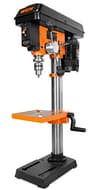
The upgrade worth paying for is not the extra two inches of swing, it is the speed dial. Mechanical variable speed from 530 to 3100 RPM with a digital readout means you set the speed for the bit instead of accepting whatever belt position you last used, and 530 RPM is slow enough for the large Forstner bits that make a drill press worth owning. What it does not give you is more depth: the spindle still travels two inches.
The only machine in this roundup whose listing says a fence comes with it, and a fence is the single accessory that turns a drill press from a metalworker's tool into a woodworker's one. It is what lets you bore a row of shelf-pin holes at a repeatable distance from an edge instead of measuring each one. Everything else about it is a competent 10-inch machine from a brand with no US service presence.
The lightest machine here by a wide margin — 48 pounds against 57 to 85 — which sounds like a weakness and is often the opposite in a garage. A drill press you can lift onto a bench alone, or move when the car has to come in, is a drill press you will keep. You pay a brand premium for a JET and the listing is thin on specifications, so buy this one for the weight, the dealer network and the 630 to 3300 RPM range, not for a spec sheet win.
The one with the safety feature nobody else lists. A bump-off switch is a paddle big enough to shut the machine down with a hip or a forearm, which is what you have available when both hands are holding a part that has started to spin. Add a tilting table that goes 45 degrees either way and an LED light, and this is the most thoughtfully equipped 10-inch machine here. Its listing is also the least forthcoming about numbers.
The upgrade worth paying for is not the extra two inches of swing, it is the speed dial. Mechanical variable speed from 530 to 3100 RPM with a digital readout means you set the speed for the bit instead of accepting whatever belt position you last used, and 530 RPM is slow enough for the large Forstner bits that make a drill press worth owning. What it does not give you is more depth: the spindle still travels two inches.
Strengths
+Mechanical variable speed across a stated 530 to 3100 RPM, set with a dial rather than by lifting the cover and moving a belt
+Digital speed readout, so "slow for a big bit" becomes a number you can repeat rather than a guess
+Adjustable depth stop, laser and a 1/2-inch keyed chuck with onboard key storage are all in the box per the listing, plus a stated two-year warranty
Trade-offs
−Still only 2 inches of spindle travel - identical to the 8-inch machine at roughly two and a half times the price. If depth per pull is your problem, this is not the fix
−The 8 by 7.5 inch beveling table is still small for furniture parts, so an aftermarket or shop-made table is still on the list
−The listing contradicts itself on weight: the feature bullets say 57 pounds, the product-info block says about 66. Either way it is a two-person lift onto a bench
−The laser is a Class IIIA 2.5 mW unit by the listing's own figure. Treat it as a rough centering aid, not a reason to stop using a center punch
Type
Benchtop drill press
In the set
Single tool
Material / build
Cast iron
Key spec
10 in swing; 2 in spindle travel; variable 530-3100 RPM; 1/2 in chuck
Best for
Best variable speed
Worth knowing. The listing states "a 6.2-amp induction motor, a 10-inch swing, and a 2-inch spindle travel", that you "adjust the mechanical variable speed anywhere from 530 to 3100 RPM", a "digital speed readout", a size of "13.2 by 19.3 by 33.9 inches" with "a weight of 57 pounds", and that the box includes "a class IIIA 2.5mW laser, adjustable depth stop, beveling 8 by 7.5-inch work table, 1/2-inch capacity keyed chuck, a chuck key with onboard storage, and a two-year warranty". Part number DP1062V. The product-info block gives the weight as roughly 66 pounds, which disagrees with the bullets; both figures are recorded here rather than choosing one. No runout figure is published.
Specs read from the product listing, on October 9, 2026. “Not listed” means the listing doesn’t state that figure.
#2Only one with a fence
Bucktool DP25016A2 10-Inch Benchtop Drill Press
The only machine in this roundup whose listing says a fence comes with it, and a fence is the single accessory that turns a drill press from a metalworker's tool into a woodworker's one. It is what lets you bore a row of shelf-pin holes at a repeatable distance from an edge instead of measuring each one. Everything else about it is a competent 10-inch machine from a brand with no US service presence.
Strengths
+The listing states a fence and head assembly that "helps to support stock on the edge" ship with the machine - the woodworking accessory you otherwise buy separately for a meaningful fraction of the price
+Five stated speeds from 650 to 3100 RPM, with the slow end where big flat-bottomed bits want to run
+Removable switch keys, which the listing says "prevent unintentional starts" - the cheapest real safety feature on any machine here
+CSA certification is named on the listing, which is more than most budget machines claim
Trade-offs
−The listing itself calls the 10-inch swing suitable for "light-duty drilling tasks" - the maker is telling you its limits and it is worth believing
−2 inches of spindle travel, the same depth cap as the cheapest machine here
−Bucktool has no meaningful US dealer or service network, so a failed switch or motor is an Amazon return rather than a parts order
−No table size and no machine weight is published, so you are planning bench space and a lift blind
Type
Benchtop drill press
In the set
Single tool
Material / build
Cast iron base
Key spec
10 in swing; 2 in spindle travel; 5 speeds, 650-3100 RPM; 1/2 in chuck; fence included
Best for
Best value with a fence included
Worth knowing. The listing states "CSA Certification, 3/4HP 6.2-Amp motor, 2-inch spindle travel, 1/2-inch keyed chuck, 30-inch total height, 120VAC" and that the "10-inch swings suit for a variety of light-duty drilling tasks"; five speeds of "650/1100/1700/2300/3100 RPM" changed "by changing the belt position on the pulleys located under the top cover"; a worktable that "bevel 45 degrees" with "built-in LED lights"; that "the fence and head assembly fit our drill press table, helps to support stock on the edge, and provide chunk clearance"; "Removable switch keys prevent unintentional starts"; and "a robust cast iron base". Part number DP25016A2, size field "10 Inch, 6.0 A, 3/4 HP, 5-Speed" - which disagrees with the 6.2-amp figure in the bullets, and both are recorded here. No table size and no weight is published.
Specs read from the product listing, on October 9, 2026. “Not listed” means the listing doesn’t state that figure.
#3Best if you have to move it
JET JWDP-10 10-Inch Benchtop Drill Press
The lightest machine here by a wide margin — 48 pounds against 57 to 85 — which sounds like a weakness and is often the opposite in a garage. A drill press you can lift onto a bench alone, or move when the car has to come in, is a drill press you will keep. You pay a brand premium for a JET and the listing is thin on specifications, so buy this one for the weight, the dealer network and the 630 to 3300 RPM range, not for a spec sheet win.
Strengths
+48.5 pounds by the listing's own figure - the only machine here one person can lift onto a bench without a second pair of hands
+A stated 630 to 3300 RPM across five speeds, the widest published range in this roundup
+JET sells through woodworking dealers rather than only online, so parts and a service conversation exist - which over a ten-year machine is worth real money
Trade-offs
−The most expensive 10-inch machine here, and the premium buys brand and support rather than capability
−The listing publishes no spindle travel, no chuck capacity and no table size, which is three of the four numbers you would want to compare
−Lighter means less mass to absorb vibration. Bolt it down - a 48-pound machine will walk on a bench top under a big bit far sooner than an 85-pound one
−The listing's own part-number field reads JWBS-10, which is a bandsaw designation, so the model had to be confirmed from the title and the feature bullets instead
Type
Benchtop drill press
In the set
Single tool
Material / build
Not listed
Key spec
10 in swing; 5 speeds, 630-3300 RPM; 48.5 lb; spindle travel not listed
Best for
Best if you have to move it
Worth knowing. The listing's title is "JWDP-10 JET 10\" DRILL PRESS (JT1-3162)" and its bullets state a "10 Inch Swing", a "630 to 3300 RPM Speed Range - Supports 5 optimized drilling speeds", that the "Table Tilts +/-45", "120V Operation" and "Only 48 lbs.", with a product-info weight of 48.5 pounds. Spindle travel, chuck capacity and table size are not published. The listing's manufacturer part-number field returns JWBS-10, a bandsaw model designation that contradicts its own title; the model written up here is taken from the title and the feature bullets, and the discrepancy is recorded rather than smoothed over.
Specs read from the product listing, on October 9, 2026. “Not listed” means the listing doesn’t state that figure.
The one with the safety feature nobody else lists. A bump-off switch is a paddle big enough to shut the machine down with a hip or a forearm, which is what you have available when both hands are holding a part that has started to spin. Add a tilting table that goes 45 degrees either way and an LED light, and this is the most thoughtfully equipped 10-inch machine here. Its listing is also the least forthcoming about numbers.
Strengths
+Bump-off switch - a large paddle you can hit with a hip or a forearm when both hands are occupied, which is exactly when you need it
+Table tilts 0 to 45 degrees left AND right by the listing's own wording, so angled holes do not depend on which side the work sits
+Laser alignment and an LED worklight, with the laser's own figures published (Class II, 0.83 mW maximum average radiant power) rather than left vague
Trade-offs
−Five belt-change speeds from 610 to 2800 RPM, not variable - and 2800 RPM is the lowest top speed here, which only matters for very small bits
−The listing publishes no spindle travel, no chuck capacity and no table size, so three of the four specs that decide a drill press purchase are simply absent
−Its product-info dimensions read 1 by 1 by 1 inch, an obvious placeholder, so there is no shipping weight to plan a bench around
−Priced level with machines that do publish their numbers, which is a lot of faith to extend
Type
Benchtop drill press
In the set
Single tool
Material / build
Not listed
Key spec
10 in swing; 5 speeds, 610-2800 RPM; spindle travel and chuck not listed
Best for
Best safety features
Worth knowing. The listing states a "POWERFUL 6.2 AMP INDUCTION MOTOR", a "5-SPEED SYSTEM - Take advantage of 5 speeds from 610 to 2800 RPM", a "LASER ALIGNMENT SYSTEM" with "Laser Class: II; Maximum Average Radiant Power: 0.83mW", an "ADJUSTABLE DEPTH STOP", "ADJUSTABLE TABLE HEIGHT", an "LED WORKLIGHT", a "BUMP-OFF SWITCH" and a "TILTING WORK SURFACE" with "0- to 45-degree left and right tilting". Part number DP9505-00. Spindle travel, chuck capacity, table size and weight are not published anywhere on the listing, and its product-info dimensions are a 1 by 1 by 1 inch placeholder - hence the nulls above.
Specs read from the product listing, on October 9, 2026. “Not listed” means the listing doesn’t state that figure.
Spindle travel is the ceiling in this whole band
Swing — the 10 inch figure in every title — is twice the distance from the chuck centre to the column, so it describes how wide a board you can reach into, not how deep you can drill. Spindle travel is the depth the quill moves in one pull of the handles, and every machine here that publishes it says 2 inches.
In practice that means a through-hole in 3/4 in stock is trivial, a 2 in deep mortise bore is at the limit, and anything deeper needs the table raised and a second pull — which costs you the registration that made the drill press worth using. If your work is deep boring, the honest advice is to save for a 12 in machine with more travel rather than to buy the best 10 in press.
The other spec worth naming: chuck capacity, 1/2 in on the two machines that publish it, which covers every woodworking bit you are likely to own. Our drill bit roundup and the Forstner versus spade bit comparison are the pages that decide what you actually chuck into one of these.
A fence is the upgrade that changes what it can do
The Bucktool DP25016A2is here for one reason: its listing states that a fence and head assembly which “helps to support stock on the edge” ships with the machine. A fence is what lets you bore a row of shelf-pin holes at a repeatable distance from an edge instead of measuring each one, and it is the accessory that turns a drill press from a metalworker’s tool into a woodworker’s. Bought separately, a table-and-fence kit costs a meaningful fraction of any machine on this page.
Its listing also states five speeds from 650 to 3100 RPM changed by moving the belt, a 3/4 HP 6.2 amp motor, 2 in of spindle travel, a 1/2 in keyed chuck, a 45-degree bevelling table with built-in LED lights, and removable switch keys to prevent unintentional starts.
The honest costs are support and candour. The listing itself calls the 10 in swing suitable for “light-duty drilling tasks” — the maker is telling you its limits, and it is worth believing — and Bucktool has no meaningful US dealer or service network, so a failed switch is an Amazon return rather than a parts order. That is exactly the axis on which the JET earns its premium: dealers, parts and a service conversation over a ten-year machine.
Weight, safety and the thing that actually hurts people
The hazard on a drill press is not the bit, it is the workpiece. A part that is not clamped will, sooner or later, catch and spin — and it does it at the exact moment both your hands are occupied. That is why the Skil’s bump-off switch is a real feature rather than a bullet point: a paddle you can hit with a hip or a forearm is the only control you can reach with your hands full.
The fix that costs nothing is to clamp the work to the table every time, and to add a backing board under it so the bit exits into sacrificial stock instead of tearing out. Our guide to drilling straight holes covers both, and how to drill wood without splintering is the companion for the exit side.
Weight cuts both ways. The JET’s listed 48.5 lb is the only machine here one person can lift onto a bench alone — which in a garage that doubles as a car park is the difference between a machine you keep and a machine you resent. But less mass means less vibration absorption, so bolt it down: a 48-pound machine walks on a bench top under a big bit far sooner than an 85-pound one.
The one to buy
The WEN DP1062V for most people: variable speed is the feature you will use on every big bit, and the digital readout makes it repeatable. The Skil if the budget is the constraint and you value the bump-off switch — which is a defensible reason to choose it. The Bucktool if the included fence appeals more than a speed dial, accepting the support trade. The JET if the machine has to move, and plan to bolt it down.
Frequently asked questions
What is the best drill press under $200?+
The WEN DP1062V. At this price the upgrade worth paying for is speed control rather than swing, and its mechanical variable speed with a digital readout - a stated 530 to 3100 RPM - is what lets you run large Forstner bits slowly and repeatably. It does not give you more depth: like everything in this band it publishes 2 inches of spindle travel.
Is a benchtop drill press good enough for woodworking?+
Yes, for the things a woodworker actually wants: perpendicular holes, repeatable holes and clean large-diameter bores. The limits are depth per pull, usually 2 inches, and table size, which is small on every machine in this band. A shop-made table and fence fixes the second problem for the cost of a sheet of plywood.
What is spindle travel and why does it matter?+
Spindle travel is how far the quill moves down in one pull of the handles - the maximum depth you can drill without repositioning the work. Every drill press under $200 that publishes the figure states about 2 inches. Swing, the 10-inch number in the title, is a different thing: it describes how far from the column you can reach, not how deep you can go.
Do I need variable speed on a drill press?+
It is the single most useful feature at this price. Large Forstner bits and hole saws need low RPM or they burn the wood and dull quickly, and on a belt-change machine the slow speed means lifting the cover mid-job - so most people never change it. A dial makes the correct speed a thirty-second decision instead of a chore.
What is the most dangerous part of using a drill press?+
An unclamped workpiece. When a bit catches, it spins the part, and it happens when both of your hands are occupied holding it. Clamp the work to the table every time, use a backing board so the bit exits into sacrificial stock, and value a large bump-off switch you can hit with a hip or forearm.
Should I buy a drill press or a drill guide?+
A drill guide if your holes are through-holes in thin stock with twist bits - it costs a fraction of a press and stores in a drawer. A drill press once you are boring large flat-bottomed holes, rows of repeated holes, or anything that must be dead square through thick stock, because that is where a guide's accuracy runs out.