A brad nailer needs about 2 CFM at 90 PSI, which almost every small compressor delivers - so the spec that should decide your purchase is noise, and it runs from 56 to 79 dBA. Ten compressors, hoses and fittings compared on the figures the listings actually publish.
Here is the unusual thing about this purchase: the spec everyone shops on barely matters. Our guide to whether you need a compressor at all does the arithmetic — an 18-gauge brad nailer fires a short burst using roughly 0.3 cubic feet of air per shot, so about 2 CFM at 90 PSI covers hand-nailing and a 1 to 6 gallon tank is ample. Every machine on this page except one meets that, and most exceed it comfortably. Tank size and horsepower are not what separates them.
What separates them is noise, and the range is enormous. The pancake compressors here publish 78.5 dBA or no figure at all; the quiet machines publish 56 and 59 dBA. That is not a small difference — roughly 20 dB is a four-fold change in perceived loudness. In a detached workshop it is a footnote. In a garage attached to a house where someone is asleep upstairs, it is the only spec that decides whether the tool gets used.
So the lens, in order of how much it changes your life. Noise first, because the CFM is already sufficient. CFM at 90 PSI second— 2 CFM for nailing, 4 CFM and up if you ever want a sander, sprayer or impact wrench, and note that three listings here publish no CFM figure at all. Tank size third, which decides how often the motor restarts rather than whether the nailer works. What is in the box last: a compressor with no hose and no fittings cannot drive a nail, and that is a real cost people forget to budget.
And keep the honest answer from that guide in view: for a home shop, a cordless brad naileris often the better buy. No hose across the floor, no motor cycling, nothing to drain. Buy a compressor if you already own a pneumatic nailer, if you want a tool that will never need a battery, or if you want shop air for blowing out joinery and inflating tires. Prices are live and the brackets in the prose are qualitative, because they move. Every spec on every card was read from that seller’s own listing on the date shown on the card. Here is exactly what we do instead of testing.
Shopping to a number rather than to a tool? Four of the ten entries here price under two hundred dollars, and our best air compressor under $200 page compares just those on what is in the box and what noise figure each listing publishes.
How this is funded: we earn a commission if you buy through our links, at no extra cost to you. It never changes which tool we recommend, and we’ll tell you plainly when to skip one. Full disclosure.
Quick picks
Ranked on the specs that matter for a beginner and honest buyer fit. Select a row to jump to the full write-up. We haven’t hands-on-tested these — here is exactly what we do instead.
#
Product
Best for
Price
1
Bostitch BTFP02012 Pancake Air Compressor, 6 Gallon
The compressor most beginner woodworkers end up owning, and for good reason: 2.6 SCFM at 90 PSI is comfortably more than a brad nailer asks for, the pump is oil-free so there is nothing to maintain, and 29 lb means it moves. It is also one of the louder machines here, which in a garage attached to a house is the thing you will care about by week two.
California Air Tools CAT-1P1060S Light & Quiet Portable Air Compressor, 1 Gallon
The quietest machine on this page at a published 56 dBA, and for a garage shop attached to a house that number matters more than any other spec here. 1.2 CFM at 90 PSI is modest, and the listing names brad nailers, finish nailers and staplers directly - which is the whole job. If your shop shares a wall with a bedroom, start here.
Craftsman CMXECXA0210641C 6-Gallon Pancake Air Compressor with 25 ft Hose
The same 6 gallon, 2.6 SCFM specification as the Bostitch, with a 25 ft hose in the box and a lower price. If you have no hose yet - and if this is your first compressor, you do not - this is the cheapest way to get from a sealed box to driving a nail.
The other quiet 1 gallon machine, at a published 59 dB and 25.2 lb - the lightest compressor here. A steel roll cage and a shaped rubber handle make it the one that survives being carried around and set down carelessly, which is how a small compressor actually lives.
California Air Tools 8010 Ultra Quiet Air Compressor, 8 Gallon Steel Tank
Quiet and big, which is the combination nothing else here offers. 60 dBA with 2.2 CFM at 90 PSI and an 8 gallon tank on wheels is the compressor to buy if you expect to use air for more than nailing but still have to work next to a house. It publishes a recovery time, which almost no listing in this category does.
Metabo HPT EC914S Pancake Air Compressor, 6 Gallon, 200 PSI
The one to buy if the compressor has to do more than brad nailing. 4 CFM at 90 PSI is roughly half again what the 2.6 SCFM machines deliver, and 200 PSI of tank pressure means more usable air stored in the same 6 gallons. For a woodworker it is more machine than the job needs - which is exactly why it is the one that still works when the job changes.
Craftsman CMXECXA0200244A 2 Gallon Air Compressor with 10-Piece Accessory Kit
The cheapest way into air, and the one that arrives with the fittings. 19 lb, 2 gallons, 125 PSI and a box of couplers, plugs, a blowgun and a tire chuck - which is most of the shopping list a first compressor generates. Read the honest con first: it publishes no CFM figure, so nothing here promises it will keep up with a nailer.
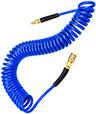
Yotoo Polyurethane Recoil Air Hose, 1/4 in x 25 ft
The hose to buy with a compressor that does not include one, and a recoil hose is the right type for a small shop: it springs back on itself when you drop it, so it does not lie across the floor waiting to be tripped over. It arrives with the coupler and plug fitted, which is the difference between working tonight and ordering fittings.
Amazon Basics Quick Connect Brass Air Coupler and Plug Kit, 14 Count
The small box that stops a compressor purchase stalling. Every air tool needs a plug on its inlet and every hose end needs a coupler, and they are sold separately from both. Fourteen brass fittings cost less than a single router bit and mean you can connect whatever turns up.
The professional answer, listed so you can see what you are declining and why. A cast iron, oil-lubricated pump turning at 1,730 RPM delivers 4.2 CFM at 90 PSI at 79 dB, and it will outlast every oil-free machine here several times over. It costs roughly double, needs its oil checked, and does nothing extra for a brad nailer.
Bostitch BTFP02012 Pancake Air Compressor, 6 Gallon
The compressor most beginner woodworkers end up owning, and for good reason: 2.6 SCFM at 90 PSI is comfortably more than a brad nailer asks for, the pump is oil-free so there is nothing to maintain, and 29 lb means it moves. It is also one of the louder machines here, which in a garage attached to a house is the thing you will care about by week two.
Strengths
+2.6 SCFM delivered at 90 PSI against the roughly 0.3 cu ft a brad nailer uses per shot - you will never outrun it hand-nailing
+Oil-free, maintenance-free pump: no oil to check, no oil to change, no sump to worry about when it sits all winter
+Two universal couplers, so a nailer and a blowgun can both stay connected
+High-efficiency motor the maker says starts in cold weather or on a 50 ft, 14 gauge extension cord - which is exactly how a garage shop is wired
Trade-offs
−78.5 dBA on the listing's own figure is the loudest of the small units here - loud enough that you will not run it while anyone is asleep
−150 max PSI is tank pressure, not working pressure; a brad nailer runs at 70 to 120 PSI and the regulator does the rest
−The tank still has to be drained after use or it rusts from the inside, which is the one maintenance job an oil-free pump does not remove
−A 6 gallon tank is more than brad nailing needs and the extra is dead weight unless you also spray or inflate
Type
Pancake air compressor
In the set
Single tool
Material / build
Steel tank, oil-free pump
Key spec
6 gal; 150 max PSI; 2.6 SCFM at 90 PSI; 78.5 dBA; 29 lb per listing
Best for
Best overall for a brad or finish nailer
Worth knowing. The listing states a "long-life oil-free, maintenance-free pump", "150 max PSI 6.0 gallon tank (22.7 L) and 2.6 SCFM* delivered @ 90 PSI pump", a "high efficiency motor ... made for easy start up in cold weather or extension cord application [14 GA or larger, 50 ft. (15.2 m) or less]", "78.5 dBA** operational noise level", "29 lb. weight makes unit easy to carry and store", a "high flow regulator and couplers", and "Two universal couplers to easily support two users". NOTE: the product-info block gives the weight as 31 lb while the feature bullet says 29 lb - both are recorded and neither is resolved here. Product-info color Yellow, 17 x 17 x 19.25 in; part number and model BTFP02012; warranty "1 year limited manufacturer warranty". The asterisks on the SCFM and dBA figures are the listing's own and no test standard is named.
Specs read from the product listing, on November 6, 2026. “Not listed” means the listing doesn’t state that figure.
#2Quietest
California Air Tools CAT-1P1060S Light & Quiet Portable Air Compressor, 1 Gallon
The quietest machine on this page at a published 56 dBA, and for a garage shop attached to a house that number matters more than any other spec here. 1.2 CFM at 90 PSI is modest, and the listing names brad nailers, finish nailers and staplers directly - which is the whole job. If your shop shares a wall with a bedroom, start here.
Strengths
+56 dBA published, the lowest figure on the page - and 22 dB below the 78.5 dBA pancakes, which on the usual 10 dB-per-doubling rule is roughly a quarter of the perceived loudness
+1.2 CFM at 90 PSI and 1.6 CFM at 40 PSI, with the listing naming staple guns, brad nailers, finish nailers, airbrushes and blow guns
+Oil-free single piston rated by the maker at over 3,000 hours before wear, with the motor running at only 1,680 RPM
+29 lb and a 12.5 x 14.7 x 14.75 in footprint, so it fits on a shelf rather than owning a corner of the floor
Trade-offs
−1 gallon and 1.2 CFM is a genuine limit: fine for hand-nailing, useless for a sprayer, a sander or an impact wrench
−A small tank means the motor restarts constantly - quiet, but running far more of the time than a 6 gallon unit would
−Maximum pressure is not published on this listing, so there is no figure for how much usable air the gallon actually holds
−The 3,000-hour life figure is the maker's own with no standard named, and nothing here verifies it
Type
Ultra-quiet portable air compressor
In the set
Single tool
Material / build
Steel tank, oil-free single-piston pump
Key spec
1 gal; 1.2 CFM at 90 PSI, 1.6 CFM at 40 PSI; 56 dBA; 0.6 HP at 1,680 RPM; 29 lb
Best for
Best quiet compressor for a shared garage
Worth knowing. The listing states it "operates at only 56 decibels, making it one of the quietest air compressors available", "Airflow 1.20 CFM @ 90 PSI and 1.60 CFM @ 40 PSI", an "oil-free Oil-Free Single Piston pump" (sic) "built to last over 3000 hours before wear", a "high-performance .6 HP motor" that "operates at only 1680 RPM", that it is "only 29 lbs", and that "The 1P1060S produces 1.2 CFM @ 90 PSI, making it ideal for staple guns, brad nail guns, finish nail guns, nail guns, airbrushes, and blow guns", with "Product dimensions - L (12.5\") x W/D (14.7\") x H (14.75\")". Product-info color Silver, size "1 Gallon", 29 lb; part number and model CAT-1P1060S; warranty "1 Year Limited Warranty". NO maximum tank pressure and no recovery time is published on this listing.
Specs read from the product listing, on November 6, 2026. “Not listed” means the listing doesn’t state that figure.
#3Best value, hose included
Craftsman CMXECXA0210641C 6-Gallon Pancake Air Compressor with 25 ft Hose
The same 6 gallon, 2.6 SCFM specification as the Bostitch, with a 25 ft hose in the box and a lower price. If you have no hose yet - and if this is your first compressor, you do not - this is the cheapest way to get from a sealed box to driving a nail.
Strengths
+Includes the 25 ft hose, which otherwise costs real money and is the part people forget to order
+2.6 SCFM at 90 PSI and 150 max PSI, the same working specification as the Bostitch above
+Dual gauges and a large regulator, plus dual universal quick couplers for two tools
+A drain valve to remove moisture, which is the maintenance job that decides how long the tank lasts
Trade-offs
−The listing publishes NO noise figure at all, which on a pancake compressor is the spec most likely to make you regret the purchase
−30.8 lb, slightly heavier than the Bostitch, with the same flat pancake shape that is awkward to carry one-handed
−1.0 HP, 120V and oil-free means it is built to the same price point as everything else in this class, not above it
−Bullet text is formatted with decorative brackets and reads as a generic marketplace listing rather than a Craftsman spec sheet
Type
Pancake air compressor with hose
In the set
Single tool
Material / build
Steel tank, oil-free pump
Key spec
6 gal; 150 max PSI; 2.6 SCFM at 90 PSI; 1.0 HP 120V; 25 ft hose included; 30.8 lb
Best for
Best value: compressor and hose in one box
Worth knowing. The listing states it "Delivers a maximum 150 PSI tank pressure and 2.6 SCFM at 90 PSI, with a durable oil-free pump requiring no external lubrication", that it is "perfect for professional-grade finish nailers, brad nailers, and precision trim work", a "Compact 6-gallon pancake-style tank with a lightweight 30.8 lb build, sturdy rubber-grip handle, and rubber foot pads", a "low-voltage start motor" for "cold weather or with extension cords", "Dual gauges", a "large regulator", "dual universal quick couplers to run two tools simultaneously", "a convenient drain valve to remove moisture", and a "1.0 HP 120V motor" "backed by a 1-year limited warranty". Product-info color Red, 17.3 x 15.9 x 16.5 in, 30.8 lb; part number and model CMXECXA0210641C. NO noise (dBA) figure, no tank recovery time and no hose material is published on this listing.
Specs read from the product listing, on November 6, 2026. “Not listed” means the listing doesn’t state that figure.
#4Lightest quiet option
Metabo HPT EC28M Quiet Air Compressor, 1 Gallon
The other quiet 1 gallon machine, at a published 59 dB and 25.2 lb - the lightest compressor here. A steel roll cage and a shaped rubber handle make it the one that survives being carried around and set down carelessly, which is how a small compressor actually lives.
Strengths
+59 dB published, quiet enough that the listing claims a normal conversation can continue while it cycles
+25.2 lb, the lightest machine on this page, with a steel roll cage protecting the gauges and regulator
+Universal quick coupler and an integrated control panel for accurate PSI adjustment
+Overload protection circuit that cuts power rather than cooking the motor - worth having on a tool run off a garage extension cord
Trade-offs
−The listing publishes NO CFM figure at all, which for a compressor is the single most important number - so you are buying on the dB figure and the brand
−No maximum tank pressure published either, so there is no way to compare its stored air against the 1 gallon California unit
−1 gallon, so the same restart-constantly behavior as every small-tank machine
−The bullets are written for framing, siding and roofing crews, none of which is what a 1 gallon compressor is for
Worth knowing. The listing states it "operates at only 59 dB, so quiet that a normal conversation can take place while the compressor is cycling", that it "features a universal quick coupler for fast tool changes between framing, siding, finish, roofing nailers and others", that "The integrated control panel allows for accurate PSI adjustments", that "Weighing only 25.2 lbs, this 1 gallon air compressor is easy to transport", with an "ergonomically shaped rubber carrying handle and steel roll cage design", that the "quiet operation of this oil-free compressor provides high durability with no maintenance", and that "The motor is protected by an overload protection circuit". Product-info 14 x 14 x 13.5 in, 25.2 lb; part number and model EC28M; warranty "1 year". NO CFM figure, NO maximum PSI and NO horsepower is published on this listing - the absence is stated in the cons rather than filled in with a guess.
Specs read from the product listing, on November 6, 2026. “Not listed” means the listing doesn’t state that figure.
#5Best quiet with capacity
California Air Tools 8010 Ultra Quiet Air Compressor, 8 Gallon Steel Tank
Quiet and big, which is the combination nothing else here offers. 60 dBA with 2.2 CFM at 90 PSI and an 8 gallon tank on wheels is the compressor to buy if you expect to use air for more than nailing but still have to work next to a house. It publishes a recovery time, which almost no listing in this category does.
Strengths
+60 dBA with 2.2 CFM at 90 PSI - roughly pancake-compressor flow at roughly library noise
+Publishes the numbers that matter for real work: 120 PSI maximum, 165 second tank fill, and 60 seconds to recover from 90 to 120 PSI
+Oil-free dual piston pump rated by the maker at over 3,000 hours, running at 1,680 RPM
+8 gallons on a wheel kit, so the capacity does not cost you the ability to move it
Trade-offs
−48 lb and 26 x 14 x 23 in - it takes real floor space and does not go on a shelf
−Maximum 120 PSI against 150 or 200 on the pancakes, so it stores less air per gallon than the tank size suggests
−Costs about what a loud 6 gallon pancake costs plus a hose, so you pay for the quiet rather than for capability
−The 3,000-hour pump life is the maker's claim with no standard behind it, same as their 1 gallon machine
Type
Ultra-quiet wheeled air compressor
In the set
Single tool
Material / build
Steel tank, oil-free dual-piston pump
Key spec
8 gal; 120 max PSI; 2.2 CFM at 90 PSI, 3.1 at 40 PSI; 60 dBA; 1.0 HP at 1,680 RPM; 48 lb
Best for
Best quiet machine with real capacity
Worth knowing. The listing states it "operates at only 60 decibels", "Airflow is 3.10 CFM at 40 PSI and 2.20 CFM at 90 PSI", an "oil-free Dual Piston Pump System" "built to last over 3000 hours before wear", a "powerful 1.0 HP motor" that "operates at only 1680 RPM", that it is "only 48 lbs and equipped with a wheel kit", and that it will "Achieve maximum pressure of 120 PSI with a fast tank fill time of 165 seconds and a recovery time from 90 PSI to 120 PSI in just 60 seconds", with "Product dimensions - 26\" L x 14\" W x 23\" H". Product-info color Silver, size "8 Gallon", 48 lb; part number and model 8010; warranty "1 Year Limited Warranty". The 3,000-hour figure names no test standard.
Specs read from the product listing, on November 6, 2026. “Not listed” means the listing doesn’t state that figure.
#6Most airflow
Metabo HPT EC914S Pancake Air Compressor, 6 Gallon, 200 PSI
The one to buy if the compressor has to do more than brad nailing. 4 CFM at 90 PSI is roughly half again what the 2.6 SCFM machines deliver, and 200 PSI of tank pressure means more usable air stored in the same 6 gallons. For a woodworker it is more machine than the job needs - which is exactly why it is the one that still works when the job changes.
Strengths
+4 CFM at 90 PSI, the highest flow of the portable units here, and the listing states it will run five brad nailers at once
+200 PSI tank pressure means more air stored per gallon, so the motor cycles less often on the same work
+Oil-free pump with a 1-year warranty from a nailer brand that has been in the trade a long time
+42 lb and pancake-shaped - the listing notes it is 22% lighter than a twin-stack of comparable capacity
Trade-offs
−The listing publishes NO noise figure, and higher pressure generally means a harder-working pump
−Heaviest of the pancakes here at 41 to 42 lb, which is a two-handed carry up a step
−All the marketing is about framing, roofing and siding crews - none of which a furniture shop does, so you are buying capacity you will not use
−NOTE THE WEIGHT CONFLICT on the listing: a bullet says 42 lbs while the product-info block says 41 lb
Type
High-pressure pancake air compressor
In the set
Single tool
Material / build
Steel tank, oil-free pump
Key spec
6 gal; 200 PSI; 4 CFM at 90 PSI; 41-42 lb
Best for
Best airflow for more than nailing
Worth knowing. The listing states "At 200 PSI, THE TANK from Metabo HPT offers 25% more pressure than a basic pancake air compressor", "Delivering 4 CFM at 90 PSI, this 6-gallon tank air compressor provides 30% more air flow, allowing multiple large body nailers to run simultaneously", that it "can simultaneously run 2 framing nailers, 2 roofing nailers, 2 siding nailers, 3 finish nailers, or 5 brad nailers", that "Weighing only 42 lbs, this pancake air compressor is 22% lighter than traditional twin-stack models", and that it "comes with Metabo HPT's 1-year warranty". Product-info color Green, size "6 Gallon", 18.5 x 16 x 16 in, 41 lb; part number EC914SM, model EC914S. NO dBA noise figure, no motor horsepower and no recovery time is published, and the weight bullet (42 lb) disagrees with the product-info weight (41 lb).
Specs read from the product listing, on November 6, 2026. “Not listed” means the listing doesn’t state that figure.
#7Cheapest start
Craftsman CMXECXA0200244A 2 Gallon Air Compressor with 10-Piece Accessory Kit
The cheapest way into air, and the one that arrives with the fittings. 19 lb, 2 gallons, 125 PSI and a box of couplers, plugs, a blowgun and a tire chuck - which is most of the shopping list a first compressor generates. Read the honest con first: it publishes no CFM figure, so nothing here promises it will keep up with a nailer.
Strengths
+Ships with the accessories that otherwise become a second order: hose, couplers, plugs, blow gun, tire chuck, gauge, nozzle and thread seal tape
+19 lb on the listing's own figure - light enough to carry in one hand up a step
+2 gallons and two quick couplings, with 125 PSI maximum and an oil-free, maintenance-free pump
+Overload protection and a designed heat-dissipation system, which matters on a small pump that will cycle often
Trade-offs
−NO CFM figure is published anywhere on the listing - the one number that decides whether it keeps up with a tool is simply absent
−1/3 HP is the smallest motor here by a wide margin, and 125 PSI the lowest maximum pressure
−No noise figure either, and small cheap pumps are rarely quiet ones
−The inclusions bullet lists "1/4 npt auto plug" twice and the product-info weight (24.5 lb) contradicts the 19 lb in the bullet - a sloppily written listing
Type
Compact air compressor with accessory kit
In the set
10 pieces
Material / build
Steel tank, oil-free pump
Key spec
2 gal; 125 max PSI; 1/3 HP; 10-piece accessory kit; 19 lb per listing; CFM not listed
Best for
Cheapest start, with fittings included
Worth knowing. The listing states inclusions of "1*air hose, 1* thread seal tape, 1* 1/4 fntp ball foot air chuck, 1* 1/4 npt auto plug, 1* 1/4 npt auto plug, 1* 1/4 npt auto coupler, 1* tire pressure gauge, 1* nozzle, 1* high performance blow gun and 1* sleeve" (the "auto plug" line appears twice, which is the listing's own duplication), that it "weighs only 19 Ibs", that it has a "1/3 HP UMC motor and two quick couplings, with a maximum pressure of 125 PSI", and an "oil-free maintenance-free pump system" with a "heat dissipation system and overload protection mechanism". Product-info color Red, size "With Accessories", weight 24.5 lb; model CMXECXA0200244A, no part number given. NO CFM figure, NO dBA figure and NO tank recovery time is published, and the two stated weights disagree.
Specs read from the product listing, on November 6, 2026. “Not listed” means the listing doesn’t state that figure.
#8Best hose
Yotoo Polyurethane Recoil Air Hose, 1/4 in x 25 ft
The hose to buy with a compressor that does not include one, and a recoil hose is the right type for a small shop: it springs back on itself when you drop it, so it does not lie across the floor waiting to be tripped over. It arrives with the coupler and plug fitted, which is the difference between working tonight and ordering fittings.
Strengths
+Self-coiling polyurethane - it snaps back when not in use, which is the whole argument against a straight rubber hose in a one-car garage
+Arrives with a 1/4 in industrial quick coupler and plug already installed, so no fittings order and no thread tape
+Rated to 150 PSI maximum working pressure and -40 to +150 degrees F, which covers an unheated garage in February
+Bend restrictors at both ends, which is where a coiled hose always fails first
Trade-offs
−A coiled hose pulls back against you as you work, so at full stretch it is fighting your hand - a straight hose does not
−25 ft coiled is noticeably shorter in practice than 25 ft straight, because the coil never fully extends
−1/4 in inner diameter is right for a brad nailer and too small for high-flow tools like a sander or a sprayer
−The industrial-type coupler fitted here is one of several incompatible US quick-connect profiles - check it matches your compressor's couplers
Type
Recoil air hose
In the set
Single tool
Material / build
Polyurethane
Key spec
1/4 in ID x 25 ft; 150 PSI max working pressure; -40 to +150 degrees F; industrial coupler and plug fitted
Best for
Best hose for a small shop
Worth knowing. The listing states "POLYURETHANE CONSTRUCTION: No tangles, anti kinking, abrasion resistance, durable and light weight", "1/4 inch inner diameter by 25 feet long", that "When not in use. The coiled hose will snap back automatively for saving spacing and easy storage" (sic), that "It delivers up to 150 PSI for maximum working pressure", a "-40 degrees to +150 degrees F temperature range", and "Installed 1/4\" heavy duty industrial quick coupler and plug" with "Bend restrictors" that "reduce kinking", noting the "quick coupler and plug CAN BE REMOVED by a wrench". Product-info color Blue, size "25 Feet", 1.32 lb; part number and model 102001; warranty "TWO YEAR WARRANTY". No burst pressure and no coil memory figure is published.
Specs read from the product listing, on November 6, 2026. “Not listed” means the listing doesn’t state that figure.
#9Best fittings kit
Amazon Basics Quick Connect Brass Air Coupler and Plug Kit, 14 Count
The small box that stops a compressor purchase stalling. Every air tool needs a plug on its inlet and every hose end needs a coupler, and they are sold separately from both. Fourteen brass fittings cost less than a single router bit and mean you can connect whatever turns up.
Strengths
+Fourteen pieces - two female couplers, two male couplers, four female plugs and six male plugs - which covers a nailer, a blowgun and a spare hose end
+Brass rather than plated steel, so the threads survive being taken apart and refitted
+Deep-knurled sockets with a ball-locking mechanism, which is what gives a connection you can feel click home
+Costs a fraction of what the same fittings cost bought singly at a hardware counter
Trade-offs
−US quick-connect couplers come in several incompatible profiles (industrial, automotive, ARO) and this listing only says "IM" - match it to the couplers already on your compressor before you buy
−1/4 in NPT only, so it is the wrong kit for 3/8 in plumbing on a larger shop compressor
−No thread sealant included, and NPT threads on air fittings need tape or paste to seal properly
−No pressure rating is published on the listing at all
Type
Air fittings kit
In the set
14 pieces
Material / build
Brass
Key spec
14 pieces; 1/4 in NPT; 2 female + 2 male couplers, 4 female + 6 male plugs; ball-locking
Best for
Best fittings kit to buy alongside
Worth knowing. The listing states a "Brass plug and coupler accessory kit", that it is "Compatible with 1/4-Inch NPT air compressors (compressor not included)", a "Deep-knurled socket for a positive connection with ball-locking mechanism", and that the "Kit includes (2) 1/4\" NPT IM female couplers, (2) 1/4\" NPT IM male couplers, (4) 1/4\" NPT IM female plugs, and (6) 1/4\" NPT IM male plugs". Product-info color Brass, size "14 count (Pack of 1)", 1.28 lb; part number and model A140001. NO maximum pressure rating and no explicit coupler profile standard is published - "IM" is the only designation given, which is why the cons tell you to match it against your existing couplers rather than assume.
Specs read from the product listing, on November 6, 2026. “Not listed” means the listing doesn’t state that figure.
#10The professional step up to skip
Makita MAC2400 Big Bore 2.5 HP Air Compressor
The professional answer, listed so you can see what you are declining and why. A cast iron, oil-lubricated pump turning at 1,730 RPM delivers 4.2 CFM at 90 PSI at 79 dB, and it will outlast every oil-free machine here several times over. It costs roughly double, needs its oil checked, and does nothing extra for a brad nailer.
Strengths
+4.2 CFM at 90 PSI from a 2.5 HP 4-pole motor - the most air on this page, enough for tools a nailer-sized compressor cannot run
+Cast iron Big Bore cylinder, oil-lubricated and removable for maintenance, which is why these machines last decades on job sites
+Runs at only 1,730 RPM for 79 dB and lower wear, with a large automotive-style air filter
+Low amp draw at start-up, so it is less likely to trip a shared garage breaker than its power suggests
Trade-offs
−Oil-lubricated means checking and changing oil, and it cannot be stored or run on its side the way an oil-free machine can
−79 dB is louder than every quiet machine here and only marginally better than a pancake, so the money does not buy silence
−Roughly double the price of a 6 gallon pancake for capability a furniture shop will not use
−The listing's own dimensions block reports a weight of 0 lb, so no weight figure is published - and these are heavy, two-handed machines
Type
Cast-iron, oil-lubricated air compressor
In the set
Single tool
Material / build
Cast iron pump, oil-lubricated
Key spec
2.5 HP 4-pole; 4.2 CFM at 90 PSI; 1,730 RPM; 79 dB; weight not listed
Best for
The professional step up to skip
Worth knowing. The listing states a "Cast iron pump with Big Bore cylinder and piston" "engineered to provide faster recovery time", a "Powerful 2.5 HP 4-Pole motor" that "produces 4.2 CFM at 90 PSI", "Roll-cage construction", "Low AMP draw" that "reduces incidences of tripped breakers at start-up", that the "Pump is oil-lubricated for cooler running temperatures and reduced wear", that the "Durable cast iron cylinder reduces wear and increases pump life; Removable for easy maintenance", a "Large automotive style industrial air filter", and that the "Pump runs at lower RPM (1,730) resulting in lower noise (79dB) and improved pump durability". Product-info 20 x 18 x 18.75 in with a weight field of 0 lb, which is not a figure and is treated as not published; part number and model MAC2400; warranty "1 Year Parts & Labor". NO tank size is stated on this listing.
Specs read from the product listing, on November 6, 2026. “Not listed” means the listing doesn’t state that figure.
The specs that matter, and the ones that do not
Compressor marketing leans on the two numbers that are least useful, so here is what each figure actually tells you.
CFM at 90 PSI is the real capacity figure.It is the rate the pump can supply air indefinitely, and it is the only number that decides whether a tool keeps working or waits. For brad nailing you want roughly 2 CFM; the Bostitch and the Craftsman pancakes publish 2.6 SCFM, the Metabo HPT EC914S publishes 4 CFM, and the Makita publishes 4.2. Three listings here — the Metabo HPT EC28M, the Craftsman 2 gallon and, on tank pressure, the California 1 gallon — publish no CFM figure at all, which we have stated on each card rather than filled in with an estimate.
Maximum PSI is storage, not power.A 150 or 200 PSI tank holds more air in the same volume than a 120 PSI tank, so it runs longer between motor cycles. It does not make the nailer hit harder: the regulator drops the pressure to the 70 to 120 PSI your tool wants regardless. The Metabo HPT EC914S’s 200 PSI is genuinely useful for this reason, and it is also why the California 8010’s 8 gallons at 120 PSI stores less than its size suggests.
Tank size decides restart frequency. A 1 gallon machine running a brad nailer will cycle constantly; a 6 gallon machine will fire a dozen nails on a tank. On a quiet compressor, constant cycling is fine. On a 78 dBA pancake, it is the thing that makes you stop working.
Horsepower is nearly meaningless here.It is an input figure, inconsistently rated across brands, and it tells you nothing the CFM does not. The Makita’s 2.5 HP matters because of what it drives — a cast iron pump turning slowly — not because of the number.
Oil-free versus oil-lubricatedis the one real design fork. Oil-free pumps need no maintenance, can be stored any way up, and wear out sooner; the makers of the California machines claim over 3,000 hours before wear, with no test standard named. Oil-lubricated pumps like the Makita’s cast iron Big Bore run cooler, last decades, and need their oil checked and changed. For a hobby shop that runs a compressor a few hours a month, oil-free is the right answer and it is what nine of these ten are.
Two published rules nobody follows
OSHA’s general industry standards cover compressed air, and two clauses are worth knowing before you plug one in. They are employer standards and do not bind a home shop, but they are the published versions of two things usually passed on as shop lore.
The 30 PSI cleaning limit. 1910.242(b) is one sentence: “Compressed air shall not be used for cleaning purposes except where reduced to less than 30 p.s.i. and then only with effective chip guarding and personal protective equipment.” A compressor regulated at 90 PSI to run a nailer is three times that. The first thing almost everyone does with a new compressor is blow sawdust off a bench with an unregulated blowgun, which fires grit at eye height at triple the limit the standard sets. Turn the regulator down, wear eye protection, and note that blowing dust around a shop makes it airborne rather than gone — a vacuum is the better tool.
The drain valve is not optional. 1910.169(b)(2): “A drain pipe and valve shall be installed at the lowest point of every air receiver”, with the receiver to be drained often enough to prevent an excessive accumulation of liquid. Compressing air condenses water out of it, and that water sits in the bottom of your tank rusting it from the inside. This is the one maintenance job an oil-free pump does not remove: open the drain after each session and let it hiss until it runs dry. A tank left wet in an unheated garage is the failure mode that ends these machines, which is the same reason everything else metal in a garage needs attention.
The same standard adds that every receiver needs an indicating pressure gage and one or more spring-loaded safety valves, and that “No valve of any type shall be placed between the air receiver and its safety valve or valves”. Every machine here ships compliant with that. It is worth knowing because it is the reason you never plumb or plug anything into the pop-off valve on top of the tank.
The hidden cost: hose and fittings
A compressor on its own cannot drive a nail. You need a hose, a coupler on the hose end, and a plug threaded into the nailer’s inlet, and most compressors ship with none of those. This is the part that turns a tidy purchase into three orders.
Two machines here solve it in the box. The Craftsman 6 gallon includes a 25 ft hose, and the Craftsman 2 gallon includes a ten-piece accessory kit with hose, couplers, plugs, a blowgun, a tire chuck and thread tape. Everything else needs the Yotoo recoil hose and the Amazon Basics brass coupler kit, which together cost less than a decent router bit.
One warning that trips up more first purchases than anything else: US quick-connect couplers come in several incompatible profiles — industrial, automotive and ARO all look similar and do not mate. The Amazon Basics kit calls its fittings “IM” and the Yotoo hose says “industrial”; neither names a standard beyond that. Check what is already fitted to your compressor and match it, or buy the hose and the fittings together so at least they agree with each other.
A recoil hose is the right type for a small shop, because it springs back on itself rather than lying across the floor waiting to be tripped over. The trade is that it pulls against your hand at full stretch and never quite extends to its stated length. For nailing within a few feet of the bench, that is the correct compromise. And 1/4 inch inner diameter is right for a nailer and too small for high-flow tools, which is one more reason the sander and sprayer plan is a different purchase entirely.
What to buy, in one paragraph
If you already own a pneumatic nailer and your shop is not attached to a bedroom, buy the Bostitch BTFP02012 and the Yotoo hose and fittings kit. If noise is the constraint, buy the California Air Tools CAT-1P1060S and accept that it nails and does little else. If you want to spend as little as possible to find out whether you like working with air, buy the Craftsman 2 gallon kit, which arrives with the fittings — and read its honest con first, because it publishes no CFM figure. Whatever you buy, open the drain valve when you finish for the day, and turn the regulator below 30 PSI before you use it as a blowgun.
Frequently asked questions
What size air compressor do I need for a brad nailer?+
Far less than the shelf suggests. An 18-gauge brad nailer fires a short burst using roughly 0.3 cubic feet of air per shot, so around 2 CFM at 90 PSI keeps up with hand-nailing comfortably, and a 1 to 6 gallon tank is ample. The tank size decides how often the motor restarts, not whether the tool works. Buy on noise and on what is in the box instead - the air capacity is a solved problem at this end of the market.
How loud is an air compressor, really?+
It depends enormously on which one, and this is the spec to shop on. The Bostitch pancake publishes 78.5 dBA. The Metabo HPT EC28M publishes 59 dB and says a normal conversation can continue while it cycles. The California Air Tools 1 gallon publishes 56 dBA, the quietest figure here. Roughly 20 dB is a four-fold difference in perceived loudness - the gap between a machine you can run at 9pm in an attached garage and one you cannot. Several listings publish no figure at all, which is usually a bad sign.
Should I buy a cordless brad nailer instead of a compressor?+
For a lot of home shops, yes - and that is the verdict our compressor guide already reaches. A compressor plus a hose plus fittings costs about what a decent cordless brad nailer costs, and the cordless gun has no hose across the floor, no motor cycling and no tank to drain. Buy the compressor if you already own a pneumatic nailer, if you want a tool that will still work when a battery platform is discontinued, or if you want shop air for blowing out joinery and inflating tires.
Do I need an oil-free or oil-lubricated air compressor?+
Oil-free, for almost every home shop. There is no oil to check or change, it can be stored any way up, and it runs fine after sitting all winter. The trade is pump life - the California Air Tools machines claim over 3,000 hours before wear, with no test standard named. An oil-lubricated cast iron pump like the Makita MAC2400's runs cooler and lasts decades, which is why trim carpenters buy them, but it is maintenance you do not need for a few hours of nailing a month.
What else do I need to buy with an air compressor?+
A hose and fittings, and most compressors include neither. You need a hose, a quick-connect coupler on the hose end and a plug threaded into the tool's inlet. One warning: US quick-connect couplers come in several incompatible profiles - industrial, automotive and ARO look alike and do not mate - so match whatever is already fitted to your compressor, or buy the hose and fittings together. Two Craftsman machines here ship with a hose or a full accessory kit, which saves that whole problem.
Do I have to drain an air compressor tank?+
Yes, every time, and it is the one job an oil-free pump does not remove. Compressing air condenses water out of it, and that water sits in the bottom of the tank rusting it from inside. OSHA's air receiver standard, 1910.169(b)(2), requires "a drain pipe and valve ... at the lowest point of every air receiver" and requires draining often enough to prevent an excessive accumulation of liquid. In practice: open the drain when you finish and let it hiss until it runs dry. A tank left wet in an unheated garage is how these machines die.
Can I use compressed air to blow sawdust off my bench?+
Not at your nailer's working pressure. OSHA 1910.242(b) reads: "Compressed air shall not be used for cleaning purposes except where reduced to less than 30 p.s.i. and then only with effective chip guarding and personal protective equipment." A compressor regulated at 90 PSI for a nailer is three times that limit, and a blowgun at that pressure fires grit at eye height. Turn the regulator down, wear eye protection - and bear in mind that blowing dust around makes it airborne rather than gone. A shop vacuum is the better tool.
What PSI should I set for a brad nailer?+
Check the nailer's own manual, but most 18-gauge brad nailers run between about 70 and 120 PSI, and you set it with the regulator rather than by the tank pressure. Start lower than you think, drive a test nail into offcut stock of the same species, and raise the pressure until the head sits just below the surface. Too much pressure drives brads straight through thin stock and dents the work; too little leaves proud heads you then have to set by hand.
Sources
OSHA — 1910.242(b), Compressed air used for cleaning — One sentence, and the one rule most people with a new compressor break on day one. Paragraph (b) reads: "Compressed air shall not be used for cleaning purposes except where reduced to less than 30 p.s.i. and then only with effective chip guarding and personal protective equipment." A shop compressor regulated at 90 PSI for a nailer is three times that limit, which is why blowing sawdust off a bench with an unregulated blowgun is the practice this standard exists to stop. The page carries no footnote and names no exception beyond the one quoted (accessed November 6, 2026)
OSHA — 1910.169, Air receivers — The standard for the tank itself, and the sourced basis for the one maintenance job an oil-free compressor does not remove. On drains, (b)(2): "A drain pipe and valve shall be installed at the lowest point of every air receiver", with the receiver to be drained often enough to prevent an excessive accumulation of liquid. On gages and valves, (b)(3): "Every air receiver shall be equipped with an indicating pressure gage" and with "one or more spring-loaded safety valves" whose combined relieving capacity keeps pressure from exceeding the maximum allowable working pressure by more than 10 percent. And (b)(3)(ii): "No valve of any type shall be placed between the air receiver and its safety valve or valves." Like the rest of 1910 this binds employers rather than home shops, but it is the published statement of what the drain valve on the bottom of a pancake compressor is for (accessed November 6, 2026)
OSHA — 1926.302, Power-operated hand tools — Paragraph (b)(3): pneumatically driven nailers and staplers with automatic fastener feed operating above 100 psi must have a muzzle safety device that stops the tool ejecting fasteners unless the muzzle is against the work (accessed August 27, 2026)
NIOSH and OSHA — Nail Gun Safety: A Guide for Construction Contractors — The joint NIOSH/OSHA guide: the risk of a nail gun injury is twice as high with a multi-shot contact trigger as with a single-shot sequential trigger, and step one of its six steps is to use full sequential trigger nail guns (accessed August 27, 2026)