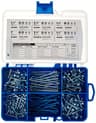
The fastener nearly every project on this site tells you to buy, and the one almost nobody explains. Eight boxes compared on drive type, thread, length and coating, plus the pilot-hole numbers from the US Forest Service's own handbook.
Almost every project page on this site ends up telling you to drive a screw. The simple workbench wants structural screws through its leg frames. The joinery versus fastening argument comes down on the side of “use screws now so you actually finish things”. And then nobody tells you which screws, so you end up at the hardware store in front of forty small boxes, or — far more likely — you reach for the drywall screws left over from hanging a sheet of plasterboard. This page exists to fix that.
Here is the lens we compare on, in order, because the order is what beginners get backwards. Drive type — a star or square recess stays engaged under a drill; a Phillips cams out, chews its own head and leaves you drilling the screw back out. That single property causes more ruined evenings than any other. Thread and point — whether the screw cuts its way in and spreads the fibers, or acts like the wedge it physically is and splits the board. Head shape — flat and countersunk to disappear, washer-head to clamp and stay proud, pan or truss head to hold sheet goods that a flat head would just pull through. Length and gauge, which is arithmetic rather than taste, and we give you the numbers below. Coating, which decides where the screw is allowed to live. And count, because the real cost of a screw is price per screw, and a trade pail is not a bargain if you use forty of them in five years.
One thing this page is not: a claim that we have load-tested these. We have not. Every figure on every card below was read from the seller’s listing or the manufacturer’s own page on the date shown on that card, and where nobody publishes a number the card says “Not listed” rather than guessing. The pilot-hole and holding-power numbers in the guide sections come from the US Forest Service’s Wood Handbook, which is cited at the foot of the page. Here is exactly what we do instead of testing.
How this is funded: we earn a commission if you buy through our links, at no extra cost to you. It never changes which tool we recommend, and we’ll tell you plainly when to skip one. Full disclosure.
Quick picks
Ranked on the specs that matter for a beginner and honest buyer fit. Select a row to jump to the full write-up. We haven’t hands-on-tested these — here is exactly what we do instead.
#
Product
Best for
Price
1
GRK R4 #8 x 2 in Multi-Purpose Framing Screws, 100 count
The screw that makes a beginner look competent. It cuts its own countersink, does not need a pilot hole in softwood, takes a star bit that will not skate out, and the coating is rated by the maker for interior and exterior work in the same box. You pay roughly double per screw for all of that, and on the twenty screws that actually hold a project together it is worth it.
SPAX #8 x 1-1/4 in Flat Head Partial Thread T-Star+, 1 lb / 240 count
The length you will reach for most often, in a box big enough that you stop rationing screws. 1-1/4 in is the right screw for 3/4 in stock into a frame, for shop jigs, for cleats and for hardware, and SPAX puts a star drive and a self-countersinking head on it at a sane price per screw.
Rok #8 x 1 in Coarse Thread Flat Square-Drive Wood Screws, Type 17, 100 count
A cabinetmaker's screw rather than a builder's. Square drive holds a bit dead straight with one hand, the coarse thread grabs the soft core of plywood and MDF, and 1 in is the honest length for screwing 3/4 in sheet goods to a frame without the point bursting out the far side.
Simpson Strong-Tie Strong-Drive SDWS Timber Screw, 0.220 in x 3 in, 50 count (SDWS22300DB-R50)
The screw for the dozen joints that hold weight. Simpson sells these as a replacement for lag bolts and through-bolting, which is exactly the job a workbench base and a wall of garage shelving ask for, and it drives with a T40 bit instead of a wrench and a pre-drilled hole.
The purchase everyone forgets. Pocket screws are not ordinary wood screws, the thread you need depends on the wood, and this assortment covers six of the common sizes in both threads so your first project is not held up by a hardware run.
Power Pro Premium Exterior Wood Screws, #8 x 2-1/2 in, 595 count, Bronze (48637)
The box to buy once, for outdoor furniture and anything that lives on a porch. Epoxy-coated, star drive, a T25 bit in the box, and a quantity that means you will never buy exterior screws again — which is also the catch, because almost nobody building one bench needs 595 of them.
Hillman Solid Brass Slotted Flat-Head Wood Screws, #8 x 1 in, 20 count (1931)
The screw you use when it will be seen. Solid brass, not plated, so a hinge on a box or a catch on a cabinet door keeps its color and never bleeds rust into the wood. It is also soft, slotted and slow to drive, which is the price of looking right.
Mr. Pen Wood Screws Assortment Kit, 152 pieces, Phillips Flat Head (SSC152)
The cheapest honest way to stop a project at 9pm for want of a screw. Six lengths in a sorted case for the price of a coffee, and that is the whole argument. These are not the screws for the joints that matter, and the case is arguably worth more than what is in it.
GRK R4 #8 x 2 in Multi-Purpose Framing Screws, 100 count
The screw that makes a beginner look competent. It cuts its own countersink, does not need a pilot hole in softwood, takes a star bit that will not skate out, and the coating is rated by the maker for interior and exterior work in the same box. You pay roughly double per screw for all of that, and on the twenty screws that actually hold a project together it is worth it.
Strengths
+Star drive with six points of contact, so the bit does not cam out and chew the head the way a Phillips does under a drill
+Self-countersinking head and a Zip-Tip the maker says eliminates pre-drilling, which removes the two steps beginners skip anyway
+Climatek coating that GRK rates for interior AND exterior use and for pressure-treated lumber, so one box covers indoor furniture and a covered-porch bench
Trade-offs
−Around twice the price per screw of a hardware-store box of the same size — fine for structural joints, wasteful for jigs and shop shelves
−The listing does not say a star bit is included in this 100-count pack, so budget for one if you own no T-handle bits
−One size only (#8 x 2 in). A first shop needs a shorter screw far more often, so this is a second box, not a whole collection
Type
General-purpose wood screw
In the set
100 pieces
Material / build
Climatek-coated steel
Key spec
#8 x 2 in; 100 count; star drive; self-countersinking head
Best for
Best overall — the one box to buy if you buy one
Worth knowing. The listing states multipurpose wood-to-wood framing, interior/exterior use, "Zip-Tip eliminates pre-drilling" and "Star Drive Recess for zero stripping", with a size of '#8 x 2" Gold 100 count' and a manufacturer part number of 772691020772. GRK's own R4 page, fetched October 2, 2026, is where the named features come from: a Climatek coating giving "superior corrosion resistance, allowing the screw to be used in both interior and exterior applications as well as pressure treated lumber", a W-Cut for "low torque, faster drive", a CEE Thread that "enlarges hole to reduce splitting", and ESR-3201 approval for structural applications. No bit size and no holding-power figure is published on either page.
Specs read from the product listing, on October 2, 2026. “Not listed” means the listing doesn’t state that figure.
#2Best for the length you use most
SPAX #8 x 1-1/4 in Flat Head Partial Thread T-Star+, 1 lb / 240 count
The length you will reach for most often, in a box big enough that you stop rationing screws. 1-1/4 in is the right screw for 3/4 in stock into a frame, for shop jigs, for cleats and for hardware, and SPAX puts a star drive and a self-countersinking head on it at a sane price per screw.
Strengths
+240 screws in the single most useful length for 3/4 in material, so the box outlasts several projects
+T-Star Plus drive and a patented MULTIhead the maker says countersinks the head flush, so no separate countersink step on shop work
+Partial thread, which is what actually pulls two boards tight together instead of jacking them apart as the thread bites the top piece
Trade-offs
−Yellow zinc is an indoor coating and this listing claims no exterior rating — the wrong screw for anything that gets rained on
−Still a premium-brand price per screw against a plain hardware-store box of #8 x 1-1/4
−The listing does not say a T-Star bit is included, and the heat-treated Grade 5 steel is harder on a worn bit than a soft screw is
Type
General-purpose wood screw
In the set
240 pieces
Material / build
Heat-treated Grade 5 steel, yellow zinc coating
Key spec
#8 x 1-1/4 in; 240 count (1 lb); T-Star Plus drive; partial thread
Best for
Best for the length a first shop uses most
Worth knowing. The listing states a patented thread technology that "allows the screw to be driven faster, is easier to install, and reduces splitting in wood", "No required pre-drilling in wood", a "patented MULTIhead" that "countersinks the screw head flush in wood", a "T-Star plus head" for "superior bit engagement", and "Heat Treated Grade 5 Durability". Size 8 x 1-1/4 in, color yellow, 1 lb, manufactured by PrimeSource, part number 4191020400324. The listing publishes no drive-bit size, no coating thickness and no holding-power figure.
Specs read from the product listing, on October 2, 2026. “Not listed” means the listing doesn’t state that figure.
#3Best for plywood and MDF
Rok #8 x 1 in Coarse Thread Flat Square-Drive Wood Screws, Type 17, 100 count
A cabinetmaker's screw rather than a builder's. Square drive holds a bit dead straight with one hand, the coarse thread grabs the soft core of plywood and MDF, and 1 in is the honest length for screwing 3/4 in sheet goods to a frame without the point bursting out the far side.
Strengths
+Square drive is the most forgiving one-handed drive there is — the bit stays in the recess when you are holding a panel with the other hand
+Coarse thread and the Type 17 point the listing names are aimed at the soft, crumbly core of sheet goods rather than at solid wood
+Under nine cents a screw for a 100-count box, which is cabinet-assembly money rather than premium-brand money
Trade-offs
−You need a #2 square bit and the listing does not say one is included — a Phillips bit will not drive these at all
−1 in reaches 3/4 in material into a frame and nothing deeper, so it is a specialist length not a general one
−Zinc finish only, and Rok publishes nothing about this screw beyond the five lines in the listing — no load data, no coating spec
Type
Cabinet and sheet-goods screw
In the set
100 pieces
Material / build
Steel with zinc finish
Key spec
#8 x 1 in; 100 count; square drive; coarse thread
Best for
Best for plywood, MDF and cabinet carcasses
Worth knowing. The listing's feature bullets state "Diameter: #8", "Length: 1 in", "Drive: Flat Square Head" and "Material: steel with zinc finish to protect the screw from corrosion", with 100 pieces and a part number of ROKS8X1FCSZNPB. The title is where "Type 17" and MDF come from — the bullets do not explain the point geometry, and no thread pitch, root diameter or holding-power figure is published.
Specs read from the product listing, on October 2, 2026. “Not listed” means the listing doesn’t state that figure.
#4Best structural screw
Simpson Strong-Tie Strong-Drive SDWS Timber Screw, 0.220 in x 3 in, 50 count (SDWS22300DB-R50)
The screw for the dozen joints that hold weight. Simpson sells these as a replacement for lag bolts and through-bolting, which is exactly the job a workbench base and a wall of garage shelving ask for, and it drives with a T40 bit instead of a wrench and a pre-drilled hole.
Strengths
+Sold by the maker as an alternative to through-bolting and traditional lag bolts, so a bench leg goes together with a driver rather than a socket set and a brace bit
+Sawtooth point the listing says eliminates predrilling "in almost every application", and under-head nibs that let the washer head pull flush without splintering
+Double-barrier coating the listing rates as equivalent to hot-dip galvanization, which covers preservative-treated lumber and covered outdoor framing
Trade-offs
−Roughly sixty-five cents a screw — an order of magnitude more than a general-purpose screw, so this is for load-bearing joints and nothing else
−The washer head is designed to sit proud of the surface, not to be countersunk, so it is visible hardware wherever you use it
−3 in is too long for anything thinner than doubled 2x stock, and the listing's own applications are ledgers, mass timber and CLT — construction, not furniture
Type
Structural timber screw
In the set
50 pieces
Material / build
Steel, double-barrier coated
Key spec
0.220 in x 3 in; 50 count; T40 6-lobe; washer head
Best for
Best structural screw for a workbench base and garage shelving
Worth knowing. The listing states a "6-lobe T40 drive", a "Sawtooth point" that "ensures a fast start, eliminating the need for predrilling in almost every application", a "double-barrier coating, which provides corrosion resistance that is equivalent to hot-dip galvanization in steel screws, making it suitable for select exterior and preservative-treated wood applications", that the screws "serve as an alternative to through bolting and traditional lag bolts", and that "the under head nibs allow for the head to drive flush to surface with reduced splintering". Applications named are wood-to-wood ledger, mass timber and CLT connections. Part number SDWS22300DB-R50, tan, washer head, 50 per pack, 2.05 lb, 12-month warranty. No allowable load value is carried on the listing, and Simpson's own product page renders as a JavaScript shell that returns no specification text to a fetch, so none is quoted here.
Specs read from the product listing, on October 2, 2026. “Not listed” means the listing doesn’t state that figure.
The purchase everyone forgets. Pocket screws are not ordinary wood screws, the thread you need depends on the wood, and this assortment covers six of the common sizes in both threads so your first project is not held up by a hardware run.
Strengths
+Six of the most commonly used pocket-hole screw sizes in one box
+Contains both coarse and fine thread, which is the choice that actually depends on your wood
+Includes Blue-Kote anti-corrosion and zinc-coated screws, so indoor and outdoor projects are both covered
+Self-tapping, with pan and Maxi-Loc heads — the flat head is what seats correctly in a pocket hole
Trade-offs
−An assortment always leaves you short of the one size you use most — expect to buy a bulk box of that size later
−Costs about as much as a budget jig, which surprises people
−Kreg screws carry a brand premium over generic pocket screws of the same size
Type
Pocket-hole screw assortment
In the set
260 pieces
Material / build
Blue-Kote and zinc-coated steel
Key spec
6 sizes; coarse and fine thread; pan and Maxi-Loc heads
Best for
Best screw assortment to buy with a first jig
Worth knowing. The listing states 6 of the most commonly used pocket-hole screw sizes, both fine and coarse threads, pan and Maxi-Loc heads, Blue-Kote anti-corrosion and zinc-coated screws for indoor or outdoor use, and compatibility with all Kreg pocket-hole jigs.
Specs read from the product listing, on September 4, 2026. “Not listed” means the listing doesn’t state that figure.
#6Best for outdoor projects
Power Pro Premium Exterior Wood Screws, #8 x 2-1/2 in, 595 count, Bronze (48637)
The box to buy once, for outdoor furniture and anything that lives on a porch. Epoxy-coated, star drive, a T25 bit in the box, and a quantity that means you will never buy exterior screws again — which is also the catch, because almost nobody building one bench needs 595 of them.
Strengths
+Epoxy coating and a rust-and-corrosion warranty, which is what an outdoor bench or a planter actually needs and a zinc screw cannot give
+A T25 star bit is included with the 2-1/2 in screws per the listing, so the box is complete on arrival
+Coarse thread and a self-starting tip the maker says remove the need for a pilot hole, including in pressure-treated stock
Trade-offs
−595 screws is a trade quantity. For one outdoor project it is far more screw than you will use in several years
−Written and marketed for decking and pressure-treated lumber rather than furniture, so 2-1/2 in is longer than most garden-furniture joints want
−The "20 percent faster engagement" and "75% less wood splitting" figures are the manufacturer's own with no test cited, and the listing's quantity fields disagree with each other — 595 in the title, 655 in its own count field
Type
Exterior wood screw
In the set
595 pieces
Material / build
Epoxy-coated steel, bronze finish
Key spec
#8 x 2-1/2 in; 595 count per the listing title; T25 star drive, bit included
Best for
Best for outdoor furniture and covered-porch projects
Worth knowing. The listing states screws "engineered for outdoor durability" with an "epoxy coating" for corrosion resistance; a "Self-Starting Tip" offering "20 percent faster engagement into wood" where "coarse screw threads and a self-drilling point design eliminate the need for a pilot hole"; "75% less wood splitting" and suitability for pressure-treated wood; and "Star Drive Style: Featuring a T25 Star Bit, included with the 2-1/2 inch screws" giving "six contact points, reducing slippage and camout". Brand Power Pro, manufactured by The Hillman Group, part number 48637, bronze, 5.44 lb. The title says 595 pack while the listing's own NumberOfItems field says 655; the lower figure is used here. No gauge root diameter and no holding-power figure is published.
Specs read from the product listing, on October 2, 2026. “Not listed” means the listing doesn’t state that figure.
#7Best for visible hardware
Hillman Solid Brass Slotted Flat-Head Wood Screws, #8 x 1 in, 20 count (1931)
The screw you use when it will be seen. Solid brass, not plated, so a hinge on a box or a catch on a cabinet door keeps its color and never bleeds rust into the wood. It is also soft, slotted and slow to drive, which is the price of looking right.
Strengths
+Solid brass rather than plated steel, so it will not rust or weep a black stain into oak and it keeps its tone in damp rooms
+Traditional slotted flat head is the correct fastener for period hardware and for brass hinges, where a zinc Phillips screw looks wrong
+Cheap in absolute terms — under ten dollars buys enough screws for several boxes' worth of hinges
Trade-offs
−Brass is soft. Drive one into hardwood without a pilot hole, or without running a steel screw of the same size in first to cut the thread, and the head twists off in the hole
−A slotted drive cannot be power-driven safely — the bit skates out of the slot and across the work, which is how a finished lid gets a scar
−Around forty cents a screw, the most expensive per screw here by a wide margin, and no strength figures are published for it at all
Type
Solid brass hardware screw
In the set
20 pieces
Material / build
Solid brass
Key spec
#8 x 1 in; 20 count; slotted drive; countersunk flat head
Best for
Best for hinges and visible hardware
Worth knowing. The listing states solid brass wood screws that "fasten wood securely while adding a warm, finished gold accent", a "countersunk flat head" that "seats flush with the surface", a "traditional slotted drive and sharp point with coarse threads", and that being "solid brass rather than plated steel, these screws will not rust and resist corrosion inside and out" in "humid, damp, and even marine settings". Named uses are cabinetry, furniture, hinges, decorative hardware, boat and marine trim and antique restoration. Part number 1931, 20-piece pack, #8 x 1 in. No torque limit, no shear figure and no withdrawal figure is published.
Specs read from the product listing, on October 2, 2026. “Not listed” means the listing doesn’t state that figure.
#8Best cheap starter box
Mr. Pen Wood Screws Assortment Kit, 152 pieces, Phillips Flat Head (SSC152)
The cheapest honest way to stop a project at 9pm for want of a screw. Six lengths in a sorted case for the price of a coffee, and that is the whole argument. These are not the screws for the joints that matter, and the case is arguably worth more than what is in it.
Strengths
+Six lengths from roughly 3/4 in to 2 in in one sorted case, which covers the small jobs that otherwise stop a build
+Under six dollars, so it costs less than being short one screw on a Sunday
+The compartment case is reusable, and stays useful as storage after the screws are gone
Trade-offs
−The listing never states a gauge or a thread diameter — only metric lengths — so you cannot match a pilot bit to these with any confidence
−Phillips drive, which cams out under a drill far more readily than a star or square drive and chews the head when it does
−The longest screw is 50 mm, about 2 in, so nothing in the box reaches far enough for a workbench leg or a structural joint
−"Galvanized iron" is all the listing says about the steel, and the maker publishes no coating or strength spec at all
Type
Wood screw assortment
In the set
152 pieces
Material / build
Galvanized iron per the listing
Key spec
152 screws in 6 metric lengths, 20-50 mm; Phillips flat head
Best for
Best cheap first box — breadth over quality
Worth knowing. The listing states the pack "consist 50 pcs x 20mm, 30 pcs x 25mm, 24 pcs x 30mm, 20 pcs x 35mm, 16 pcs x 40mm and 12 pcs x 50mm", that it is "Made of galvanized iron, corrosion-resistant", that it suits "outdoor and indoor woodworking such as build benches and tables, maintain shelves, fence panels, and door hinges", and that the screws come "packed in a sturdy convenient case". Part number SSC152, 152 pieces, silver. No gauge, no thread diameter, no drive-bit size and no strength figure is published anywhere on the listing.
Specs read from the product listing, on October 2, 2026. “Not listed” means the listing doesn’t state that figure.
The four boxes that cover a first shop
Live prices, pulled from the same feed as the cards above. Two general screw sizes, the bit that drills for them, and the pocket-hole assortment if you own a jig.
Tool
Why you need it
Price
SPAX #8 x 1-1/4 in Flat Head Partial Thread T-Star+, 1 lb / 240 count
The everyday length: 3/4 in stock into a frame, cleats, hardware, jigs
Live Amazon prices as of October 2, 2026; they change, and we don’t display stale numbers — a tool with no live price shows “Check price” and is left out of the subtotal. #adHow we’re funded.
First: stop using drywall screws
This is the most common fastener mistake in a first shop, and it is worth being blunt about. A drywall screw is designed for exactly one job: holding a sheet of gypsum board against framing until the board’s own paper and compound take over. It is thin, it is hardened so the bugle head can be driven consistently to depth, and it is fully threaded, which means it pulls the two pieces of wood you are joining apart rather than together as the top piece rides up the thread.
The argument for not using them structurally is simpler than the forum folklore about brittleness, and you can verify it yourself: no manufacturer publishes a shear or withdrawal rating for a drywall screw, because nobody sells one for that purpose. Every structural screw on this page carries a code listing or a stated application that a drywall screw does not. That absence is the whole argument. If a joint carries weight — a shelf, a bench leg, anything above a child’s head — put a screw in it that someone was willing to rate.
For shop shelving, a jig, or a scrap fixture nobody’s safety depends on, use up the drywall screws in the drawer and feel no guilt. Just stop treating them as the default.
Pilot holes: the numbers that actually matter
“Drill a pilot hole” is advice everyone gives and nobody sizes. The US Forest Service’s Wood Handbook does size it, and the numbers are more specific than you would expect. Two facts do the work. First, “the root diameter for most sizes of screws averages about two-thirds the shank diameter.” Second, the handbook’s own withdrawal figures hold true when lead holes are about 70% of the root diameter in softwoods and about 90% in hardwoods.
Work those two rules through the handbook’s gauge table and you get a chart you can tape inside a cabinet door. Shank diameters are the handbook’s; the lead-hole sizes are that arithmetic rounded to the nearest bit you are likely to own.
#6 — 0.138 in shank. Pilot about 1/16 in in pine, 5/64 in in oak or maple.
#8 — 0.164 in shank, and the gauge you will buy most. Pilot about 5/64 in in pine, 3/32 in in hardwood.
#10 — 0.190 in shank. Pilot about 3/32 in in pine, 7/64 in in hardwood.
#12 — 0.216 in shank. Pilot about 7/64 in in pine, 1/8 in in hardwood.
Note which way that goes, because it surprises people: the harder the wood, the bigger the pilot hole. Oak has no give. Drill it to softwood size and the screw either splits the board or snaps. A tapered countersink bit sidesteps most of this by matching one bit to one screw gauge, which is why it is the single accessory we would buy alongside the screws themselves.
Two more lines from the same source are worth having. Lubricating a screw “with soap or similar lubricant is recommended to facilitate insertion, especially in dense woods, and it will have little effect on ultimate withdrawal resistance” — so the old trick of rubbing a brass screw on a candle is real, and it does not weaken the joint. And: “Screws should always be turned in. They should never be started or driven with a hammer because this practice tears the wood fibers and injures the screw threads, seriously reducing the load carrying capacity of the screw.”
How long a screw do you actually need?
Also arithmetic, and also from the handbook. For the screw to develop its published lateral load, it must penetrate the piece holding the point by at least seven times its shank diameter, and the piece you are screwing through should be about half that depth.
For the #8 you will mostly be using, seven times 0.164 in is about 1.15 in of penetration. Add the 3/4 in board you are going through and you land at roughly 1.9 in — which is why a 2 in #8 is the structural screw for 3/4 in stock, and why a 1-1/4 in screw in the same joint is holding on by about half of what it should. Both lengths have a place; they are just not the same place. Run the same sum for a #10 and you need about 1.33 in of penetration, so 2-1/2 in through 3/4 in stock.
Three qualifiers the handbook adds, all of which matter in a real shop:
End grain is weak. Withdrawal from end grain, “when splitting is avoided,” averages 75% of the side-grain figure. A screw into the end of a board is a 25% discount before you have done anything wrong, which is the quiet reason a cut joint beats a screw in a butt joint.
Density does most of the holding. Withdrawal resistance “varies directly with the square of the specific gravity of the wood” — squared, not proportional. A screw in white oak holds dramatically better than the same screw in pine, which is worth knowing when you choose a species.
Longer is not always better. The handbook notes that “the longer lengths of standard screws are therefore superfluous in dense hardwoods” — past a point the screw fails in tension before the wood lets go. In oak, a 1-1/2 in screw that fits is better than a 3 in screw that bursts out the far face.
Plywood, MDF and particleboard are a different problem
Sheet goods do not hold a screw the way solid wood does, and the failure is different: instead of splitting, the core crumbles and the thread spins free. The handbook’s particleboard guidance is reassuring on one count and a warning on another. Withdrawal is “not significantly different for lead holes of 50% to 90% of the root diameter,” so pilot sizing is forgiving — but “care must be taken when tightening screws in particleboard to avoid stripping the threads.” It also notes that a modest tightening “provides an effective compromise between optimizing withdrawal resistance and stripping threads.”
In practice that means three habits. Use the clutch on your drill, set low, and stop as soon as the head seats — this is a job for a drill, not for an impact driver, which has no clutch at all. Use a coarse thread, which is what the Rok screws above are and what Kreg specifies for sheet goods. And never put a flat countersunk head into the face of thin ply if you can use a pan or truss head instead, because a countersink in 1/2 in plywood removes most of the material that was going to hold the head.
Screwing into the edge of plywood is worse again, and screwing into the edge of MDF is close to hopeless without a special fastener. If you are building carcasses, that is the argument for pocket-hole joinery, which turns every edge joint into a face-grain one, and for glue doing the real work with screws acting as clamps.
Drive types, ranked for a beginner
If you take one thing from this page, take this. The recess in the screw head is not a styling choice; it decides whether the screw goes in.
Star / Torx / 6-lobe — best. Six contact points, almost no cam-out, drives one-handed. GRK calls its version “zero stripping, with 6 points of contact”; SPAX, Simpson and Power Pro all use a star recess too. The catch is that bit sizes vary (T25, T40) and you need the right one.
Square / Robertson — nearly as good and genuinely better one-handed, because the bit holds the screw upright by friction. One bit size (#2) covers most woodworking screws. Common in cabinet and pocket-hole screws.
Phillips — designed to cam out. That was the original point, back when drivers had no clutch; today it just means a chewed head and a screw you cannot remove. Workable with a sharp bit, light pressure and a drill set slow. Avoid for anything structural.
Slotted — for hand driving and for looks only. The bit has nothing holding it in the slot, so under power it skates out and across your work. The only reason to buy slotted screws is that brass hardware looks wrong with anything else.
Coatings, and where each screw is allowed to live
Coating is the spec beginners ignore and then rediscover eighteen months later as a black stain bleeding out of an oak joint. The short version:
Plain or yellow zinc — indoors, dry. The SPAX box above is zinc and claims no exterior rating; the Rok cabinet screws are zinc too. Fine for furniture, jigs and anything that never sees weather.
Proprietary coatings (GRK’s Climatek, Power Pro’s epoxy) — rated by their makers for exterior use and for pressure-treated lumber, which matters because the copper in modern treated timber eats ordinary steel.
Double-barrier and hot-dip equivalents — the Simpson timber screw’s listing rates its coating as equivalent to hot-dip galvanization, which is the band you want for structural connections in treated wood.
Solid brass and stainless — for visible hardware and for damp rooms. Brass will not rust or stain the wood around it, which is exactly why it costs forty cents a screw.
One rule worth memorizing: never put a bare steel screw in white oak, cherry or anything you intend to finish pale, and never leave one in damp wood. The iron reacts with the tannins and leaves a dark halo you cannot sand out. Brass, stainless, or a coated screw in a plugged hole.
Pocket screws are their own category
If you own a pocket-hole jig, ordinary wood screws will not work in it. Pocket screws have a flat self-drilling tip and a wide pan or washer head sized to seat in the bottom of the pocket, and the thread choice is not cosmetic: Kreg’s own guidance is coarse thread for softwoods and sheet goods like pine, cedar, plywood and MDF, and fine thread for dense hardwoods like cherry, maple and oak. Kreg also splits the coatings three ways — zinc for indoor work, Blue-Kote for damp or treated lumber, stainless for harsh exposure — which is why the starter assortment above is the sane first purchase and a bulk box of one size is the sensible second one.
The one to buy first
Buy the SPAX #8 x 1-1/4 in box. It is the length a first shop reaches for most, there are 240 of them so you stop treating screws as precious, and the star drive means your first attempt at driving one does not end with a stripped head. Add the GRK #8 x 2 in box the first time you build something that has to hold weight, and the countersink bit set at the same time as either.
If your budget this week is six dollars, the Mr. Pen assortment is a legitimate answer and we would rather say so than pretend you need to spend thirty. Just know what you are buying: breadth, a useful case, and screws whose gauge nobody will tell you. If you are already building cabinets, start with the square-drive Rok screws instead. And if the project in front of you is the workbench, buy the Simpson timber screws for the leg frames and a general-purpose box for everything else — that bench is the clearest case on this site where the expensive screw is the right one.
Frequently asked questions
What screws should I use for woodworking?+
For most of what a first shop builds, a #8 wood screw in a star or square drive, in two lengths: 1-1/4 in for fastening 3/4 in stock to a frame, and 2 in for joints that carry load. Buy those two boxes plus a tapered countersink bit and you can build almost anything. Everything else - structural screws, cabinet screws, exterior screws, brass - is a specialist answer you can buy the week you first need it.
Can I use drywall screws for woodworking?+
For shop shelving or a scrap jig, yes, and you may as well use up the ones in the drawer. For anything that carries weight, no. A drywall screw is sold for one job - holding gypsum board to framing - and no manufacturer publishes a shear or withdrawal rating for one, because nobody sells it for load. It is also fully threaded, which means it pulls your two boards apart rather than together as the top piece rides up the thread.
What size pilot hole do I drill for a #8 wood screw?+
About 5/64 in in softwood and about 3/32 in in hardwood. That comes from the US Forest Service Wood Handbook: a screw's root diameter averages about two-thirds its shank diameter, and the lead hole should be about 70% of that root diameter in softwoods and about 90% in hardwoods. A #8 has a 0.164 in shank, so the root is about 0.109 in, and 70% and 90% of that round to those two bit sizes. Note the direction - harder wood wants a bigger pilot, not a smaller one.
How long should a wood screw be?+
Long enough to penetrate the piece holding the point by at least seven times the screw's shank diameter, with the piece you screw through being about half that depth. For a #8 that is about 1.15 in of penetration, so going through 3/4 in stock you want a 2 in screw. A 1-1/4 in screw in the same joint is holding by roughly half of what it should - fine for a cleat or a jig, not for a shelf bracket.
Do I need to drill a pilot hole for wood screws?+
Not always, and less often than you would think. Several screws on this page are sold specifically to avoid it: GRK says its Zip-Tip eliminates pre-drilling, SPAX says no pre-drilling is required in wood, and Simpson says its sawtooth point removes the need in almost every application. But drill one every time the screw goes near the end of a board, every time you are in hardwood, and every time you are using brass. Splitting happens at the end grain first.
Star drive, square drive or Phillips - which is best?+
Star (Torx) first, square second, Phillips a distant third. A star recess has six contact points and barely cams out; a square drive holds the screw upright by friction, which is better one-handed, and one #2 bit covers most woodworking screws. Phillips was literally designed to cam out, back when drivers had no clutch, and today that just means a chewed head you cannot back out. Slotted is for hand driving and for brass hardware that would look wrong with anything else.
What screws should I use for plywood and MDF?+
A coarse-thread screw with a pan, truss or washer head rather than a flat countersunk one, driven with a drill on a low clutch setting rather than an impact driver. The core of a sheet good crumbles instead of splitting, so the failure is the thread spinning free, and a countersink in thin ply removes most of the material that was going to hold the head. Pilot sizing is forgiving - the Wood Handbook found no significant difference across lead holes from 50% to 90% of root diameter in particleboard - but over-tightening strips it immediately.
Can I use regular wood screws in a pocket-hole jig?+
No. Pocket screws have a flat self-drilling tip and a wide pan or washer head sized to seat in the bottom of the pocket; an ordinary countersunk screw has nothing to bear against and splits the pocket wall. Thread matters too - Kreg specifies coarse thread for softwoods and sheet goods, fine thread for dense hardwoods like maple and oak. Buy the assortment with your first jig and a bulk box of your most-used size later.
Will a steel screw stain my wood?+
In white oak, cherry and other tannin-rich species, yes - bare steel reacts with the tannins and leaves a dark halo you cannot sand out, and damp wood makes it worse. Use solid brass, stainless, or a coated screw set in a hole you plug. This is the real reason brass hardware screws still exist at forty cents each, not nostalgia.
Why did my brass screw snap off in the hole?+
Because brass is soft and you asked it to cut its own thread. Drill the pilot, then run a steel screw of the same size all the way in first to cut the thread, back it out, and drive the brass screw into the finished thread by hand. Rubbing it on soap or a candle helps - the Wood Handbook notes lubricant is recommended for dense woods and has little effect on holding power. And never drive a slotted brass screw with a power driver.
How many screws do I actually need to buy?+
Far fewer than the bulk boxes imply. A small box of 100 to 240 screws in your main size will outlast several projects, and the per-screw saving on a 595- or 2,000-count pail is irrelevant at hobby volume - you will lose the pail to rust in the garage before you empty it. Buy trade quantities only after you have run out of a small box of the same screw twice.
Sources
USDA Forest Service, Forest Products Laboratory — Wood Handbook (FPL-GTR-190), Chapter 8: Fastenings — The "Wood Screws" section, pages 8-10 to 8-12. "The root diameter for most sizes of screws averages about two-thirds the shank diameter." Withdrawal "varies directly with the square of the specific gravity of the wood" and, within limits, "directly with the depth of penetration of the threaded portion and the diameter of the screw" — so "the longer lengths of standard screws are therefore superfluous in dense hardwoods." The withdrawal equation "is applicable when screw lead holes have a diameter of about 70% of the root diameter of the threads in softwoods, and about 90% in hardwoods." End-grain withdrawal, "when splitting is avoided," averages 75% of side-grain. For lateral load the screw must penetrate the member holding the point by at least seven times the shank diameter, and the side member should be about half that depth. "Screws should always be turned in. They should never be started or driven with a hammer because this practice tears the wood fibers and injures the screw threads, seriously reducing the load carrying capacity of the screw." Soap or a similar lubricant "is recommended to facilitate insertion, especially in dense woods, and it will have little effect on ultimate withdrawal resistance." Table 8-9 gives shank diameters by gauge: #6 0.138 in, #8 0.164 in, #10 0.190 in, #12 0.216 in. In particleboard, withdrawal "is not significantly different for lead holes of 50% to 90% of the root diameter," and "care must be taken when tightening screws in particleboard to avoid stripping the threads" (accessed October 2, 2026)
GRK Fasteners — R4 Multi-Purpose Screw — The manufacturer's own feature names, which the Amazon listing compresses into four lines: a Climatek coating giving "superior corrosion resistance, allowing the screw to be used in both interior and exterior applications as well as pressure treated lumber"; "Star Drive Recess: Zero stripping, with 6 points of contact"; "W-Cut: Low torque, faster drive"; "CEE Thread: Enlarges hole to reduce splitting"; "Zip-Tip: Eliminates pre-drilling"; a Fast Bite Tip that "provides a fast start"; and "ESR-3201 approved for structural applications". Diameters #6 through #12/14 and lengths 1-1/4 in to 8 in across Handy, Pro, Contractor and bulk packs (accessed October 2, 2026)
Kreg Tool — Selecting the right pocket-hole screw — The manufacturer's own thread guidance: coarse thread for softwoods like cedar, pine and fir and for sheet goods such as plywood and MDF; fine thread for hard, dense hardwoods like cherry, maple and oak. Zinc is for indoor projects where moisture is not a concern, Blue-Kote for damp or wet applications and treated lumber, stainless for extreme, corrosive exposure (accessed September 4, 2026)