There is a moment in most people’s first year when the projects stop being boxes screwed together and start being things somebody sits at, eats off, or keeps clothes in. The tool list changes at that point, and it changes less than you would expect — six additions cover almost all of it.
Furniture asks three things that shelving does not. It has to be flat and square over a longer span, because a wobbling table is obvious in a way a wobbling garage shelf is not. It has to hold together under racking— the sideways force that a chair gets every time somebody leans back, and a bookcase screwed to a wall never sees. And it is looked at closely, so the surface and the joints have to survive inspection from two feet away.
Each tool below answers one of those. None of them is exotic, none needs a dedicated shop, and four of the six are hand tools or hand-held. What you will notice is missing: a jointer, a planer, a domino, a full machine room. You do not need them to build good furniture, and pretending otherwise is how people talk themselves out of starting.
This page assumes you can already cut a board and drive a screw. If you are not there yet, start with the beginner tool kit and the bookshelf tool list, and come back. Prices below are live and dated.
How this is funded:we earn a commission if you buy through our links, at no extra cost to you. It never changes which tool we recommend, and we’ll tell you plainly when to skip one. Full disclosure.
Quick picks
Ranked on the specs that matter for a beginner and honest buyer fit. Select a row to jump to the full write-up. We haven’t hands-on-tested these — here is exactly what we do instead.
#
Product
Best for
Price
1
Bessey GSCC2.536 Clutch-Style Bar Clamp, 36 in
When a glue-up needs real, even pressure, a screw-tightened F-style clamp does what a trigger clamp can't. Bessey rates this one at 600 lb, and its 36-inch bar handles the panels and tabletops a beginner grows into.
Kreg Pocket-Hole Jig 320 with Classic 2 in Face Clamp (KPHJ320-22)
The version of this tool a first shop should own: two drill guides so a pair of holes needs one setup, a case that keeps the bit and the collar together, and — in this bundle — the face clamp that every cheaper jig makes you buy separately.
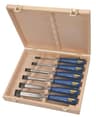
The chisel set most experienced woodworkers point beginners to: six honest sizes, blue-chip steel that takes a keen edge, and struck-capable handles. It is the safe default, and it is genuinely all you need for years.
Bosch 1617EVSPK 2.25 HP Combination Plunge- and Fixed-Base Router
The router most people should grow into: a 2.25 HP motor that swaps between a fixed base for edge work and a plunge base for mortises and inlay. One tool that covers nearly everything a home shop asks of a router.
The sander most people should buy. Variable speed, a genuinely effective micro-filter dust canister, and a low-vibration body you can hold for an hour without your hands buzzing. It is the boring right answer.
The upgrade, and honestly the last No. 4 most hobbyists ever buy. Bedrock-style bed, a thick blade that does not chatter, and machining tight enough that setup is honing rather than rescuing. It costs many times a budget plane and feels it.
When a glue-up needs real, even pressure, a screw-tightened F-style clamp does what a trigger clamp can't. Bessey rates this one at 600 lb, and its 36-inch bar handles the panels and tabletops a beginner grows into.
Strengths
+Rated at 600 lb of clamping force, tightened by a screw handle rather than a trigger
+36 in of bar spans panels, doors and tabletops
+Non-marring pads on both jaws, and slip-clutch plates that hold the sliding jaw in place on the rail
Trade-offs
−Two-handed to operate — slide the jaw up, then turn the handle, so the work needs to be positioned first
−The 2-1/2 in throat can't reach far in from an edge — fine for edge-gluing boards, limiting on the middle of a panel
Worth knowing. You don't need these on week one, but the first time you glue up a panel and the seam won't close with trigger clamps, this is the answer. Buy a pair when a project demands them, not before.
Specs read from the product listing, on September 10, 2026. “Not listed” means the listing doesn’t state that figure.
#2Best joinery method to start with
Kreg Pocket-Hole Jig 320 with Classic 2 in Face Clamp (KPHJ320-22)
The version of this tool a first shop should own: two drill guides so a pair of holes needs one setup, a case that keeps the bit and the collar together, and — in this bundle — the face clamp that every cheaper jig makes you buy separately.
Strengths
+Two drill guides with material thickness stops — drill both holes of a joint without repositioning
+Rated for material from 1/2 in to 1 1/2 in thick, which covers nearly all beginner stock
+This part number ships with the Classic 2 in face clamp, the accessory that decides whether a jig is usable
+Carrying case, drill bit, stop collar, thickness gauge, driver bit and 40 sample screws included
Trade-offs
−It clamps to the workpiece for every joint — slower than a bench-mounted jig once you are drilling dozens of holes
−Roughly twice the price of the 310, and the second drill guide is most of what the money buys
−No dust collection: shavings come out of the guide onto your work
Type
Portable pocket-hole jig with face clamp
In the set
Single tool
Material / build
Not listed
Key spec
2 drill guides; material 1/2 in to 1 1/2 in thick
Best for
Best first pocket-hole jig for most beginners
Worth knowing. The guide count and box contents come from Kreg's own spec page for the 320, which lists (2) drill guides with material thickness stops, a drill guide spacer, an Easy-Set drill bit and stop collar, a material thickness gauge/hex wrench, a 6 in square-drive bit, a carrying case and 40 sample screws. The -22 suffix on this listing is the version bundled with the Classic 2 in face clamp; the Amazon listing's own dimensions block gives 2.16 lb.
Specs read from the product listing, on September 4, 2026. “Not listed” means the listing doesn’t state that figure.
#3Best for the fit nothing else fixes
Irwin Marples 6-Piece Bench Chisel Set (M444)
The chisel set most experienced woodworkers point beginners to: six honest sizes, blue-chip steel that takes a keen edge, and struck-capable handles. It is the safe default, and it is genuinely all you need for years.
Strengths
+Six common widths (1/4 to 1 1/2 in) cover almost every beginner cut
+Chrome-vanadium blades sharpen easily and hold an edge
+Impact-resistant handles are rated for mallet blows, not just hand pressure
Trade-offs
−Backs need flattening and honing out of the box (true of every chisel)
−Costs more than the ultra-budget sets — but you buy it once
Type
Bench chisel set
In the set
6 pieces
Material / build
Chrome-vanadium steel, impact-resistant handles
Key spec
6 widths: 1/4, 3/8, 1/2, 3/4, 1, 1 1/2 in
Best for
The one set to buy if you buy one
Worth knowing. Marples is the beginner benchmark for a reason — the steel is easy to sharpen (which matters most when you're learning), and the handles take a mallet, so the set grows with you instead of getting replaced.
Specs read from the product listing, on July 24, 2026. “Not listed” means the listing doesn’t state that figure.
#4Best for joinery and edges
Bosch 1617EVSPK 2.25 HP Combination Plunge- and Fixed-Base Router
The router most people should grow into: a 2.25 HP motor that swaps between a fixed base for edge work and a plunge base for mortises and inlay. One tool that covers nearly everything a home shop asks of a router.
Strengths
+Fixed AND plunge bases included — the two setups you'll actually use
+2.25 HP handles big bits and hardwood without bogging
+Soft-start and variable speed make it calmer to learn on
Trade-offs
−Bigger and heavier than a compact router for simple edge work
−Handheld-only — a router table is a separate future purchase
Type
Mid-size router (2 bases)
In the set
Single tool
Material / build
—
Key spec
2.25 HP, fixed + plunge base, variable speed
Best for
Best do-everything first router
Worth knowing. A router is the one power tool that most transforms what a beginner can build — rounded edges, dados, hinge mortises, even simple joinery. The 1617EVSPK's two bases mean you won't out-grow it. Always rout with both hands and let the bit reach full speed before it touches wood. Note the PK suffix: the plain 1617EVS is the same motor sold with the fixed base only.
Specs read from the product listing, on September 1, 2026. “Not listed” means the listing doesn’t state that figure.
#5Best surface prep
Bosch ROS20VSC 5 in Random Orbit Sander
The sander most people should buy. Variable speed, a genuinely effective micro-filter dust canister, and a low-vibration body you can hold for an hour without your hands buzzing. It is the boring right answer.
Strengths
+Variable speed lets you slow down for veneer and finishes instead of burning through them
+Microfilter canister captures a real share of the dust without a vacuum attached
+Notably low vibration for the class — the thing you feel after twenty minutes
Trade-offs
−2.5 amps is modest; on heavy stock removal a bigger motor is faster
−Hook-and-loop pads wear out and are a recurring cost on every sander of this type
Type
Random orbit sander (corded)
In the set
Single tool
Material / build
Composite body, hook-and-loop pad
Key spec
5 in pad, 2.5 A, variable speed
Best for
Best overall for a first shop
Worth knowing. "Random orbit" means the pad spins and oscillates on an offset at the same time, so the abrasive never repeats its path. That is why it leaves no swirl pattern, and it is why this beats a cheap square palm sander for finish work.
Specs read from the product listing, on August 11, 2026. “Not listed” means the listing doesn’t state that figure.
#6Best for flat, seamless panels
WoodRiver #4 Bench Plane, V3
The upgrade, and honestly the last No. 4 most hobbyists ever buy. Bedrock-style bed, a thick blade that does not chatter, and machining tight enough that setup is honing rather than rescuing. It costs many times a budget plane and feels it.
Strengths
+Thick blade and heavy bedding almost eliminate chatter in hard timber
+Machined to a standard where out-of-the-box setup is honing, not lapping the sole flat
+Holds resale value in a way budget planes never do
Trade-offs
−Costs more than a decent cordless drill — completely wrong as a first plane
−Heavy: satisfying on a bench, tiring overhead or on site
Type
No. 4 smoothing plane (Bedrock pattern)
In the set
Single tool
Material / build
Cast iron body, thick high-carbon blade, wooden handles
Key spec
#4 size, V3 Bedrock-style frog
Best for
The upgrade once you know you love hand tools
Worth knowing. Buy this second, never first. A beginner who cannot yet sharpen will get identical results from a $30 plane, and a beginner who can sharpen will feel exactly what the extra money bought.
Specs read from the product listing, on August 11, 2026. “Not listed” means the listing doesn’t state that figure.
What furniture needs that shelving doesn’t
1. Joints that resist racking
A shelf screwed into a wall borrows the wall’s rigidity. A table or a chair has to supply its own, and that is a different engineering problem: the joint has to stop the frame turning into a parallelogram. That is why furniture uses mortise-and-tenon, dowels, or at minimum a properly glued and screwed joint with a wide glue surface.
Our joinery vs fasteningcomparison has the independent bench numbers — the short version is that a cut joint carried roughly twice the load of a pocket-screwed one in the test it cites. That gap is decisive on a chair and irrelevant on a shop shelf, and knowing which of those you are building is most of the skill.
2. Wide, flat surfaces
Nearly every piece of furniture has a panel in it: a table top, a cabinet side, a drawer bottom, a door. Solid wood does not come 20 inches wide at a sensible price, so you make wide boards by gluing narrow ones edge to edge. The skill is covered in how to glue up a panel, and it is the technique that separates furniture from carpentry more than any joint does.
3. A surface that survives close inspection
Furniture gets finished, and finish is unforgiving — it darkens every scratch, every glue smear and every torn edge you left behind. Preparation is most of the result, which is why the sander is on this list rather than the nice-to-have list. See how to sand wood properly and how to apply a wood finish.
Why these six, and what each one actually solves
The pocket-hole jig: strength today, while you learn the rest
A pocket-hole jig turns a drill into a joinery tool. It will build a solid table base, a face frame and a cabinet carcass this weekend with no chisel work at all, which matters because the alternative — waiting until you can cut a mortise and tenon — is how people end up with a shop full of tools and nothing built. Its limit is real and worth knowing: the screw pulls into end grain, so it is weakest exactly where racking loads are highest. Use it freely on casework, cautiously on chairs. The pocket-hole jig roundup compares six of them and covers the coarse-versus-fine screw rule.
The chisels: the tool that makes parts fit
Every furniture project reaches a point where two components are a sixteenth of an inch from fitting and no machine will close that gap. A sharp chisel pares a tenon cheek, cleans a mortise corner, trims a proud plug, and cuts hinge mortises for doors. They are also the cheapest route into cut joinery. The whole value depends on sharpness — how to sharpen chisels and how to use a chisel are the two pages that make them work, and the chisels roundup compares the sets.
The router: the machine that earns its keep on furniture
On shelving a router is a luxury. On furniture it is close to essential, because it cuts the dados and rabbets that locate carcass parts, the mortises that take tenons, the edge profiles that stop a table top looking like a plank, and the flush trims that clean up a glued panel. One machine covers joinery, shaping and repair. Feed direction is the thing to learn before you switch it on — how to use a router safely covers it, and the router bit roundup covers what to put in it.
The random orbital sander: three hours back per project
Sanding a table top by hand is genuinely miserable and takes long enough that people skip grits, which shows up in the finish. A random orbital sander removes the misery and the swirl marks a disc sander leaves. It is also the tool most worth connecting to a vacuum, because sanding produces the finest and most breathable dust in the shop. The sander roundup compares the options and the sanding disc guide covers the grit sequence.
The bench plane: the alternative to owning machines
This is the pick that surprises people. A No. 4 bench plane flattens a glued panel, levels the joint line where two boards meet, trues a door edge and takes a finished surface beyond what sandpaper can do — and it does all of that in the footprint of a shoebox, for a fraction of the price of a planer. It is also the honest answer to “how do I flatten a wide panel without a machine?”. Expect to spend an hour setting up and sharpening any plane at this price before it works well; that is normal, not a defect. See how to use a hand plane, how to sharpen a plane iron and the hand planes roundup.
The order to buy them in
Clamps. Nothing else on the list is usable without them, and four is the working minimum.
The pocket-hole jig. The cheapest way to make the first real piece of furniture actually happen.
Chisels.Plus a way to sharpen them, which is not optional — the sharpening kit is the highest-value $50 in the hobby.
The sander. The moment you build something that gets finished rather than painted.
The router. When you want joints that locate themselves and edges that look deliberate.
The bench plane. When flatness over a wide panel becomes the thing standing between you and the result you wanted.
One last thought before you buy any of it. The single biggest difference between furniture that lasts and furniture that splits is not a tool at all — it is allowing for wood movement, because a solid top screwed rigidly to a frame will crack itself apart across a winter. Wood movement explained is fifteen minutes that will save you a project, and common beginner woodworking mistakes covers the rest of the greatest hits.
Frequently asked questions
What tools do I need to build furniture?+
Beyond a saw and a drill: long bar clamps, a joinery method (a pocket-hole jig is the easiest start), sharp chisels, a router, a random orbital sander and a bench plane. Those six cover joints that resist racking, wide flat panels and a surface that takes finish well — the three things furniture needs that shelving does not.
Do I need a jointer and planer to build furniture?+
No. They solve one problem — turning rough lumber into flat, parallel stock — and you can buy that problem away by using surfaced boards from a home center, paying a hardwood dealer to surface stock, or flattening by hand with a bench plane. They are the two biggest machines in a hobby shop and the two most often bought too early.
Are pocket screws strong enough for furniture?+
For casework, cabinets and face frames, yes. For chairs and anything that gets racked sideways, treat them with caution: the screw pulls into end grain, which is where the joint is weakest, and an independent bench test found glued mortise-and-tenon joints carried roughly twice the load of pocket-hole ones. Use pocket screws freely where loads are static and hidden.
What is the first tool to buy for furniture making?+
Long clamps — four of them, at around 36 inches. Every step after the cut depends on holding parts together under real pressure while glue cures, and the short trigger clamps that handled shelving do not reach across a table top or a carcass.
Can you build furniture without power tools?+
Yes, and people did it for centuries — but expect it to take longer and to demand sharpening skill early. The hand-tool route needs saws, chisels, a bench plane and a real way to hold work; the tools are cheaper and quieter, and the learning curve is steeper at the start. Most beginners are better off mixing the two.
How much does a furniture-making tool kit cost?+
The six tools on this page carry live prices on the table above, so the current total is always visible rather than estimated. Bought one at a time in the order suggested, most people spread it across a year of projects rather than buying it all at once — and the clamps are usually the largest single line.
Sources
Woodgears — Testing pocket holes against mortise and tenon and dowel joints — An independent bench test on spruce, loaded 15 cm from the joint: pocket-hole samples failed at 95, 120, 75 and 105 lb (99 lb average), dowel joints at 160, 160 and 149 lb (156 lb), and mortise-and-tenon samples with yellow glue at 235, 235 and 195 lb (222 lb). A follow-up adding glue to the pocket-hole joints averaged 111 lb, and the author's conclusion was that glue does not make these joints stronger (accessed September 4, 2026)