One heavy 12-gauge cord, one retractable reel to get it off the floor, and the plug-in GFCI an older garage needs - plus why a thin cord is why your saw feels weak.
How this is funded: we earn a commission if you buy through our links, at no extra cost to you. It never changes which tool we recommend, and we’ll tell you plainly when to skip one. Full disclosure.
The short answer. Buy the Powgrn 50 ft 12/3 cord. Gauge is the only specification that matters on an extension cord and 12 AWG is what a garage shop needs — it is the pick for anyone running a saw, a planer or a vacuum away from the wall. Our budget pick is the Oaonan plug-in GFCI adapter, which is the cheapest thing on this page and the first thing to buy if your garage outlets have no ground fault protection built in. The Dewenwils reel is the third purchase, and it solves a different problem: the cord on the floor.
This is a short page because there are only three things to decide and one of them is a number. Undersized cord is the most common cause of a power tool that lacks its rated punch: the motor is not weak, the volts are being lost in the wire before they arrive. Our garage shop power guide is the planning version of this page, including when to stop extending and add a circuit.
Here is the lens we compare on. Conductor gauge, which is the whole game — a lower AWG number means thicker wire and less voltage drop. Length, because voltage drop scales with it. Whether it keeps the cord out from underfoot, since a cable across a garage floor is the most common trip hazard in a one-car shop. And whether it protects you, on a concrete floor that is damp for half the year.
Quick picks
Ranked on the specs that matter for a beginner and honest buyer fit. Select a row to jump to the full write-up. We haven’t hands-on-tested these — here is exactly what we do instead.
#
Product
Best for
Price
1
Powgrn 50 ft 12/3 Outdoor Extension Cord, Lighted End
The cord a garage shop should own instead of the thin orange one in the cupboard. Twelve gauge over fifty feet is what keeps voltage up at the tool, which is what keeps motors from running hot.
A plug-in ground fault interrupter for a garage outlet that does not have one built in. Cheap, instant, and the only thing standing between a damp concrete floor and a very bad day.
Powgrn 50 ft 12/3 Outdoor Extension Cord, Lighted End
The cord a garage shop should own instead of the thin orange one in the cupboard. Twelve gauge over fifty feet is what keeps voltage up at the tool, which is what keeps motors from running hot.
Strengths
+12 AWG conductors hold voltage far better than 16 AWG over a long run
+Lighted end tells you at a glance that the circuit is live
+Cold-resistant jacket stays flexible in an unheated garage
Trade-offs
−Heavy and stiff compared with a thin household cord
−Fifty feet is more than many shops need, and coiling it is a chore
Type
Heavy-duty extension cord
In the set
Single tool
Material / build
Not listed
Key spec
50 ft, 12/3 gauge, outdoor rated
Best for
Running a saw or planer at a distance from the outlet
Worth knowing. Undersized cord is the most common cause of a power tool that lacks its rated punch. The motor is not weak; the volts are being lost in the wire before they arrive.
Specs read from the product listing, on August 19, 2026. “Not listed” means the listing doesn’t state that figure.
#2Best for keeping cords off the floor
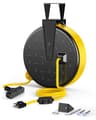
Dewenwils Retractable Extension Cord Reel, 30 ft
Gets the cord off the floor, which removes the most common trip hazard in a one-car shop and stops you rolling a wheeled base over a live cable.
Strengths
+Mounts to a ceiling or wall so the cord drops where you work
+Retracts out of the way at the end of a session in seconds
+Metal reel body stands up to being knocked
Trade-offs
−Thirty feet of thinner cord is fine for sanders and drills, less so for a planer
−Needs a mounting point that can take the pull
Type
Retractable cord reel
In the set
Single tool
Material / build
Not listed
Key spec
30 ft retractable reel, wall or ceiling mount
Best for
Keeping cords out from underfoot
Worth knowing. Check the gauge on any reel before running a high-draw tool from it. A reel is a convenience product first, and the cord inside is often thinner than the one you would have chosen.
Specs read from the product listing, on August 19, 2026. “Not listed” means the listing doesn’t state that figure.
A plug-in ground fault interrupter for a garage outlet that does not have one built in. Cheap, instant, and the only thing standing between a damp concrete floor and a very bad day.
Strengths
+Adds ground fault protection without an electrician or a wiring change
+Test and reset buttons let you verify it works before every session
+Moves with you to whichever outlet you are using
Trade-offs
−One outlet at a time, so tools plugged in elsewhere are unprotected
−A permanently wired GFCI outlet is the better long-term fix
Type
Portable GFCI adapter
In the set
Single tool
Material / build
Not listed
Key spec
15 amp, 3-prong grounded, plug-in
Best for
Older garages with no GFCI outlets
Worth knowing. OSHA 1910.304(b)(3)(ii)(A) requires ground fault protection for temporary receptacle outlets in use by personnel, and treats an extension cord connector as a receptacle outlet. Home shops sit outside its scope, but the reasoning applies to a damp garage floor exactly as written.
Specs read from the product listing, on August 19, 2026. “Not listed” means the listing doesn’t state that figure.
Gauge, in one paragraph you can act on
AWG is backwards: a lower number means thicker wire. Thicker wire has less resistance, so less of the supply voltage is lost as heat on its way to the tool. That loss grows with length and with the current the tool draws, which is why the same cord can be fine for a drill and badly undersized for a 15-amp planer.
The practical rule for a woodworking garage: 12 AWG for anything with a universal or induction motor at a distance — circular saw, planer, table saw, shop vacuum, compressor. A 16 AWG household cord is adequate for a sander, a drill charger or a light, and nothing else. If a tool bogs down, feels gutless or the cord gets warm, the cord is the first thing to change, not the tool.
Get the cord off the floor
The Dewenwils retractable reel mounts to a wall or a ceiling so the cord drops where you work and retracts out of the way in seconds at the end of a session. In a one-car shop that removes the most common trip hazard there is, and it stops you rolling a wheeled machine base over a live cable — which is how cords get damaged in the first place.
Two honest caveats. Thirty feet of reel cord is fine for sanders, drills and lights, and less so for a planer: check the gauge on any reel before you run a high-draw tool from it, because a reel is a convenience product first and the cord inside is often thinner than the one you would have chosen. And it needs a mounting point that can take the pull — a joist or a stud, not drywall.
Ground fault protection on a concrete floor
Older garages frequently have ordinary outlets with no ground fault protection. The Oaonan adapter plugs into one and adds it, with test and reset buttons so you can verify it works before every session, and it moves with you to whichever outlet you are using.
Why this matters more in a garage than in a house: a concrete floor wicks moisture continuously, and standing on damp concrete while holding a metal-bodied tool is the condition a GFCI exists for. The federal workplace standard is a reasonable guide to the intent — OSHA 1910.304(b)(3)(ii)(A) requires ground fault protection for temporary 125-volt receptacle outlets in use by personnel, and it treats an extension cord connector as a receptacle outlet. Home shops sit outside its scope entirely, but the reasoning applies to a damp garage exactly as written.
The adapter’s limit is honest: one outlet at a time, so tools plugged in elsewhere are unprotected, and a permanently wired GFCI outlet is the better long-term fix. Buy the adapter today, put the outlet on the list.
What this page cannot fix
A cord is not a circuit. If your garage runs off a single 15-amp circuit shared with the house lighting, no cord will stop a saw and a shop vacuum tripping the breaker together — that is an electrician and a dedicated 20-amp circuit. The garage shop setup guide covers where power sits in the order of jobs, and garage shop lighting is the other half of the same wiring question.
One sequencing note that saves money: sort power before you buy the machine that needs it. People buy a planer and then discover the circuit, and the planer sits in its box for a month.
The one to buy
If you buy one thing, buy the GFCI adapter — it is the cheapest item here and the only one that is about you rather than the tool. If you buy two, add the 12/3 cord. Add the reel when you get tired of coiling fifty feet of stiff cable at the end of every session, which takes about three weekends.
Frequently asked questions
What gauge extension cord do I need for a woodworking shop?+
12 AWG for anything with a motor at a distance — circular saw, planer, table saw, shop vacuum, compressor. AWG is backwards: a lower number means thicker wire and less voltage lost on the way to the tool. A 16 AWG household cord is fine for a drill charger, a sander or a light, and undersized for everything else.
Why does my power tool feel weak on an extension cord?+
Voltage drop in an undersized cord. The motor is not weak — resistance in thin wire turns some of the supply voltage into heat before it reaches the tool, and the loss grows with both length and the current the tool draws. Swap to a 12 AWG cord before you blame the tool.
Can I plug two extension cords together?+
You can, and you should not. Two 50-foot cords end to end is a 100-foot run with two connections in it, which means more voltage drop and heat at the joints than a single correctly sized cord of the length you need. Buy the right length once.
Do I need a GFCI in a garage workshop?+
It is strongly advisable, because a concrete floor wicks moisture continuously and standing on damp concrete with a metal-bodied tool is the exact condition a GFCI exists for. If your outlets have no built-in protection, a plug-in adapter adds it instantly; a permanently wired GFCI outlet is the better long-term fix.
Is a retractable cord reel good enough for power tools?+
For sanders, drills and lights, yes. Check the gauge before running a high-draw tool like a planer from one — a reel is a convenience product first and the cord inside is often thinner than the one you would have chosen for that tool. Mount it to a joist or stud, not drywall, because the retract mechanism pulls.
Sources
OSHA — 1910.304, Wiring design and protection — Paragraph (b)(3)(ii)(A): temporary 125-volt 15, 20 and 30 amp receptacle outlets in use by personnel require GFCI protection — an extension cord connector counts as a receptacle outlet (accessed August 19, 2026)
OSHA — 1910.243, Guarding of portable powered tools — Circular saws over 2 in blade diameter need upper and lower guards, and the lower guard must return to covering position automatically when the tool leaves the work (accessed August 19, 2026)
OSHA — 1926.56, Illumination — Minimum foot-candle levels by area — 10 foot-candles for carpenter shops (Table D-3) (accessed August 11, 2026)