Two wet/dry vacs under a hundred dollars and the $40 cyclone that matters more than either of them - plus why hose diameter, not peak horsepower, is the number to shop on.
How this is funded: we earn a commission if you buy through our links, at no extra cost to you. It never changes which tool we recommend, and we’ll tell you plainly when to skip one. Full disclosure.
The short answer. Buy the Craftsman CMXEVBE17584 if the vac stays put: more tank for less money is the sensible trade when you are not carrying it. Buy the Vacmaster VOC508Sif it moves — a stainless 5-gallon tank survives garage abuse better than plastic, at roughly half the price of the name-brand 5-gallon vacs. Then spend the rest of the hundred on the Oneida Dust Deputy, because it does more for your dust problem than the difference between any two vacuums here.
Here is the thing the spec sheet hides: peak horsepower is not a working figure. It describes a motor at the instant of maximum draw, not the airflow you get with a hose, a nozzle and a filter that has been collecting sawdust for twenty minutes. The two numbers that actually decide whether a vacuum is useful in a wood shop are the hose diameter— because it has to fit your sander and saw ports — and how fast the filter loads, because suction dies as it does.
So the lens, in order. Hose fit first: most sander and saw ports expect a 1-1/4 or 2-1/2 in fitting, so check yours before buying adapters blind. Filter strategy second, which is where the cyclone comes in. Tank third— capacity affects convenience, not performance. Build last, and at this price that means stainless versus polypropylene.
All three picks sat under $100 on the live feed as of November 23, 2026; the card on each one shows today’s number, because we never type a price into a page.
Quick picks
Ranked on the specs that matter for a beginner and honest buyer fit. Select a row to jump to the full write-up. We haven’t hands-on-tested these — here is exactly what we do instead.
#
Product
Best for
Price
1
Craftsman CMXEVBE17584 6-Gallon 3.5 Peak HP Wet/Dry Vac
More tank for less money — the sensible middle if the vacuum will live in one corner of the garage rather than being carried around. A bigger drum simply means fewer interruptions.
Vacmaster VOC508S 5-Gallon 4 Peak HP Stainless Wet/Dry Vac
The budget pick, and a stainless tank at this price is unusual — it will not crack the way a knocked-about plastic tank eventually does. Slightly less peak power, in a way you will never notice sweeping sawdust.
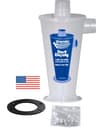
Oneida Air Systems Dust Deputy DIY Anti-Static Cyclone Separator
The single best upgrade to any shop vacuum. A cyclone drops the overwhelming majority of the dust into a bucket before it ever reaches the filter, so suction stays constant and filters last for years instead of weeks.
Craftsman CMXEVBE17584 6-Gallon 3.5 Peak HP Wet/Dry Vac
More tank for less money — the sensible middle if the vacuum will live in one corner of the garage rather than being carried around. A bigger drum simply means fewer interruptions.
Strengths
+6 gallons means longer between empties on a big sanding session
+Cheaper than the 5-gallon 5.0 peak HP models
+Onboard accessory storage keeps the nozzles with the vac instead of lost
Trade-offs
−3.5 peak HP is a step down in suction from the 5.0 models
−Bigger drum is more awkward to carry up steps or into a car
Type
Wet/dry shop vacuum
In the set
Single tool
Material / build
Polypropylene tank
Key spec
6 gal, 3.5 peak HP
Best for
Best value on capacity
Worth knowing. Tank capacity affects convenience, not performance. Suction comes from the motor and a clean filter, so a bigger drum with a clogged filter still performs worse than a small vac with a clean one.
Specs read from the product listing, on August 11, 2026. “Not listed” means the listing doesn’t state that figure.
#2Best budget pick
Vacmaster VOC508S 5-Gallon 4 Peak HP Stainless Wet/Dry Vac
The budget pick, and a stainless tank at this price is unusual — it will not crack the way a knocked-about plastic tank eventually does. Slightly less peak power, in a way you will never notice sweeping sawdust.
Strengths
+Stainless tank survives garage abuse better than plastic
+Roughly half the price of the name-brand 5-gallon vacs
+Same 5-gallon capacity as vacs costing considerably more
Trade-offs
−Filter and accessory range is narrower than the big brands
−Hose is on the short side for reaching across a garage bay
Type
Wet/dry shop vacuum
In the set
Single tool
Material / build
Stainless steel tank
Key spec
5 gal, 4 peak HP
Best for
Best budget shop vacuum
Worth knowing. Hose diameter is the spec that decides whether a vac works with your tools. Most sander and saw ports expect a 1-1/4 or 2-1/2 inch fitting — check yours before buying adapters blind.
Specs read from the product listing, on August 11, 2026. “Not listed” means the listing doesn’t state that figure.
#3Best upgrade to either
Oneida Air Systems Dust Deputy DIY Anti-Static Cyclone Separator
The single best upgrade to any shop vacuum. A cyclone drops the overwhelming majority of the dust into a bucket before it ever reaches the filter, so suction stays constant and filters last for years instead of weeks.
Strengths
+Keeps suction constant through a whole session instead of fading as the filter loads
+Filter life goes from a consumable to an afterthought
+Anti-static construction reduces the shocks a plastic cyclone can build up
Trade-offs
−Needs a bucket and hose to complete it — this is a component, not a finished product
−Takes up floor space next to the vac and adds another thing to wheel around
Type
Cyclone dust separator
In the set
Single tool
Material / build
Anti-static molded polymer
Key spec
Retrofits standard wet/dry vacs
Best for
Best add-on for any shop vac
Worth knowing. Cyclonic separation uses the air's own spiral to fling heavy particles outward and down. It is the same principle as a bagless household vacuum, just scaled to the volume a sander produces.
Specs read from the product listing, on August 11, 2026. “Not listed” means the listing doesn’t state that figure.
What $100 does not buy
Above this band you are mostly buying three things, and all three are real. More airflow: the 5.0 peak HP 5-gallon vacs pull harder, which matters when you connect to a tool port rather than sweep the floor. A better filter, usually with a finer rating, which captures more of the fine dust that does the damage. And a genuine dust collector— a single-stage machine with a 15-gallon bag moves a volume of air no shop vacuum does, and it is the right tool once you own a planer or a table saw.
None of that changes the basic physics of a shop vac in a garage, which is that suction fades as the filter loads. That is the real difference between a $60 vacuum and a $130 one in daily use, and it is also the thing a cyclone fixes for $40. Which is why, under $100, the cyclone is the upgrade and the vacuum is the commodity.
A cyclone separator sits between the hose and the vacuum and uses the air’s own spiral to fling heavy particles outward and down into a bucket — the same principle as a bagless household vacuum, scaled to the volume a sander produces. The overwhelming majority of the dust never reaches the filter at all.
Two consequences, both worth the $40. Suction stays constant through a whole session instead of fading in the first ten minutes. And filter life goes from weeks to effectively indefinite, which on a vacuum whose replacement filters cost a third of the machine is a real saving.
The honest catch: the Dust Deputy is a component, not a finished product. You supply a bucket and a short length of hose, and the assembly takes up floor space next to the vacuum — one more thing to wheel around in a shared garage. Anti-static construction is worth having for the same reason it is on the listing: a plastic cyclone moving dry sawdust builds a charge you will otherwise discover by touching it.
Hose diameter, filters and the dust that matters
Check your tool ports before you order anything. Sanders and small saws generally expect 1-1/4 in; bigger ports and most router tables take 2-1/2 in, which is also what a standard shop vac hose fits without an adapter. Getting this wrong is the most common reason a new vacuum ends up only sweeping floors.
On filters: a clean filter on a small vacuum outperforms a clogged filter on a big one, every time. Tap the filter out after every serious session, and if you are sanding or cutting MDF regularly, fit the finest filter the machine accepts. A shop vacuum is not a substitute for breathing protection either way — the particles small enough to stay airborne for hours are exactly the ones a vacuum does not catch at the source, so a rated respirator stays on the list.
And if the plan is to connect the vacuum to a tool rather than to a floor, read our small-shop tool guide on where the hose actually reaches — a short hose decides the layout of a one-car garage shop more than people expect.
The one to buy
The Craftsman 6-gallon if the vacuum has a corner to live in, the Vacmaster stainless 5-gallon if it travels, and the Dust Deputy whichever one you choose — it is the purchase on this page you will still be glad about in two years. If you already own a working shop vac of any kind, buy only the cyclone and spend the rest on a better filter.
Frequently asked questions
What is the best shop vacuum under $100?+
The Craftsman CMXEVBE17584 6-gallon wet/dry vac if the vacuum will stay in one place - it is the largest tank under the ceiling and cheaper than the 5-gallon, 5.0 peak HP machines. If you carry the vacuum around, the Vacmaster VOC508S with its stainless 5-gallon tank is the better buy at the same money.
Is peak horsepower a useful spec on a shop vac?+
Not really. Peak HP describes the motor at its instant of maximum draw, not the airflow you get through a hose, a nozzle and a partly loaded filter. Hose diameter, filter condition and whether you run a cyclone separator have far more effect on how a shop vacuum performs in a wood shop.
Do I need a cyclone separator for a shop vac?+
If you make sawdust, it is the best $40 you can spend on dust handling. A cyclone drops most of the dust into a bucket before it reaches the filter, so suction stays constant through a session and filter life stops being a running cost. It is a component rather than a product - you supply a bucket and a short hose, and it takes up floor space.
What size shop vac do I need for a small woodworking shop?+
Five to six gallons is the practical sweet spot for a one-car garage. Smaller tanks fill in a single sanding session; larger ones are awkward to move and no more powerful, because capacity affects convenience rather than suction. Spend the difference on a cyclone and a finer filter instead.
Can a shop vac replace a dust collector?+
For hand sanders, trim routers and jigsaws, yes. For a planer, a table saw or a router table it cannot - those machines produce a volume of chips that needs a much higher airflow at a lower pressure, which is what a single-stage dust collector is built for. A shop vac plus a cyclone is the right answer until you own one of those machines.
What hose size should a shop vacuum have for woodworking?+
Match it to your tools: most sanders and compact saws expect a 1-1/4 in fitting, while larger ports and router tables generally take 2-1/2 in, which is also what a standard shop vac hose fits without an adapter. Check the ports on the tools you own before buying adapters, because this is the most common mismatch.
Sources
OSHA — Wood dust, Safety and Health Topics — The federal agency's own summary of what wood dust does, and the reason a respirator page exists on a woodworking site. On the hazard: "Breathing these particles may cause allergic respiratory symptoms, mucosal and non-allergic respiratory symptoms, and cancer." On how much is known, in the same breath and quoted here so the page does not overstate it: "The extent of these hazards and the associated wood types have not been clearly established." The page gives no single permissible exposure limit for wood dust, stating only that "Exposures to wood dust are addressed in specific OSHA standards for general industry", and it carries a section of OSHA's own eTool headed "Health Hazards: Wood Dust - Carcinogens". That is the whole sourced basis for this site's position: the risk is real and documented, the dose-response is not settled, and a mask is cheap (accessed November 13, 2026)
OSHA — 1910.134, Respiratory protection — The federal respiratory protection standard, and the published basis for everything this site says about fit rather than filtration. (b) defines the disposable type exactly: "Filtering facepiece (dust mask) means a negative pressure particulate respirator with a filter as an integral part of the facepiece". (a)(2): "A respirator shall be provided to each employee when such equipment is necessary to protect the health of such employee." On fit testing, (f) requires that "the employee must be fit tested with the same make, model, style, and size of respirator that will be used", with (f)(2) putting that "prior to initial use of the respirator" and "at least annually thereafter" - which is the sourced reason this page keeps saying that size and seal matter more than filter class. On medical clearance, (e)(1): "The employer shall provide a medical evaluation to determine the employee's ability to use a respirator" "before the employee is fit tested or required to use the respirator in the workplace" - breathing through a filter is work for your heart and lungs, which is why the standard puts a doctor before the mask. And on hobby use, (c)(2) allows that "An employer may provide respirators at the request of employees or permit employees to use their own respirators", in which case "the employer shall provide the respirator users with the information contained in appendix D to this section", appendix D being titled "Information for Employees Using Respirators When Not Required Under the Standard". This standard binds employers and not a home shop, but it is the clearest published statement of what wearing a respirator properly involves (accessed November 13, 2026)
NIOSH / CDC — Filtering facepiece respirators and the nine filter classes — The authoritative definition of the filter markings on every mask on this page. NIOSH approves particulate filters in a grid of three oil-resistance series and three efficiency levels: the page lists the series as "(1) Not resistant to oil (N-type); (2) Resistant to oil (R-type); and (3) oil Proof (P-type)" and the levels as "three levels of filtration efficiency (95%, 99%, and 99.97%)". The table's rows read "Filters at least 95%, 99%, 99.97% of airborne particles. Not resistant to oil" for N95/N99/N100, "Somewhat resistant to oil" for R95/R99/R100 and "Strongly resistant to oil" for P95/P99/P100, and a footnote records that "a 99.97% filtration efficiency is shown as '100'" - which is why a P100 is a 99.97 percent filter and not a 100 percent one. On the disposables: "Filtering facepiece respirators (FFRs) are disposable respirators that filter out particles such as dust, mist, and fumes", they protect against particles but not gases or vapors, and they "seal against your face around your nose and mouth". On fit: "FFRs require fit testing", and "A user seal check is only applicable when you have been successfully fit tested with a respirator. It is not a substitute for fit testing." (accessed November 13, 2026)